
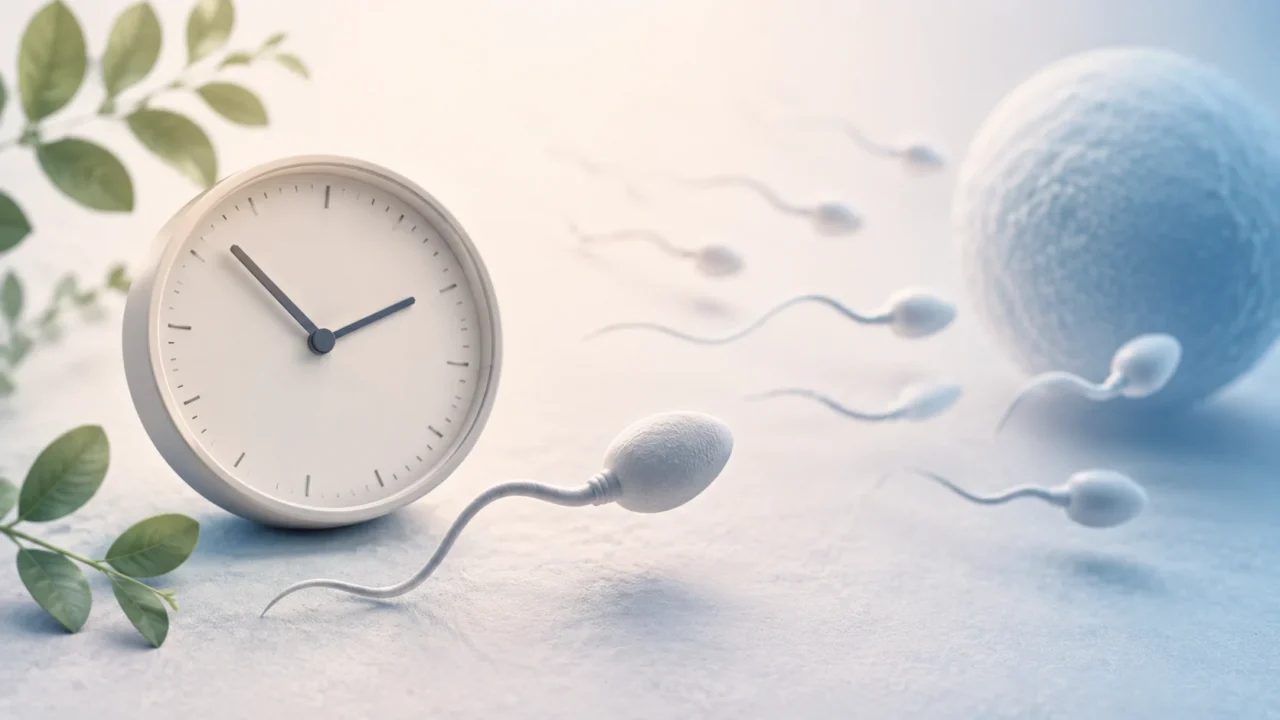
The Hidden Timeline of Male Fertility – Cesar Fertility
Cesar Fertility shared a post on LinkedIn:
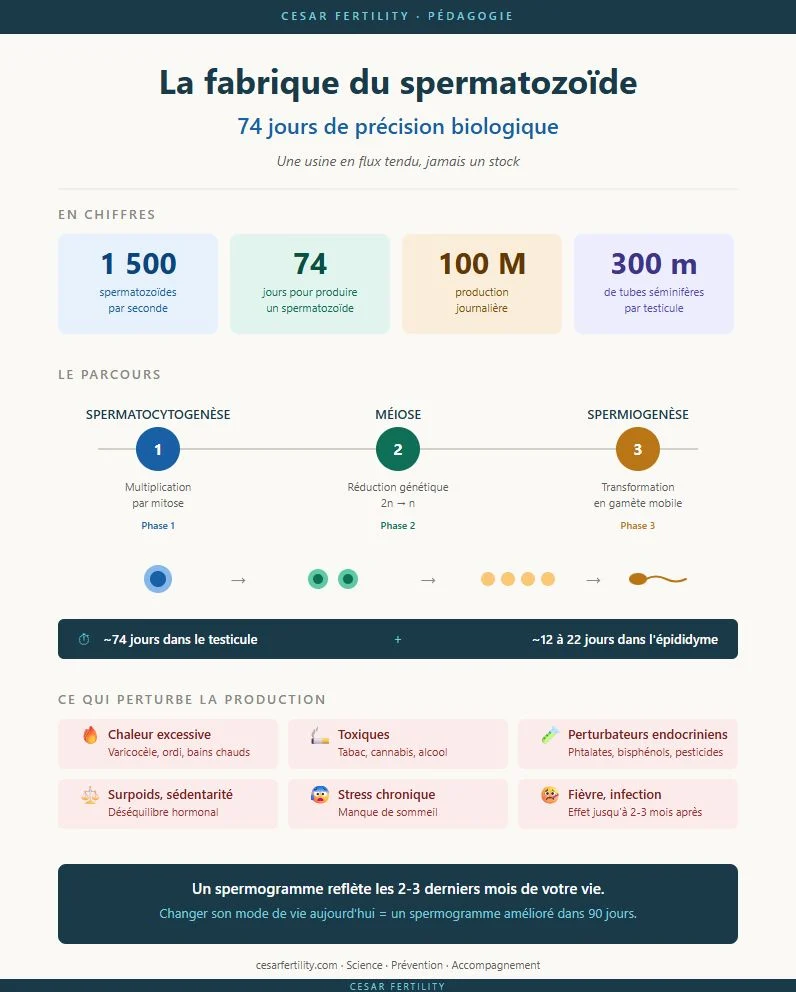
“Did you know that it takes 74 days to make a single sperm?
At Cesar, we meet men every week who are discovering their reproductive health… at 30, 35 or 40 years old. So today, we offer you a simple deciphering of what really happens in the manufacture of spermatozoa
- A factory, never a stock: The testicles continuously produce ~1,500 sperm per second, or nearly 100 million per day. It’s not a tank, it’s a production line that runs 24 hours a day.
- The complete cycle lasts ~3 months, 74 days in the testicle + 12 to 22 days of maturation in the epididymis. This period is incompressible. No supplement, no ‘boost’ can accelerate it.
- Three phases, a hormonal orchestra Multiplication (mitosis) → Genetic reduction (meiosis) → Transformation into a mobile gamete (spermiogenesis). All under the control of the hypothalamus–pituitary–testes axis, via FSH, LH and testosterone.
- Sensitive mechanics Heat, tobacco, overweight, endocrine disruptors, chronic stress, recent fever, poor sleep… all of these factors can alter production. A flu two months ago? It can still be seen on a seminogram today.
- The good news: you can act As a cycle lasts ~3 months, a change in lifestyle becomes visible on a spermiogram in 90 days. It’s a long time, but it’s doable. And it’s validated by biology.
What we remember from Cesar:
When you read a spermiogram, you don’t just see cells. We read the story of a man’s last 90 days: his diet, his sleep, his exposures, his stress.
The sperm is a silent witness. Our role is to teach men to listen to it.
And you, did you know that it takes 3 months to ‘renew’ your fertility?
Fertilité Masculine, Spermatogenèse, Santé Reproductive, Prévention, Cesar Fertility
Receive the free César Fertility newsletter
Every week: science, prevention and tips to protect male fertility.”
Lucile Ferreux, Medical Director at Cesar Fertility, shared a post by Cesar Fertility, adding:
“What figures! 1500 spermatozoa per second, 300 meters of seminiferous tubules per testicle…”
Stay updated on all scientific advances in the field of fertility with Fertility News.
-
Oct 8, 2026, 17:18Khalil Faaed: Vitrification Prevents Ice, but Does It Prevent Oocyte Damage?
-
Oct 8, 2026, 17:16Ritu Anand: Better Conversations Ultimately Lead to Better Care in Fertility
-
Oct 8, 2026, 17:14Mark Trolice: Excited to Speak at Women’s HealthX
-
Oct 8, 2026, 17:12Delighted to Welcome Dr. Róisín Mortimer – Waterstone Clinic-IVF and Fertility
-
Oct 8, 2026, 17:09Deirdre Zander-Fox: Pleased to Be an Invited Speaker at ESHRE Precision ART
-
Oct 8, 2026, 17:06Roohi Jeelani: Is Modern Life Actually Making It Harder to Get Pregnant?
-
Oct 8, 2026, 17:04Robert Borowczyk: We Judge the Newest IVF Consultation Group Too Quickly…
-
Oct 8, 2026, 17:01Carlos Guerrero: Great Couple of Days Visiting the Team at New Leaders in Fertility and Endocrinology
-
Oct 8, 2026, 17:00Sarah Banks: Improving Patient Experience Isn’t Always About Making Huge Changes…