

Svitlana Yashchenok: AI in IVF – Real Benefit or Marketing Hype?
Svitlana Yashchenok, Practice Manager at Reproductive Health Medical Centre LADA, shared on LinkedIn:
“AI in IVF: Real Benefit or Marketing Hype?
Everyone is talking about using AI for embryo selection, but few actually read the primary sources – the scientific studies underlying these claims.
One study deserves particular attention: a randomized double-blind trial conducted across 14 clinics in Australia and Europe, involving more than 1,000 patients. It directly compared AI-based embryo selection (the iDAScore system) with morphological assessment performed by an embryologist. The clinical pregnancy rate was 46.5% with AI versus 48.2% with human assessment – no statistically significant advantage for AI was found. (Nature Medicine, 2024)
Title: Deep learning versus manual morphology-based embryo selection in IVF: a randomized, double-blind noninferiority trial
Authors: Peter J. Illingworth, Christos Venetis, David K. Gardner, Scott M. Nelson, Jørgen Berntsen, Mark G. Larman, Franca Agresta, Saran Ahitan, Aisling Ahlström, Fleur Cattrall, Simon Cooke, Kristy Demmers, Anette Gabrielsen, Johnny Hindkjær, Rebecca L. Kelley, Charlotte Knight, Lisa Lee, Robert Lahoud, Manveen Mangat, Hannah Park, Anthony Price, Geoffrey Trew, Bettina Troest, Anna Vincent, Susanne Wennerström, Lyndsey Zujovic and Thorir Hardarson
You can read the Full Article in Nature Medicine.
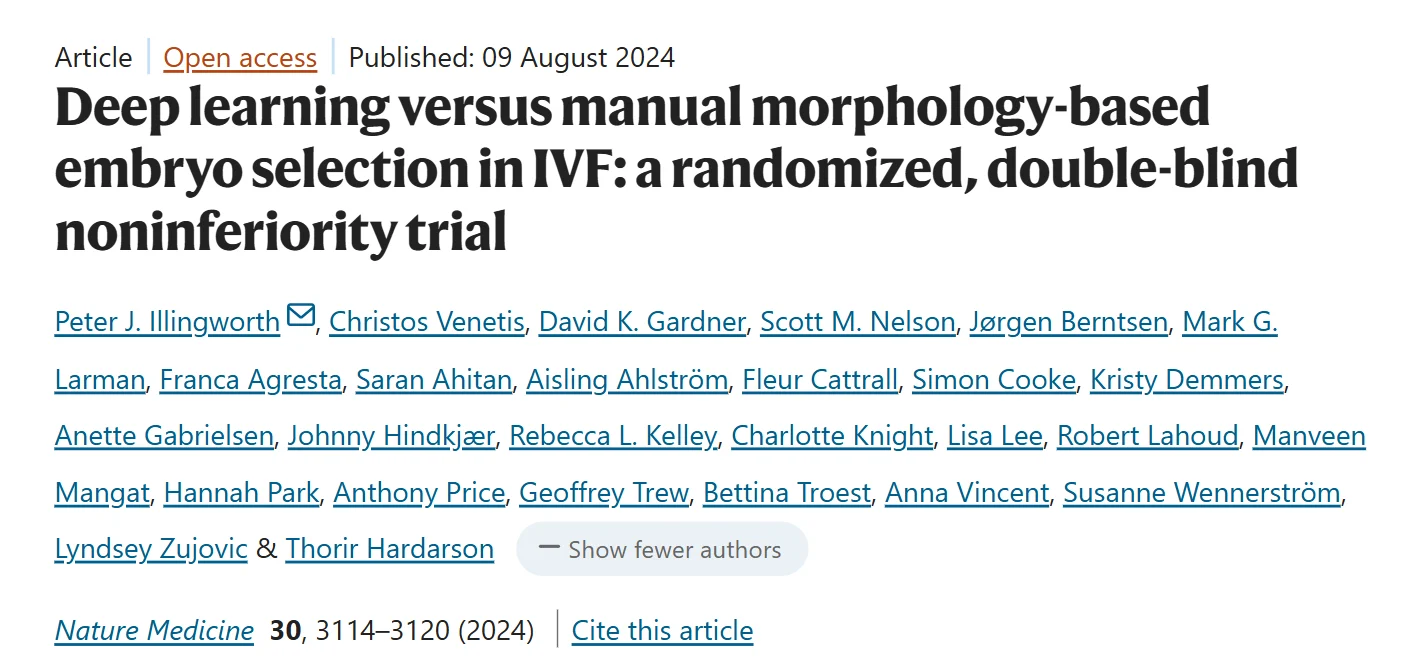
AI demonstrated results on par with human specialists, but did not surpass them. That’s the real outcome, not the one described in marketing presentations.
So where does AI’s real value lie? Not in ‘raw’ accuracy, but in the consistency of results. A study comparing the work of junior and experienced embryologists showed accuracy of 37% and 40% respectively (without AI use). With AI support, junior embryologists’ scores rose to 52%, matching the results of their more experienced colleagues (Journal of Medical Internet Research, via PMC)
Title: Evaluation of the Clinical Efficacy and Trust in AI-Assisted Embryo Ranking: Survey-Based Prospective Study
Authors: Hyung Min Kim, Hyoeun Kang, Chaeyoon Lee, Jong Hyuk Park, Mi Kyung Chung, Miran Kim, Na Young Kim, Hye Jun Lee
You can read the Full Article in the Journal of Medical Internet Research.
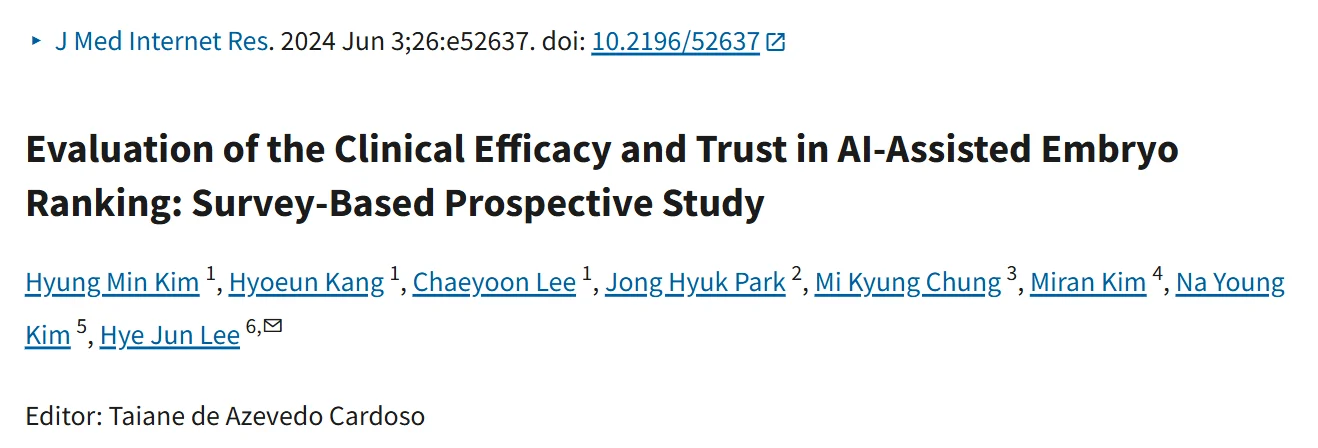
AI doesn’t make your best embryologist even better, but it brings the entire team up to that high level. This is about consistency in the quality of work, not a ‘miraculous’ leap in success rates.
The most promising preliminary data has been obtained regarding stimulation protocols. A decision support system trained on nearly 18,000 IVF cycles enables reliable personalization of stimulation regimens, prediction of pregnancy likelihood, and reduction of both costs and treatment duration.
This is retrospective data, not yet confirmed by large randomized controlled trials (RCTs), but this is precisely where AI’s ability to process large volumes of data surpasses clinical intuition: dosage selection is fundamentally a mathematical task, not simply a matter of expert judgment. (ScienceDirect, 2025)
Title: Artificial intelligence-driven precision treatment of reproductive medicine-related diseases: the optimal protocol choice for IVF-ET
Authors: Li Wen, Di Wu, Jinghan Ruan, Renjie Wang, Rui Long, Rongkai Chen, Cheng Hu, Chenxiao Tian, Yichuan Zhang, Wei Pan, Lei Jin, Shujie Liao
You can read the Full Article in the Journal of Advanced Research.
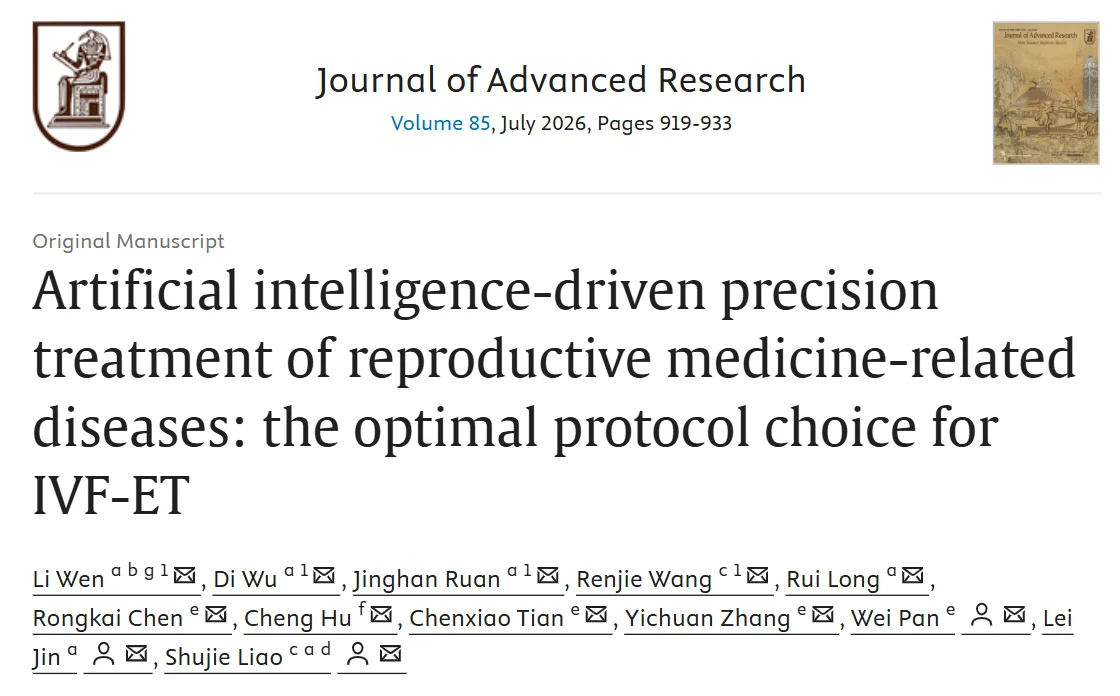
The overall findings of research are unanimous: large RCTs show no significant increase in live birth rates when using AI for embryo selection compared to assessment by expert embryologists. The most compelling evidence points to a hybrid model – the joint work of AI and humans, rather than the replacement of specialists by artificial intelligence. (PMC, 2026)
Title: Artificial Intelligence in Routine IVF Practice
Authors: Grzegorz Mrugacz, Aleksandra Mospinek, Małgorzata Jagielska, Dariusz Miszczak, Anna Matosek, Magdalena Ducher-Hanaka, Paweł Gustaw, Klaudia Januszewska, Aleksandra Grzegorczyk, Svetlana Pekar
You can read the Full Article in Biology.
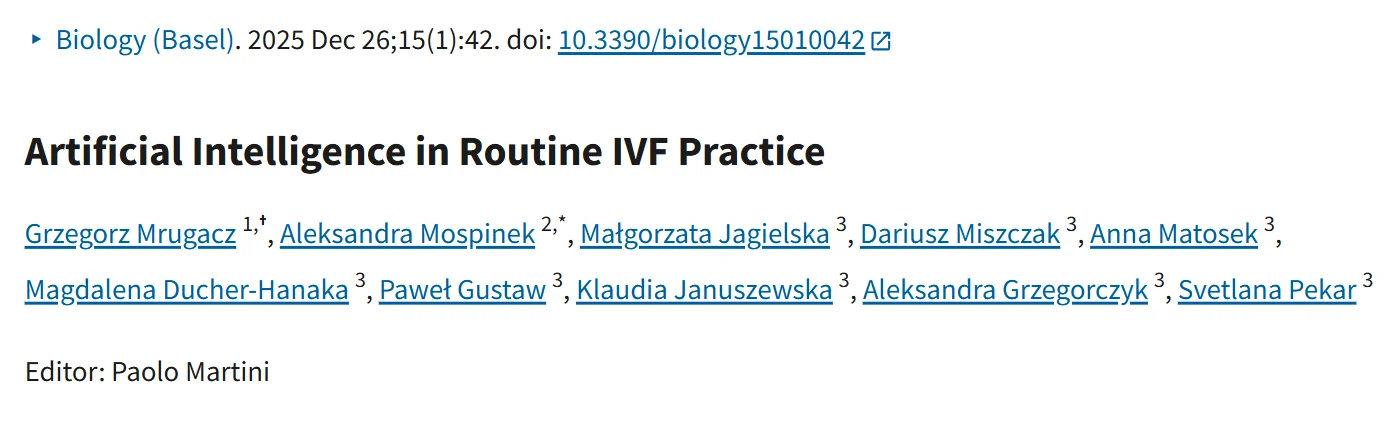
Will AI improve IVF success rates? This has not yet been proven. However, it provides standardization of team performance, reduced subjectivity in assessments, and more precise dosing of medications. This is where the real value lies. It may not sound as striking as claims that ‘AI doubles your results.’ Patients want to know the truth without embellishment. Investors want the same.”
Stay informed with the latest updates in fertility and reproductive medicine on Fertility News.
-
Oct 3, 2026, 18:27Non-Invasive Prenatal Testing: Science, Counselling, Global Access and Equity – IJGO
-
Oct 3, 2026, 18:19Erica Marsh: Congratulations to the 4 Doctors Who Were Named 2026 Top Docs by Hour Detroit Magazine
-
Oct 3, 2026, 18:16Shizuko Takahashi: What about the “Biological Clock” in Men?
-
Oct 3, 2026, 18:11Devyanshi Dixit: Call for Speakers for GFWH 2026
-
Oct 3, 2026, 18:06Shaun Greenaway: The More We Understand Male Fertility, the Better Decisions We Can Make
-
Oct 3, 2026, 17:55Reproductive BioMedicine Online’s Latest Issue, 53.4, Is Out
-
Oct 3, 2026, 17:50Ananya Anand Kumar: Excited to Share that My Cryopreservation Abstract Was Accepted for Fertility 2027
-
Oct 3, 2026, 17:48Pregnancy of the Future: Predicting, Preventing, and Treating the Great Obstetric Syndromes – SMFM
-
Oct 3, 2026, 17:46PMOS Was Never Just About the Ovaries… – PCOS Awareness Association