
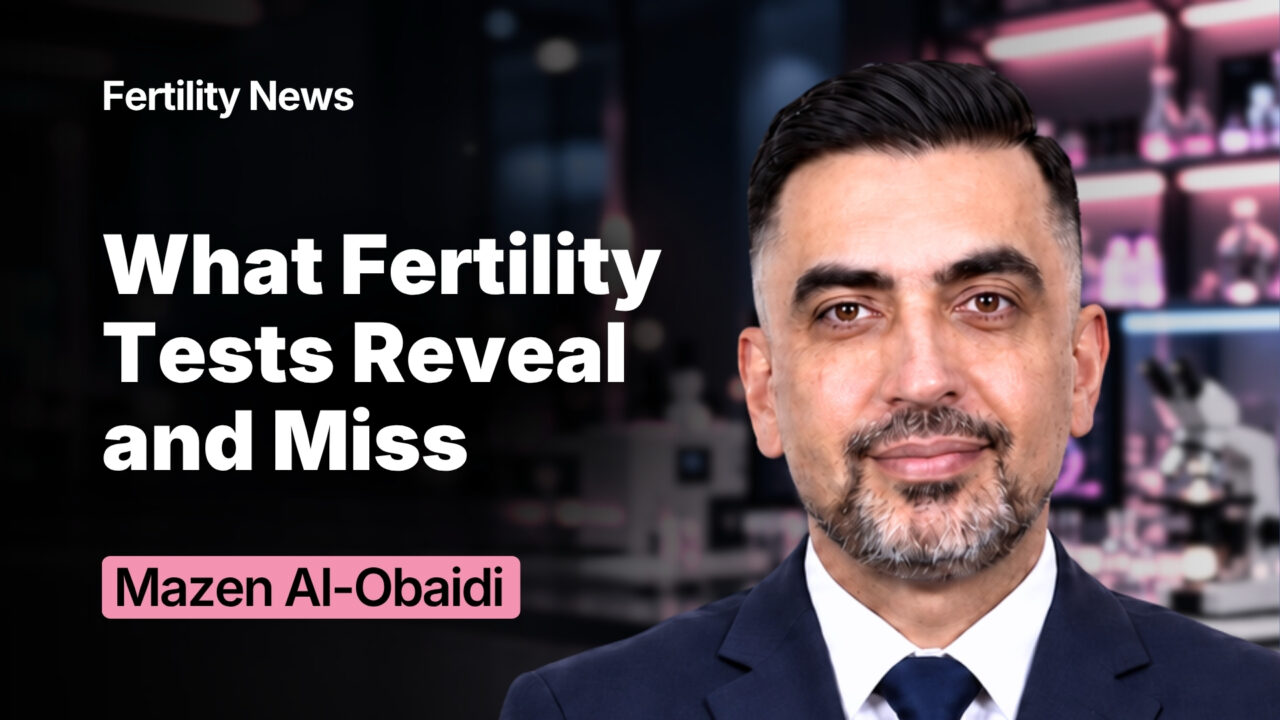
Mazen Al-Obaidi: What Your Fertility Biomarkers Really Reveal, and What They Miss
“Fertility biomarkers are measurable signs in blood, semen, or ultrasound images that show how well the reproductive system is working. The World Health Organization (2023) estimates that about 17.5% of adults experience infertility at some point in life, and both partners can contribute. According to Stavros et al. (2024), male factors account for 20% to 30% of infertility cases and may be present in up to 50% to 70% of infertile couples. In this article, I set out the main fertility biomarkers for women and for men, explain what each one measures, and note what each one cannot tell.
What are fertility biomarkers?
A biomarker is a measurable value that reflects a biological process. In fertility care, biomarkers answer three questions:
- How many eggs or sperm are present?
- How healthy are the eggs or sperm?
- Are the hormones that control reproduction in balance?
No single biomarker gives a final answer. Doctors read several together, along with age and medical history.
Which biomarkers measure female fertility?
Female fertility biomarkers fall into two groups: markers of egg supply (ovarian reserve) and markers of hormone balance.
Markers of egg supply:
- Anti-Müllerian hormone (AMH). Iwase et al. (2023) describe AMH as a hormone made by small growing follicles in the ovary, whose level indirectly reflects how many follicles remain. The level falls with age and is often high in polycystic ovary syndrome (PCOS), a common hormone disorder.
- Antral follicle count (AFC). AFC is a count of small follicles seen on a vaginal ultrasound early in the menstrual cycle. Liu et al. (2023) pooled 42 studies in a meta-analysis and found that AMH and AFC both predict a poor or high response to in vitro fertilisation (IVF) treatment well.
- Follicle-stimulating hormone (FSH). FSH is a pituitary hormone that rises when the ovary responds poorly. It is usually read alongside AMH and AFC rather than on its own.
Markers of hormone balance:
- Thyroid-stimulating hormone (TSH). TSH shows thyroid function. Thyroid dysfunction can reduce fertility. Dunbar et al. (2025) note that most professional societies support TSH screening before fertility treatment, but the American Society for Reproductive Medicine does not recommend routine screening in its 2024 guidance. In my view, this split shows that the question is not yet settled.
- Prolactin. Prolactin is the pituitary hormone that stimulates milk production. High levels can interfere with ovulation. When Ramadras et al. (2024) pooled 11 studies, they found a moderate positive correlation between prolactin and TSH in infertile women, with a pooled correlation of 0.431 on a scale where 1 means a perfect link.
Which biomarkers measure male fertility?
Male fertility biomarkers start with the semen analysis and extend to hormones and sperm DNA.
Semen and sperm markers:
- Semen analysis. This test counts sperm and assesses their movement and shape, using the World Health Organization (WHO) 2021 manual (Chawre et al., 2024). Tsinda et al. (2025), for example, used the WHO 2021 lower reference limit of 16 million sperm per millilitre to define a low sperm concentration.
- Sperm concentration and morphology. Morphology means sperm shape. In a study by Kizilgok et al. (2026), these two values separated fertile from infertile men best, with area under the curve (AUC) values of 0.984 and 0.913. An AUC of 1.0 would mean perfect separation.
- Sperm DNA fragmentation (SDF). SDF measures breaks in sperm DNA. Higher SDF accompanies lower sperm count, poorer movement (motility) and fewer normally shaped sperm. Seven of the 15 studies that reported reproductive outcomes also found lower pregnancy and live birth rates. Even so, societies such as the European Society of Human Reproduction and Embryology (ESHRE) either oppose SDF testing or limit it to research (Stavros et al., 2024).
Hormone markers:
- Testosterone. Testosterone supports sperm production. Infertile men had lower testosterone than fertile men in one study (Kizilgok et al., 2026).
- FSH. FSH rises when sperm production falls. Elevated FSH was linked to low sperm concentration, with an odds ratio of 7.25 (Tsinda et al., 2025). In simple terms, men with high FSH had about seven times the odds of a low sperm concentration.
- Inhibin B and prolactin. In the same study, inhibin B, a hormone made in the testis, was low in 38% of the 26 men tested. Infertile men also showed higher prolactin than fertile men (Kizilgok et al., 2026).
What do fertility biomarkers not show?
Every biomarker has limits:
- AMH reflects egg quantity, not egg quality. The quality of individual eggs is hard to assess in the body (Iwase et al., 2023).
- AMH falls with age, so a result is interpreted against the woman’s age (Iwase et al., 2023).
- A normal semen analysis does not rule out male infertility. Some infertile men have normal semen values (Kizilgok et al., 2026), so the evaluation should extend beyond semen analysis alone (Chawre et al., 2024).
- Doctors read the results in combination. Kizilgok et al. (2026) showed that combining semen, hormonal, and clinical parameters improved the prediction of male fertility.”
Written by Mazen Al-Obaidi
Assistant Professor, University of Technology and Applied Sciences
References
Title: A Review of Semen Analysis: Updates From the WHO Sixth Edition Manual and Advances in Male Fertility Assessment
Authors: Sunil Chawre, Mahalaqua Nazli Khatib, Alka Rawekar, Sanket Mahajan, Ritesh Jadhav, Akash More
You can read the Full Article in Cureus.
Title: Thyroid function testing prior to fertility treatment: will we ever agree?
Authors: Sade Dunbar, Rima Dhillon-Smith, Abha Maheshwari
You can read the Full Article in Human Reproduction.
Title: Anti-Müllerian hormone beyond an ovarian reserve marker: the relationship with the physiology and pathology in the life-long follicle development
Authors: Akira Iwase, Yuko Hasegawa, Yumiko Tsukui, Mio Kobayashi, Hikaru Hiraishi, Tomoko Nakazato, Yoshikazu Kitahara
You can read the Full Article in Frontiers in Endocrinology.
Title: Comparison of anti-Müllerian hormone and antral follicle count in the prediction of ovarian response: a systematic review and meta-analysis
Authors: Yang Liu, Zhengmei Pan, Yanzhi Wu, Jiamei Song, Jingsi Chen
You can read the Full Article in the Journal of Ovarian Research.
Title: Correlation of Serum Prolactin and Thyroid Stimulating Hormone Concentration in Infertile Women: A Systematic Review and Meta-Analysis
Authors: Delini Devi Ramadras, Noor Azlin Azraini Che Soh Yusof, Najib Majdi Yaacob, Wan Azman Wan Norlina, Abdul Hamid Hanisah
You can read the Full Article in The Malaysian Journal of Medical Sciences.
Title: Sperm DNA Fragmentation: Unraveling Its Imperative Impact on Male Infertility Based on Recent Evidence
Authors: Sofoklis Stavros, Anastasios Potiris, Ermioni Molopodi, Despoina Mavrogianni, Athanasios Zikopoulos, Konstantinos Louis, Theodoros Karampitsakos, Eleni Nazou, Dimdos Sioutis, Chrysi Christodoulaki, Charikleia Skentou, Angeliki Gerede, Athanasios Zachariou, Panagiotis Christopoulos, Periklis Panagopoulos, Ekaterini Domali, Peter Drakakis
You can read the Full Article in the International Journal of Molecular Sciences.
Title: Epidemiological, Clinical, and Biomarker Profile of Male Infertility in Morocco: A Retrospective Single-Center Study of 1399 Cases
Authors: Henri Hubert Kwizera Tsinda, Modou Mamoune Mbaye, Loïc Koumba, Reine Rolande Ada Edou, Achraf Zakaria, Noureddine Louanjli, Bouchra Ghazi, Fatima Maachi, Hakima Benomar, El Turk Joumana, Karima Sabounji
You can read the Full Article in Diseases.
Kizilgok B, et al. (2026). Discriminative performance of semen, hormonal, and clinical parameters for male fertility based on WHO 2021 reference values. Discovery Medicine.
World Health Organization. (2023). 1 in 6 people globally affected by infertility.
Other articles featuring Mazen Al-Obaidi on Fertility News.
FAQ
Which blood test shows a woman's egg supply?
AMH is the main blood marker of egg supply. AFC, measured by ultrasound, is the companion marker.
Does a low AMH mean a woman cannot conceive?
No. AMH reflects egg quantity and helps predict the response to IVF stimulation. It does not measure egg quality.
Which thyroid and hormone tests do infertile women need?
TSH and prolactin are common hormone checks. Guidelines differ on routine TSH testing.
What is the first test for male fertility?
The semen analysis is the first test. It follows the WHO 2021 manual.
Why test sperm DNA fragmentation?
SDF measures DNA damage that a standard semen count does not capture. It links to lower pregnancy rates in some studies, but some major societies limit its use to research.
Do hormones matter for men?
Yes. High FSH links to a low sperm concentration, and infertile men had lower testosterone than fertile men in one study.
-
Nov 8, 2026, 11:51Severe Sperm Dysmorphism: When Should We Consider Surgical Sperm Retrieval Before ICSI?
-
Nov 8, 2026, 09:24AI-Assisted Embryo Selection: From Prediction to Choice
-
Nov 7, 2026, 19:28Championing the Vital Conversation Surrounding Fertility Support, Education, and Patient Advocacy – ARCS
-
Nov 7, 2026, 19:25Emilio Gomez Sanchez: Exploring the Presence of Microplastics in Human Semen
-
Nov 7, 2026, 19:15Moving Towards Standardized Sperm Extraction and Processing Practices – ASRM
-
Nov 7, 2026, 19:12Ivy Fertility Welcomes Aimee Seungdamrong as the Leader of San Diego Fertility Center – Bryant Park
-
Nov 7, 2026, 19:09Arora Suhani Gagan: The Healthcare Struggles Women Rarely Talk About
-
Nov 7, 2026, 19:04Makeba Williams: 2 Weeks of My 1-Year Term as President of The Menopause Society
-
Nov 7, 2026, 19:00Fantastic Day at the Annual Breaking Bad News Event – ARCS