

Giulia Muraca: Race Should Not Determine Pregnancy or Childbirth Safety, But in Canada, It Matters
Giulia Muraca, Associate Professor at McMaster University, shared a post on LinkedIn about a paper she co-authored with colleagues, published in the Canadian Medical Association Journal:
“Race should not determine how safe your pregnancy or childbirth is – but our data show that in Canada, it matters.
I’m very pleased to share our new study examining racial inequities in severe maternal morbidity (SMM) among Black and White individuals in Canada.
We found that Black individuals experienced a 66% higher adjusted rate of SMM compared with White individuals.
This finding should not be interpreted to mean that being Black causes severe pregnancy complications.
In our work, self-identified race is understood as a proxy for the structural and institutional processes through which racism can influence health.
We used White individuals as the comparison group because, in the Canadian context, they are generally least likely to experience racial discrimination – not because White outcomes represent a biological ‘norm.’
The message from these data is not about individual vulnerability or deficit. It is about inequity.
These findings add to growing evidence that maternal health outcomes are not experienced equally in Canada, and that health systems need to consider how racism, access to care, quality of care, and broader social conditions may shape who is most likely to experience severe complications during pregnancy and childbirth.
I am especially grateful to the Black Reproductive Health Working Group and our community partners, whose perspectives have continually pushed us to think more carefully not only about how we conduct this work, but how we communicate it and what impact that communication may have.
The goal is not simply to document disparities, but to use these findings as a call to action toward safer, more equitable maternal care.”
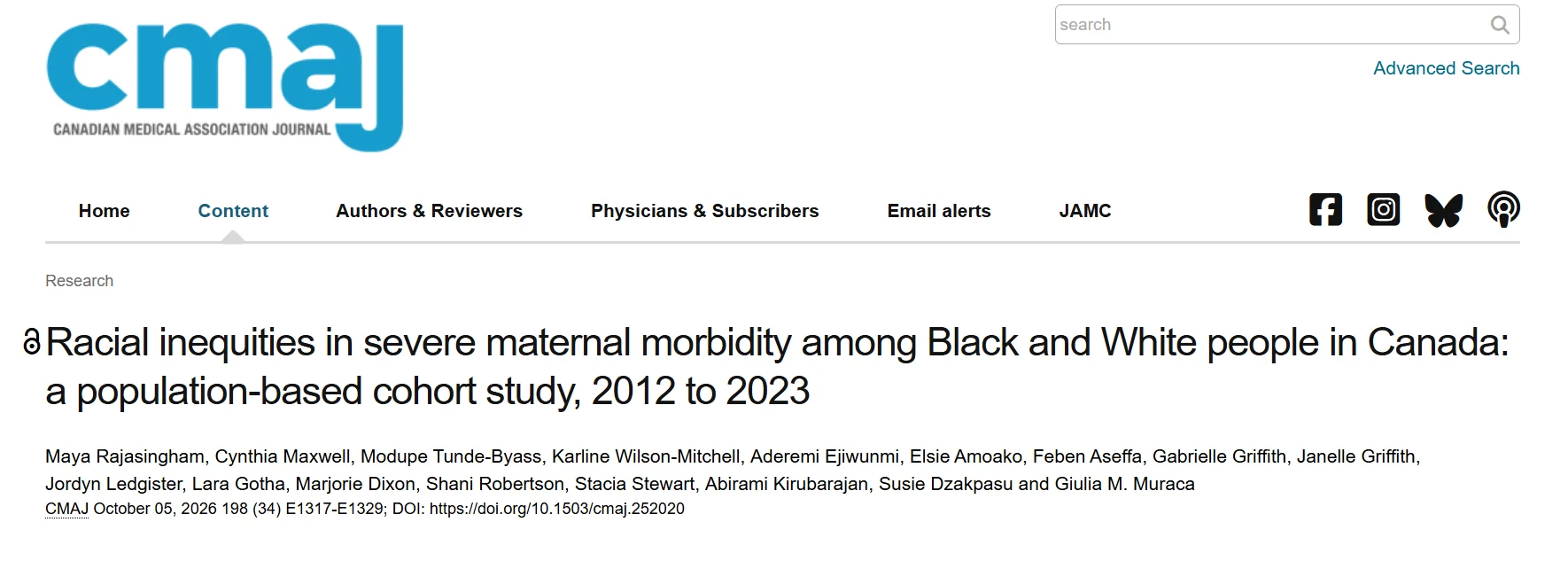
Title: Racial inequities in severe maternal morbidity among Black and White people in Canada: a population-based cohort study, 2012 to 2023
Authors: Maya Rajasingham, Cynthia Maxwell, Modupe Tunde-Byass, Karline Wilson-Mitchell, Aderemi Ejiwunmi, Elsie Amoako, Feben Aseffa, Gabrielle Griffith, Janelle Griffith, Jordyn Ledgister, Lara Gotha, Marjorie Dixon, Shani Robertson, Stacia Stewart, Abirami Kirubarajan, Susie Dzakpasu, Giulia M. Muraca.
You can read the Full Article in the Canadian Medical Association Journal.
Stay informed with the latest updates in fertility and reproductive medicine on Fertility News.
-
Oct 6, 2026, 18:08Breaking Silos: The Next ARCS365 Webinar Presented by Professor Alison Campbell
-
Oct 6, 2026, 18:02Kaberi Banerjee: Practical Techniques and Solutions for Managing Difficult Embryo Transfer
-
Oct 6, 2026, 17:54Rohit Gutgutia: AI in IVF – Real Promise or the Next Add-On?
-
Oct 6, 2026, 17:51Esther Eleboh: Thankful to Fertility News for Recognizing My Work and Amplifying My Voice
-
Oct 6, 2026, 17:47Top Tips for Effective PPH Advocacy – FIGO
-
Oct 6, 2026, 17:42Clare Mansfield։ Delighted to Join the WeScale Programme with AwakenHub and InterTradeIreland
-
Oct 6, 2026, 17:39Justin Houman: Should Men Wait for Male Contraception Instead of a Vasectomy?
-
Oct 6, 2026, 17:35Marking 1 Year Since the Inaugural World PPH Day Was Launched – RCOG
-
Oct 6, 2026, 17:30Georges Raad։ Can Cumulus Cell DNA Fragmentation Tell Us Something About Subsequent Blastocyst Development?