
Khalil Faaed: ICSI Doesn’t Just Deliver the Sperm, It Must Trigger a Molecular Signal
Khalil Faaed, Embryologist at Modern IVF Center, shared on LinkedIn:
“ICSI doesn’t just deliver the sperm. It must trigger a molecular signal.
In ICSI, we often focus on the precision of sperm injection: selecting a sperm, immobilizing it, and introducing it directly into the oocyte.
But mechanical sperm delivery is only the beginning.
The critical question is: What happens inside the oocyte after sperm injection?
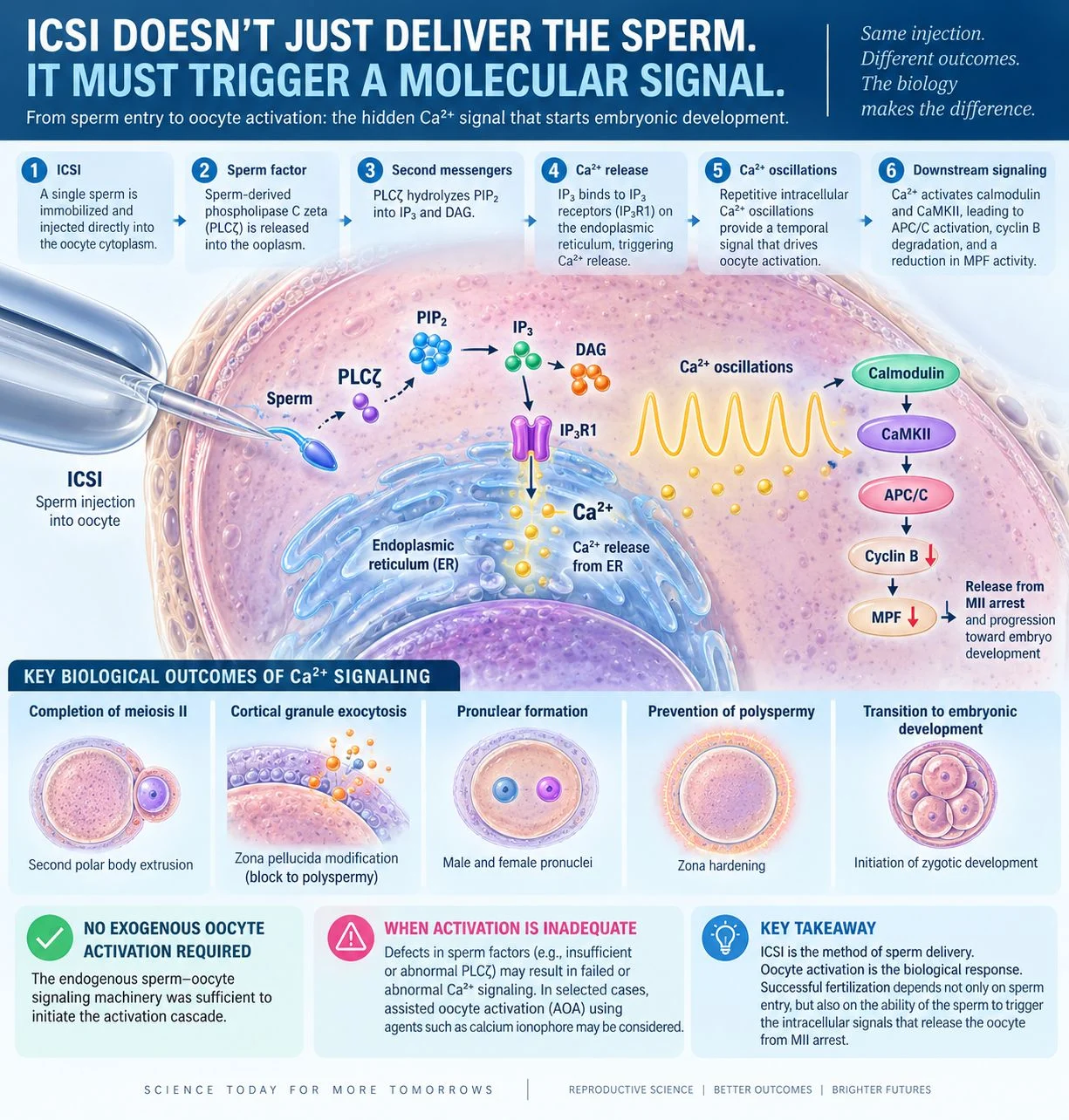
One of the central mechanisms involves sperm-derived phospholipase C zeta (PLCζ).
Following sperm entry, PLCζ can initiate the hydrolysis of PIP₂, generating IP₃. IP₃ then interacts with IP₃ receptors on the endoplasmic reticulum, promoting the release of intracellular Ca²⁺. And this is where the real activation signal emerges: PLCζ – IP₃ – IP₃R1 – Ca²⁺ release – Ca²⁺ oscillations.
These calcium oscillations are not simply a single ‘on/off’ event.
Their temporal pattern provides a critical intracellular signal that coordinates several downstream processes required for oocyte activation.
One major pathway involves:
Ca²⁺ – Calmodulin – CaMKII – APC/C activation – Cyclin B degradation – MPF reduction
The reduction of MPF activity allows the MII-arrested oocyte to resume and complete meiosis II.
At the same time, Ca²⁺ signaling contributes to:
- Second polar body extrusion
- Cortical granule exocytosis
- Zona pellucida modification
- Prevention of polyspermy
- Pronuclear formation
- Transition toward zygotic development
This gives us an important conceptual distinction:
ICSI is the method of sperm delivery.
Oocyte activation is the biological response.
Therefore, when we state: No exogenous oocyte activation was required, we are describing something biologically meaningful: the endogenous sperm – oocyte signaling machinery was sufficient to initiate the activation cascade without an additional artificial activation stimulus.
But when activation is inadequate, the problem may not be the injection itself.
The critical question may instead be:
Did the sperm generate the appropriate Ca²⁺ signaling required to release the oocyte from MII arrest?
This is one reason sperm factors such as PLCζ have attracted considerable attention in the study of unexplained or recurrent fertilization failure following ICSI. The deeper lesson for the IVF laboratory is that fertilization is not simply a mechanical event. It is a highly coordinated signaling process.
We inject the sperm. But ultimately, the oocyte must interpret the signal.
And perhaps one of the most important questions in ICSI is not simply:
Did the sperm enter the oocyte? but:
Did the sperm successfully communicate the signal required for the oocyte to begin a new developmental program?”
Other articles featuring Khalil Faaed on Fertility News.
-
Sep 24, 2026, 17:02Grateful to Have Walked Alongside So Many Long Island Patients This Year – Spring Fertility
-
Sep 24, 2026, 16:59Robert Heaton: Funded PhD Opportunity – Improving Implantation at the First Embryo Transfer
-
Sep 24, 2026, 16:56Yannick Hurni: What Does a “Normal Uterus” Actually Look Like?
-
Sep 24, 2026, 16:50The New Editors-in-Chief for the Journal of Assisted Reproduction and Genetics
-
Sep 24, 2026, 16:43Devyanshi Dixit: What Does Your DNA Really Tell You About Fertility?
-
Sep 24, 2026, 16:39Valuable Complementary Information on Follicular Sensitivity During Ovarian Stimulation – RBMO
-
Sep 24, 2026, 16:35Aris Kaltsas: What GLP-1 Receptor Agonists and Tirzepatide Do to Male Reproduction
-
Sep 24, 2026, 16:32Aparna Sridhar: New Expanding Contraceptive Options Guideline by WHO
-
Sep 24, 2026, 16:30Failed IVF Should Mean Time to Grieve, Not Simply Going Back to Work – The Fertility Alliance