

Mili Thakur: Recurrent Pregnancy Loss Is A Signal to Investigate, Not to Stop
Mili Thakur, Founder and CEO at Genome Ally, shared a post on LinkedIn:
“When pregnancy loss happens again and again, it is not a signal to stop. It is a signal to investigate.
Here is the core, evidence-based work-up we follow at Genome Ally which incorportaes the ASRM workup for recurrent pregnancy loss — and why each step matters:
- Emotional support: Because RPL is grief, fear, and uncertainty through and through. Medical investigation can only happen if the patient continues in the pursuit. RPL changes the person, their relationships, their work performance, basically their whole being is impacted. If the patient is supported, they will engage with their medical team and follow through with us, to get them the answers. Lead with support! Connect with Recurrent Pregnancy Loss Association. Talk to Megan Hanson if you haven’t already about the most important management in RPL – treating the human behind the loss.
- Family history: We ask about stillbirths, repeated miscarriages, or chromosomal conditions in close relatives or prior pregnancies. These patterns can reveal inherited risks we cannot see otherwise.
- Parental karyotype: A simple blood test for both egg source and sperm source to look for balanced translocations. Parents can be healthy carriers, but embryos/ pregnancies may not be.
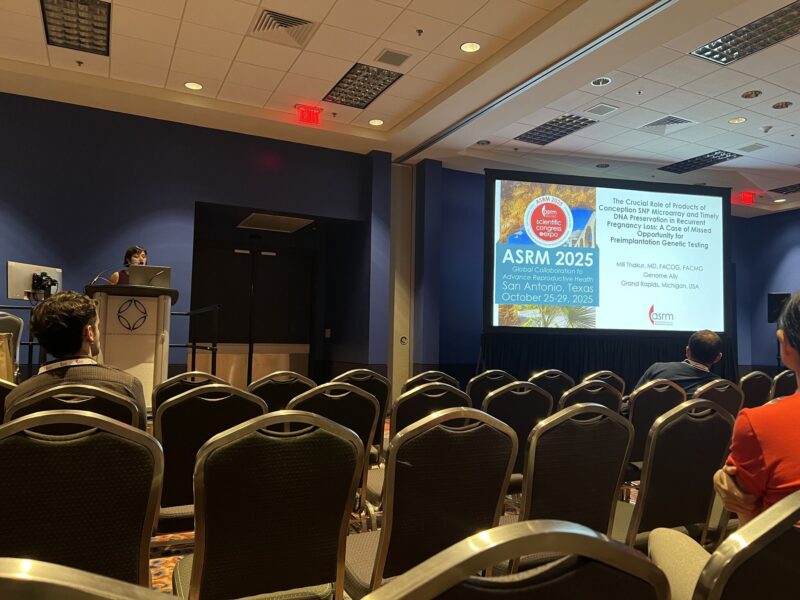
- Testing products of conception (POC) with SNP microarray: If tissue is available, this is one of the most valuable tests. It tells us if the loss was due to a chromosomal abnormality — information that can completely change next-step planning.
- Antiphospholipid antibody testing: Screening for lupus anticoagulant, anticardiolipin, and β2-glycoprotein I. These antibodies can cause clots in the placenta and are one of the treatable causes of RPL.
- Uterine imaging: Ultrasound, saline infusion sonogram, HSG or hysteroscopy to check for structural differences in the uterus such as a septum. Correcting these can significantly improve outcomes.
- Thyroid, prolactin, and A1C: Hormonal and metabolic conditions — even mild — can interfere with early pregnancy development.
- Lifestyle factors: BMI, smoking, alcohol, caffeine, environmental exposures. These are small levers that sometimes make big differences.
At this time after this full evaluation, up to 50% of cases remain unexplained — but most couples still go on to have a healthy baby.
When above workup is negative and the couple is still unsuccessful, then we at Genome Ally, order advanced genetic testing including whole genome sequencing on products of conception along with the testing for reproductive partners. We also do candidate gene testing for the partners for OZEMA related genes. DM me if you would like to know more!
And an important truth:
There is a path forward. There is a plan. And no one should walk it alone.”
Stay updated on all scientific advances in the field of fertility with Fertility News.
-
Sep 21, 2026, 18:01Mostafa Maghraby: What Makes a Good Embryologist?
-
Sep 21, 2026, 17:57Paweł Radwan: Meeting Fertility Leaders at the European Executive and Investors Fertility Meeting
-
Sep 21, 2026, 17:49Anna David: Can You Predict Pregnancy Outcome at Diagnosis of Early-Onset FGR?
-
Sep 21, 2026, 17:44Caspian Ostadian: Oocyte Abnormalities and Blastocyst Formation
-
Sep 21, 2026, 17:40Eric Lameignere: What If Part of the Sperm DNA Damage We Observe is Actually Created in the IVF Laboratory Itself?
-
Sep 21, 2026, 17:29Angelo Tocci: Paying More Without Improving Assisted Reproduction Outcomes
-
Sep 21, 2026, 17:22Santiago Munne: The Latest Bpisode of The Baby Blueprint, About the Worldwide Decline in Birth Rates
-
Sep 21, 2026, 17:12Zeinab Kazemianpour: 1 Embryo, 2 Different Biopsy Strategies
-
Sep 21, 2026, 17:10Diksha Kanekar: A Day in the Life of an Embryologist