

Nicole McPherson: New Evidence Suggests Many 1PN Embryos Can Lead to Healthy Live Births
Nicole McPherson, Director of Research, Science Education and Diagnostic Laboratories at Genea, shared a post on LinkedIn about a paper published in Human Reproduction:
“The evidence on 1PN embryos can no longer be ignored.
New paper out. Genea’s and one of the worlds largest study to date on 1PN embryos, is now published in Human Reproduction.
For years, embryos observed with a single pronucleus at fertilisation check were widely discarded. International guidelines have only just started to requestion this. But at Genea, we’ve been asking a different question for over a decade?
Our study of more than 13,000 1PN embryos across 10,730 cycles where a 1PN was present shows:
- IVF-derived 1PN embryos have a 97% rate of biparental inheritance, comparable to normally fertilised embryos.
- Euploid biparental 1PN blastocysts produce live birth rates and neonatal outcomes equivalent to 2PN embryos.
- In approximately 1 in 6 cycles, the 1PN embryo was the only viable option, a lifeline for patients who would otherwise have had nothing to transfer.
The story is more nuanced for ICSI-derived 1PNs, which carry a meaningfully higher rate of uniparental inheritance (~34%), reinforcing that a one-size-fits-all policy no longer serves patients.
This work is part of a broader and exciting shift happening across reproductive medicine right now. What we once labelled ‘abnormal fertilisation’ now known as atypical fertilisation, is increasingly revealing itself to be far more complex. Modern embryology, coupled with time-lapse microscopy, advanced genetic testing platforms, and studies like this one, is helping us distinguish true abnormalities from what may simply be natural biological variation that falls outside a narrow observation window. The label ‘atypical’ doesn’t always mean ‘unsuitable’.
This study sits alongside a growing body of evidence and concurrent systematic review and meta-analysis just published in Human Reproduction Update (Chan et al., 2026), which synthesises outcomes across 37,000+ transfer cycles and reaches similar conclusions. The field is converging.
At Genea, we’ve been building this evidence base since 2010. Our genetic testing platforms continue to evolve, and we’re not done yet.
Enormous congratulations to our co-authors (Dean Morbeck, Diana Bui, Sandra Holden, Maria Traversa, Rebecca Dickson, Clare Ussher, Alice Lee, Anthony Marren, Mark Bowman, Natalie Hesketh, Andy Murray, Steve Grkovic) and to every embryologist at Genea who has cared for these embryos with the attention they deserved, long before the guidelines started to catch up.”
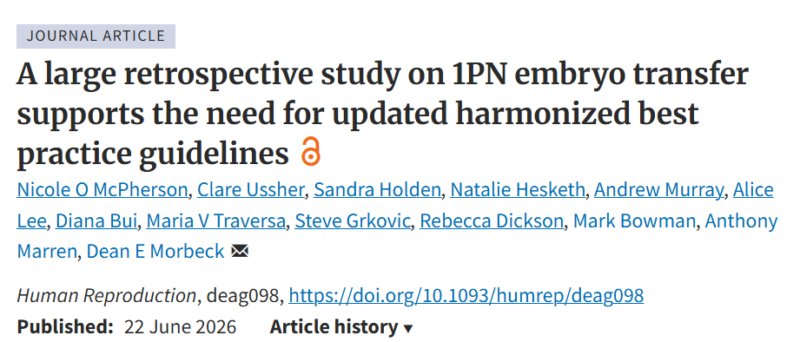
Title: A large retrospective study on 1PN embryo transfer supports the need for updated harmonized best practice guidelines
Authors: Nicole O McPherson, Clare Ussher, Sandra Holden, Natalie Hesketh, Andrew Murray, Alice Lee, Diana Bui, Maria V Traversa, Steve Grkovic, Rebecca Dickson, Mark Bowman, Anthony Marren, Dean E Morbeck
Stay updated on all scientific advances in the field of fertility with Fertility News.
-
Oct 21, 2026, 17:57Ula Sankowska: What I’ll Bring to ASRM INNOVATE in Baltimore
-
Oct 21, 2026, 17:40Robert Borowczyk: The Invisible Waiting Room
-
Oct 21, 2026, 17:35Fereshteh Safian: Behind the Scenes of Reproductive Medicine
-
Oct 21, 2026, 17:20The Relationship Between Trophectoderm Biopsy and Early Pregnancy Outcomes – RBMO
-
Oct 21, 2026, 17:09Jules McDonald: The Future of Fertility Is Happening in Abu Dhabi
-
Oct 21, 2026, 16:53Ashley Evans: I Never Imagined I’d Be a Fertility Story with a Group of People Whom I Have Never Met…
-
Oct 21, 2026, 16:41Karthik Raj: Asherman’s Syndrome – When the Endometrium Cannot Regenerate Normally
-
Oct 21, 2026, 16:36Katy Encalade: A Few Misconceptions I Think Every Woman Considering Egg Donation Deserves to Understand
-
Oct 21, 2026, 16:21The FeRGI Working Group 2026-2027 – ESHRE SIG Reproductive Genetics