

Why Does Fertility Change After 38? – Fertility Plus
Fertility Plus shared on LinkedIn:
“Why Fertility Changes After 38: The Biology Behind Ovarian Ageing
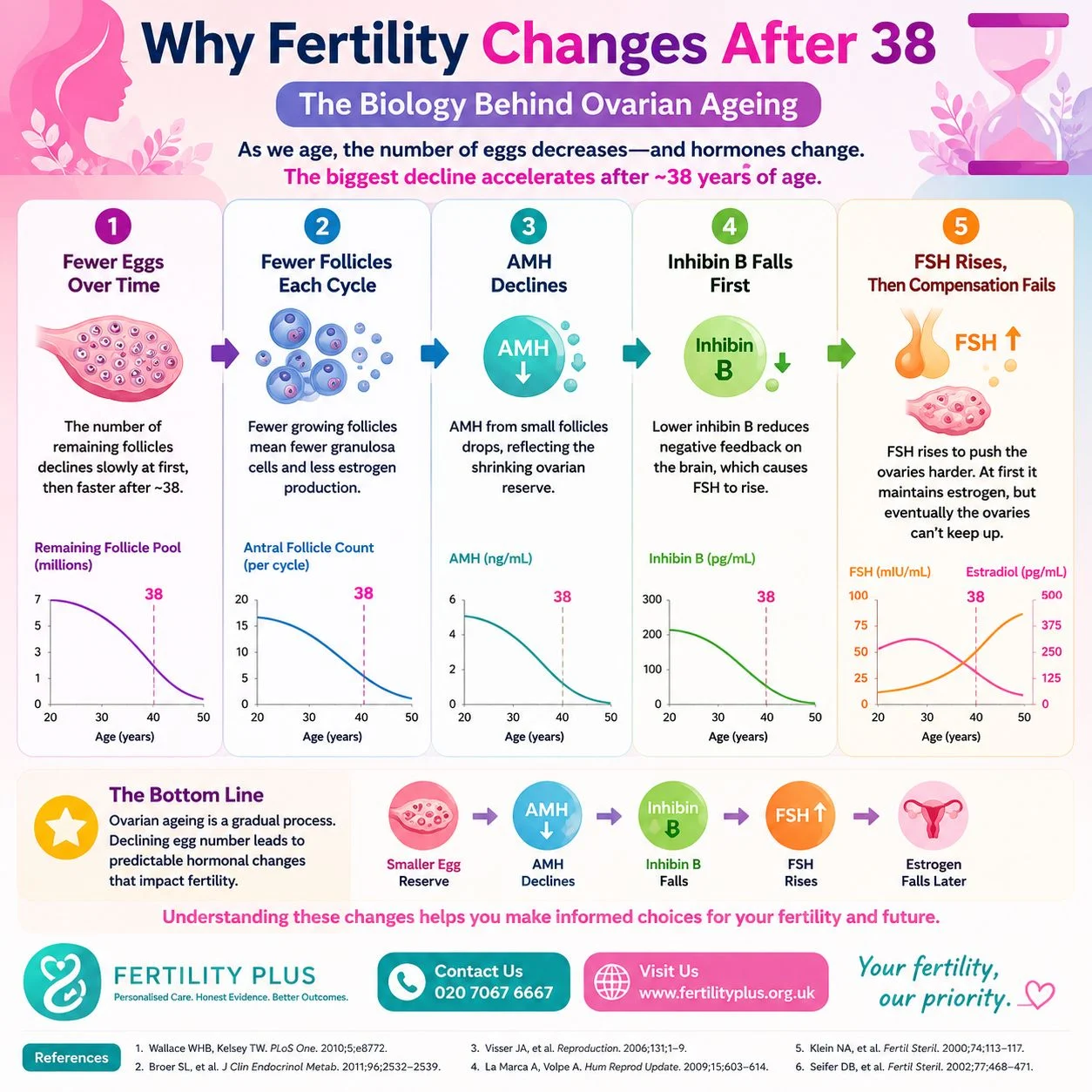
Did you know that your ovaries are born with all the eggs you’ll ever have? As time passes, this reserve naturally decreases, and after around 38 years of age, the decline often accelerates.
What happens?
- The number of remaining follicles falls more rapidly.
- AMH levels decrease due to fewer growing follicles.
- Inhibin B decreases, prompting the brain to produce more FSH.
- Initially, higher FSH helps the remaining follicles produce oestrogen, but eventually, both egg number and quality decline.
The bottom line: Ageing isn’t triggered by a sudden hormonal switch; it’s a gradual reduction in healthy follicles, leading to predictable hormonal changes over time.
If you’re planning a family, understanding these changes can empower you to make informed decisions rather than relying on myths.
Fertility Plus: Personalised fertility care based on honest evidence.
fertilityplus.org.uk
Contact us to discuss your fertility assessment or treatment options.”
Other articles featuring Fertility Plus on Fertility News.
-
Sep 21, 2026, 18:01Mostafa Maghraby: What Makes a Good Embryologist?
-
Sep 21, 2026, 17:57Paweł Radwan: Meeting Fertility Leaders at the European Executive and Investors Fertility Meeting
-
Sep 21, 2026, 17:49Anna David: Can You Predict Pregnancy Outcome at Diagnosis of Early-Onset FGR?
-
Sep 21, 2026, 17:44Caspian Ostadian: Oocyte Abnormalities and Blastocyst Formation
-
Sep 21, 2026, 17:40Eric Lameignere: What If Part of the Sperm DNA Damage We Observe is Actually Created in the IVF Laboratory Itself?
-
Sep 21, 2026, 17:29Angelo Tocci: Paying More Without Improving Assisted Reproduction Outcomes
-
Sep 21, 2026, 17:22Santiago Munne: The Latest Bpisode of The Baby Blueprint, About the Worldwide Decline in Birth Rates
-
Sep 21, 2026, 17:12Zeinab Kazemianpour: 1 Embryo, 2 Different Biopsy Strategies
-
Sep 21, 2026, 17:10Diksha Kanekar: A Day in the Life of an Embryologist