

Christina Walker: PCOS – Moving Toward Personalized Women’s Health in GFWH 2026
Christina Walker, Program Director at CLS Event and Publication, shared on LinkedIn:
“PCOS: Moving Toward Personalized Women’s Health
Polycystic Ovary Syndrome (PCOS) is more than a reproductive disorder – it is a complex condition involving hormonal, metabolic, reproductive, nutritional, and psychological health.
Our latest blog explores the evolving landscape of PCOS research, including insulin resistance, fertility, lifestyle and nutrition, gut microbiome, precision medicine, AI, and emerging therapies.
As research continues to uncover the diverse biological pathways of PCOS, multidisciplinary collaboration will be essential to developing more personalized and effective approaches to care.
Read the full blog and explore the latest perspectives on PCOS research.
Researchers and healthcare professionals working in PCOS, fertility, endocrinology, nutrition, and women’s health are invited to share their expertise at:
12th Global Summit on Gynecology, Fertility and Women’s Health
- November 23–24, 2026
- Grand Mercure Bangkok Atrium, Bangkok, Thailand
- [email protected]
- Register.
Polycystic Ovary Syndrome (PCOS): From Metabolic Complexity to Personalized Women’s Health

Polycystic Ovary Syndrome (PCOS) is one of the most complex and widely studied endocrine and reproductive disorders affecting women of reproductive age. Although it is commonly associated with irregular menstrual cycles, hyperandrogenism, and polycystic ovarian morphology, PCOS extends far beyond reproductive health.
It is increasingly recognized as a multidimensional condition involving reproductive, metabolic, endocrine, psychological, and long-term health factors.
Understanding the Complexity of PCOS
PCOS does not present in the same way in every patient. Some women primarily experience menstrual irregularities and infertility, while others may have hyperandrogenism, acne, hirsutism, weight-related concerns, insulin resistance, or metabolic abnormalities.
This clinical diversity makes individualized assessment particularly important.
The underlying mechanisms of PCOS involve complex interactions between genetic susceptibility, hormonal regulation, insulin signaling, metabolic health, lifestyle, environmental factors, and ovarian function.
Insulin resistance and compensatory hyperinsulinemia may contribute to increased androgen production and can further disrupt normal ovulatory function. At the same time, excess adiposity and chronic low-grade inflammation may aggravate metabolic and reproductive dysfunction in susceptible individuals.
PCOS and Fertility
For many women, PCOS becomes particularly significant when they experience difficulties with conception.
Irregular or absent ovulation can reduce the frequency of opportunities for conception, making PCOS one of the important causes of anovulatory infertility.
However, fertility management in PCOS is not simply about inducing ovulation. A comprehensive approach may also consider:
- Metabolic health
- Body composition
- Nutritional status
- Insulin sensitivity
- Hormonal balance
- Mental well-being
- Sleep and physical activity
- Individual reproductive goals
Advances in reproductive medicine are increasingly supporting a more personalized approach to fertility care, particularly for women with different PCOS phenotypes and varying metabolic risks.
Lifestyle, Nutrition and PCOS
Lifestyle management remains an important component of comprehensive PCOS care.
Regular physical activity, appropriate nutrition, adequate sleep, stress management, and sustainable behavioral changes can contribute to improvements in metabolic and reproductive health.
Rather than focusing exclusively on weight, modern approaches increasingly emphasize overall metabolic health, healthy behaviors, and individualized patient goals.
Research into dietary patterns, micronutrients, the gut microbiome, inflammation, and metabolic interventions is also expanding our understanding of how nutrition may interact with PCOS biology.
PCOS Beyond Reproductive Health
One of the most important developments in PCOS research is the growing recognition that the condition can have implications beyond fertility.
Women with PCOS may have increased risks associated with metabolic dysfunction, including impaired glucose regulation and other cardiometabolic risk factors. Psychological health is also an important component of comprehensive PCOS management.
An effective clinical strategy therefore requires collaboration across multiple disciplines, including:
- Gynecology
- Reproductive Endocrinology
- Endocrinology
- Nutrition
- Metabolic Medicine
- Psychology
- Fertility Medicine
- Primary Care
The Future of PCOS Research

The future of PCOS research is moving toward precision, prevention, and personalized care.
Emerging areas of investigation include:
- PCOS phenotyping and biomarkers
- Precision medicine and individualized treatment
- Metabolic health and insulin resistance
- Nutrition and lifestyle interventions
- Gut microbiome and inflammation
- PCOS and fertility outcomes
- Mental health and quality of life
- Digital health and remote patient monitoring
- AI-assisted diagnosis and risk prediction
- Long-term cardiometabolic health
- Novel pharmacological and reproductive therapies
PCOS remains an area where clinical medicine and research must work closely together. Greater understanding of its biological diversity may help clinicians move toward more targeted interventions while improving reproductive, metabolic, and quality-of-life outcomes.
The next generation of PCOS research will depend on multidisciplinary collaboration, high-quality evidence, and a stronger focus on personalized women’s healthcare.
PCOS Research Is Moving Toward Personalized Women’s Health
Polycystic Ovary Syndrome is more than a reproductive disorder.
Its complex relationship with hormonal regulation, metabolic health, insulin resistance, nutrition, fertility, inflammation, lifestyle, and long-term women’s health makes PCOS one of the most important areas of multidisciplinary research today.
From improving diagnostic approaches to developing personalized treatment strategies, researchers and clinicians are working to better understand the diverse biological and clinical presentations of PCOS.
The future of PCOS care will depend on bringing together expertise from gynecology, reproductive endocrinology, endocrinology, fertility medicine, nutrition, metabolic health, digital health, and precision medicine.
We invite researchers, physicians, gynecologists, endocrinologists, reproductive specialists, fertility experts, nutrition scientists, embryologists, healthcare professionals, and innovators to share their latest research and clinical insights at:
12th Global Summit on Gynecology, Fertility and Women’s Health
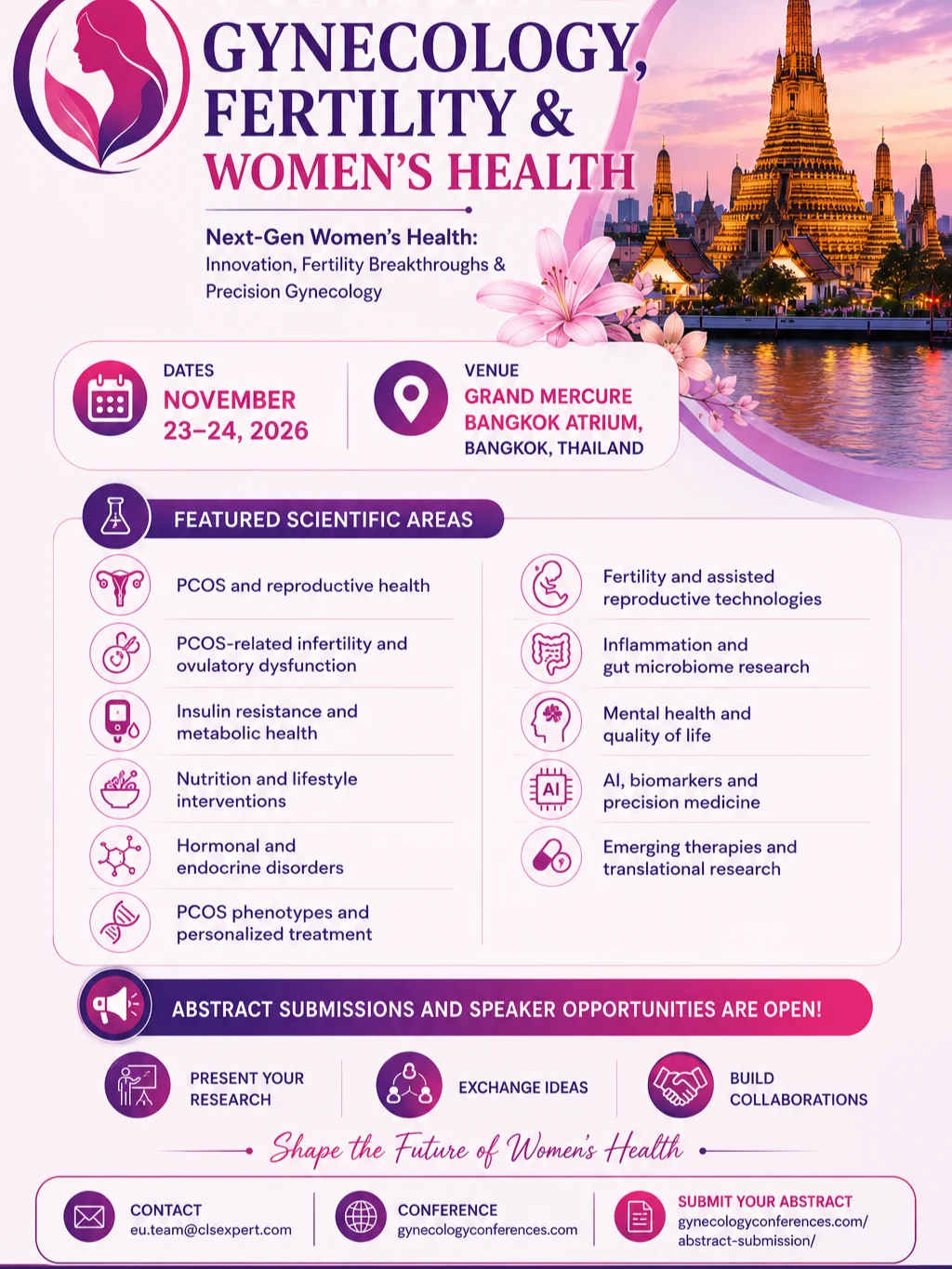
Featured Scientific Areas
- PCOS and reproductive health
- PCOS-related infertility and ovulatory dysfunction
- Insulin resistance and metabolic health
- Nutrition and lifestyle interventions
- Hormonal and endocrine disorders
- PCOS phenotypes and personalized treatment
- Fertility and assisted reproductive technologies
- Inflammation and gut microbiome research
- Mental health and quality of life
- AI, biomarkers and precision medicine
- Emerging therapies and translational research
Abstract submissions and speaker opportunities are open.
If your research is helping advance our understanding of PCOS, fertility, metabolic health, nutrition, or personalized women’s healthcare, we invite you to present your work and connect with an international community of researchers and healthcare professionals.
Present your research. Exchange ideas. Build collaborations. Shape the future of women’s health.
Contact: [email protected]
Join us in Bangkok for two days of scientific exchange, collaboration, and innovation in gynecology, fertility, and women’s health.”
Other articles on GFWH 2026 on Fertility News.
-
Sep 26, 2026, 18:20Rajeev Agarwal: Preconception Care Should Be about More than Preparing the Body for Pregnancy
-
Sep 26, 2026, 18:07Let’s Talk Access This World Contraception Day – FIGO
-
Sep 26, 2026, 17:57Nishad Tasnim and Iftekhar Ahmed Sakib: When Ultrasound and MRI Disagree in Septate Uterus
-
Sep 26, 2026, 17:53The Fertile Window: Why Your Best Days Come Before Ovulation – Fertility Plus
-
Sep 26, 2026, 17:47Kate Pleace: How You Are Told You Have POI Matters
-
Sep 26, 2026, 17:43Sarah Martins da Silva: Great to See Male Reproductive Health Front and Center at Gedeon Richter’s Future of Fertility
-
Sep 26, 2026, 17:37Paola Fasola: The Sound of Science and the Pulse of Humanity at the 5th Narture International Summit
-
Sep 26, 2026, 17:34Mostafa Maghraby: Is a ”Good Grade” Really a Good Embryo?
-
Sep 26, 2026, 17:31Emad Sedeek: Oocyte Quality and Developmental Competence Among the Most Critical Factors