

Bhumika։ Gardner Grading System – How Do We Assess the Quality of a Blastocyst?
Bhumika, Intern Embryologist at Indira IVF Group, shared on LinkedIn։
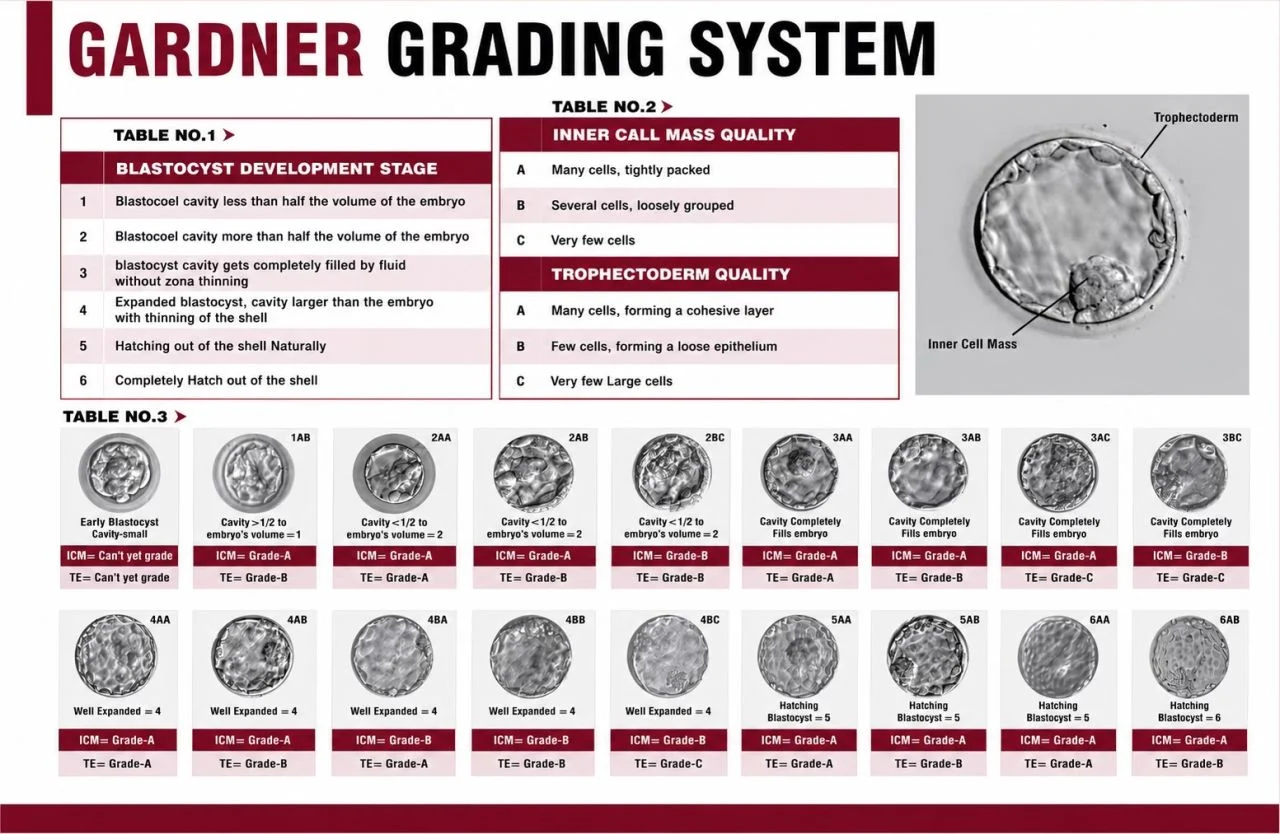
“Gardner Grading System: How Do We Assess the Quality of a Blastocyst?
In embryology, every blastocyst represents an incredible journey of development – from a single fertilized oocyte to a highly organized structure with the potential for implantation.
One of the most widely used methods for evaluating blastocyst morphology is the Gardner Grading System.
The Gardner system provides a standardized way to describe blastocyst development based on three important morphological parameters:
- Blastocyst Expansion – 1 to 6
The first number represents the degree of blastocyst expansion:
- Early blastocyst
- Blastocyst
- Full blastocyst
- Expanded blastocyst
- Hatching blastocyst
- Hatched blastocyst
As the blastocoel expands, the zona pellucida becomes thinner, and the embryo progresses toward hatching.
- Inner Cell Mass (ICM) – A, B or C
The ICM is the group of cells that will eventually contribute to the formation of the fetus.
- Many cells, tightly packed and well organized
- Several cells with a less compact appearance
- Very few cells or poorly organized ICM
- Trophectoderm (TE) – A, B or C
The trophectoderm forms the outer layer of the blastocyst and contributes primarily to the placental tissues.
- Many cells, forming a cohesive and well-organized layer
- Fewer cells with a less cohesive appearance
- Very few large cells or a sparse/disorganized layer
For example: 4AA
This indicates an expanded blastocyst with a high-quality ICM (A) and trophectoderm (A).
But an important point to remember is that morphological grading is not a guarantee of implantation or pregnancy. It is one of the important tools used by embryologists to assess and document embryo development and to support clinical decision-making.
What I find fascinating about embryology is that morphology allows us to observe and document the remarkable organization happening at a microscopic level.
Every stage tells a story – and every grade represents hours of development, observation, precision and patience.
As I continue learning and gaining hands-on exposure in the field of embryology, understanding systems like Gardner grading helps me appreciate the science behind every embryo we observe.
For fellow embryologists and IVF professionals:
Which blastocyst grading system or morphological feature do you find most interesting?”
Stay informed with the latest updates in fertility and reproductive medicine on Fertility News.
-
Sep 27, 2026, 15:51Saadat Hassan: Reproductive Ageing Is Not Just about Chromosomes…
-
Sep 27, 2026, 15:43Precious Chukwuemeka: A Glimpse Behind the Embryology Laboratory Doors
-
Sep 27, 2026, 15:35Lilian Yee: A Little “Bun” in the IVF Lab
-
Sep 27, 2026, 15:27Understanding the Clinical Implications of Ovulation Induction – Fertility Plus
-
Sep 27, 2026, 15:19Bhumika: Does the Culture Environment Change the Outcome?
-
Sep 27, 2026, 15:13Ingemārs Sokolovskis: Thoughts after Day 2 at the AIFertility World Conference
-
Sep 27, 2026, 15:04Huzaifa Gulzar: Right Equipment, Right Protection, Safer Laboratory
-
Sep 27, 2026, 14:55Yasmin Sajjad: A Wonderful Day at the Fertility Preservation and Modern IVF Scientific Seminar
-
Sep 27, 2026, 14:32From Ovarian Stimulation to Embryo Transfer: Rethinking OHSS Prevention in Modern IVF