

Aris Kaltsas: What GLP-1 Receptor Agonists and Tirzepatide Do to Male Reproduction
Aris Kaltsas, Assistant Professor of Urology and Andrology at National and Kapodistrian University of Athens, shared a post on LinkedIn about a paper he co-authored with colleagues published in the Journal of Clinical Medicine:
” ‘I’m on semaglutide, and we are trying for a baby. Is that a problem?’
More and more men ask this. The honest answer is shorter than they expect: we do not know enough.
Our new review in the Journal of Clinical Medicine examines what GLP-1 receptor agonists and tirzepatide do to male reproduction.
Three things stood out.
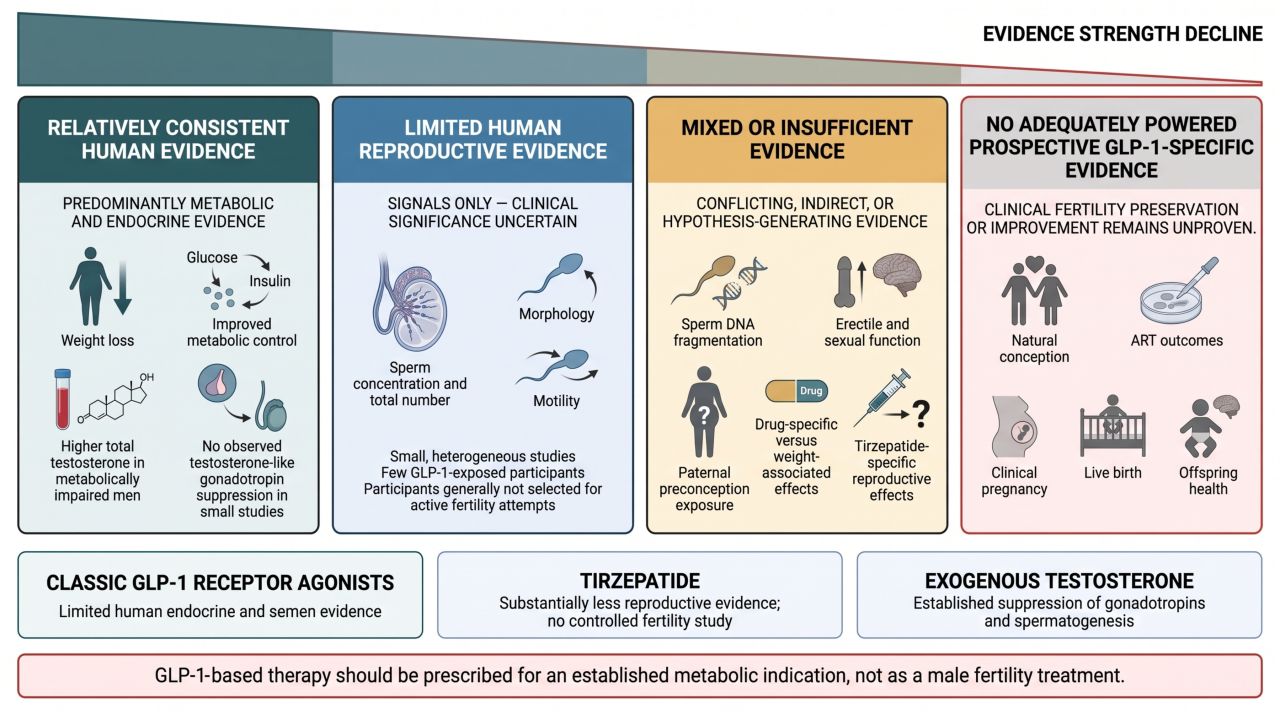
- In men with obesity or type 2 diabetes, total testosterone often rises. Free testosterone is less consistent. The small studies available did not show the gonadotropin suppression expected with exogenous testosterone.
- Some semen parameters improve, but the studies are small and the effect cannot be separated from weight loss itself. In a randomized weight-maintenance substudy, the semen gains followed the weight, and no additional benefit from liraglutide was detected.
- For the outcomes couples care about (conception, ART results, pregnancy, live birth, offspring health), we found no adequately powered prospective study. For tirzepatide, we found no controlled study of semen or fertility outcomes at all.
Better hormones are not the same as proven fertility benefit. These drugs belong to metabolic indications, not to the infertility clinic. And when a man wants children, testosterone monotherapy is still the thing to avoid.
We also propose a counseling framework built on a question that is asked too rarely: what are your fertility plans? It is pragmatic, non-validated and not guideline-endorsed. We say so in the paper, and we hope someone will test it.”
Title: GLP-1 Receptor Agonists and Tirzepatide in Men Seeking Fertility: A Structured Narrative Review and Proposed Clinical Framework
Authors: Aris Kaltsas, Vasileios Gkioxaris, Timoleon Giannakas, Athanasios Zachariou, Fotios Dimitriadis, Nikolaos Sofikitis, Michael Chrisofos
You can read the Full Article in the Journal of Clinical Medicine.
Stay informed with the latest updates in fertility and reproductive medicine on Fertility News.
-
Sep 24, 2026, 17:02Grateful to Have Walked Alongside So Many Long Island Patients This Year – Spring Fertility
-
Sep 24, 2026, 16:59Robert Heaton: Funded PhD Opportunity – Improving Implantation at the First Embryo Transfer
-
Sep 24, 2026, 16:56Yannick Hurni: What Does a “Normal Uterus” Actually Look Like?
-
Sep 24, 2026, 16:50The New Editors-in-Chief for the Journal of Assisted Reproduction and Genetics
-
Sep 24, 2026, 16:47Khalil Faaed: ICSI Doesn’t Just Deliver the Sperm, It Must Trigger a Molecular Signal
-
Sep 24, 2026, 16:43Devyanshi Dixit: What Does Your DNA Really Tell You About Fertility?
-
Sep 24, 2026, 16:39Valuable Complementary Information on Follicular Sensitivity During Ovarian Stimulation – RBMO
-
Sep 24, 2026, 16:32Aparna Sridhar: New Expanding Contraceptive Options Guideline by WHO
-
Sep 24, 2026, 16:30Failed IVF Should Mean Time to Grieve, Not Simply Going Back to Work – The Fertility Alliance