
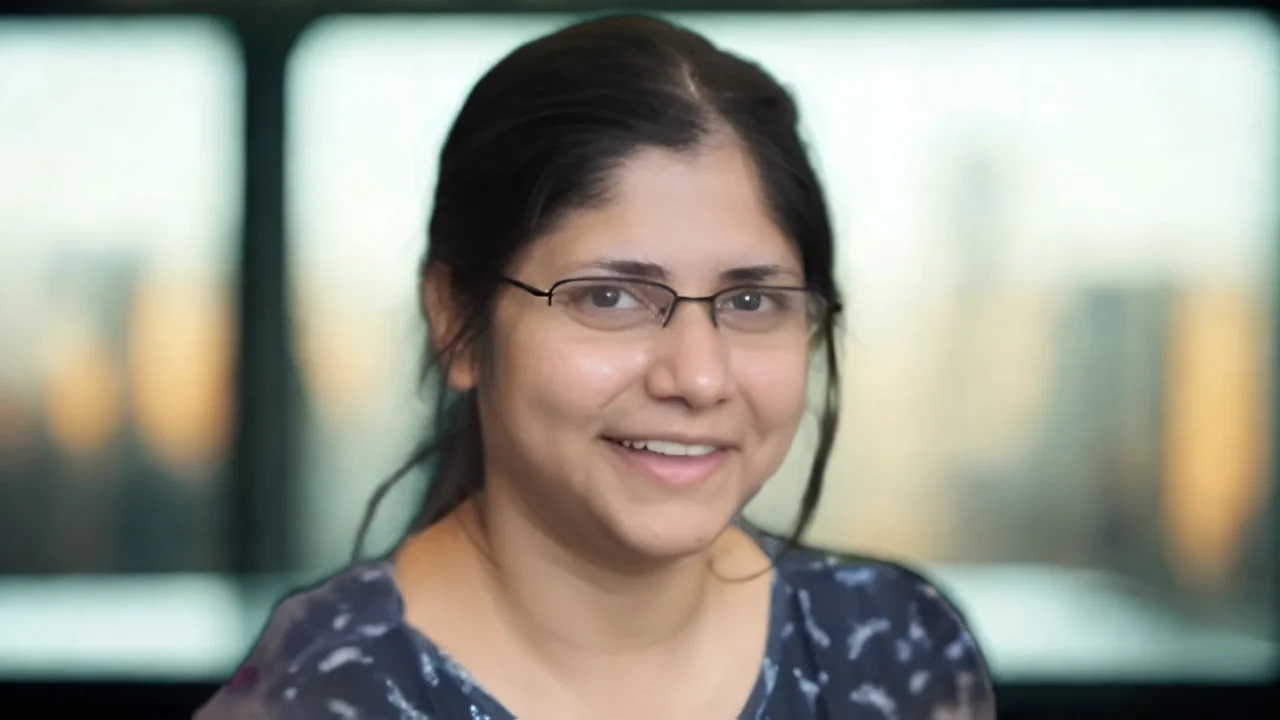
Sonia Muliyil: Perinatal Mental Health Care Must Reach Women Before Crisis
Sonia Muliyil, Editor-in-Chief at The Lancet Obstetrics, Gynaecology and Women’s Health, shared on LinkedIn:
“Perinatal mental health care must reach women before crisis.
The October Editorial of The Lancet Obstetrics, Gynaecology, and Women’s Health reflects on the recent Lindsay Clancy case and the renewed public attention it has brought to postpartum psychosis, while stressing the importance of distinguishing this rare but severe condition from the much more common challenge of perinatal depression.
Perinatal depression is one of the most common mental-health challenges encountered during pregnancy and after birth. It affects a substantial number of people, yet only a minority receive evidence-based treatment.
This gap is often framed as a problem of individual resilience or motivation, which is not always the case.
The barriers are often structural: too few mental-health specialists, fragmented referral systems, transport and childcare difficulties, cost, geography, and the practical impossibility of attending regular appointments while caring for a newborn.
In other words, this is a systems problem.
That is why the SUMMIT trial from Daisy Singla and colleagues is so important. In this large, multicentre study, 1230 pregnant or postpartum adults with depressive symptoms received the same manualised behavioural-activation intervention.
The treatment was delivered in four different ways: by mental-health specialists or trained non-specialists, and through telemedicine or in-person care.
The primary findings showed that care delivered by non-specialists, and care delivered remotely, was no worse than specialist or in-person care at three months.
The prespecified 12-month analysis is equally encouraging: depressive and anxiety symptoms improved substantially across all groups, with no meaningful differences according to who delivered the intervention or how it was delivered.
These findings still need replication in other countries and health systems. But the economic results make the implementation case stronger.
Non-specialist delivery was more likely to be cost-effective than specialist delivery, and telemedicine more likely to be cost-effective than in-person care.
The right interpretation is not that specialists are unnecessary. It is that specialist expertise may be used more intelligently.
Specialists can train and supervise non-specialist providers, advise on difficult cases, manage complexity, and provide rapid escalation when risk changes.
This is task-sharing as a way of expanding capacity not lowering standards. Findings of this study suggest that we can widen the front door to care for perinatal depression through trained providers and telemedicine while preserving clear pathways to specialist and emergency services.”
Title: Perinatal mental health care must reach women before crisis
Author: The Lancet Obstetrics, Gynaecology, and Women’s Health
You can read the Full Article in The Lancet Obstetrics, Gynaecology, and Women’s Health.
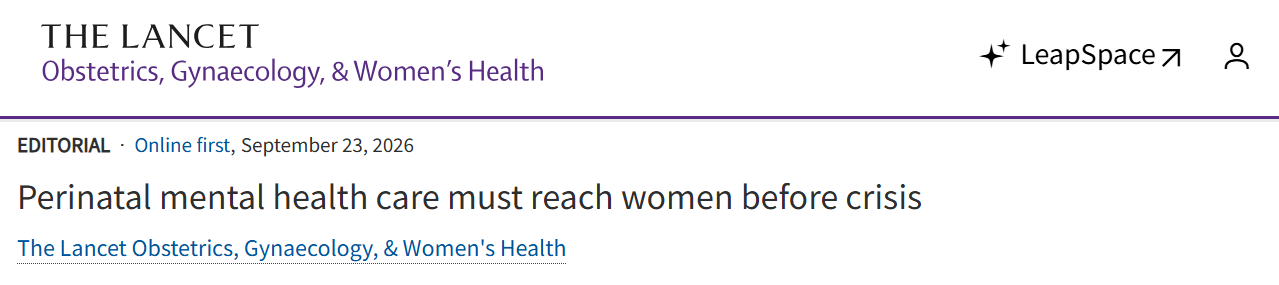
Title: Task-sharing and telemedicine delivery of psychotherapy to treat perinatal depression: a pragmatic, noninferiority randomized trial
Authors: Daisy R. Singla, Richard K. Silver, Simone N. Vigod, Nour Schoueri-Mychasiw, J. Jo Kim, Laura M. La Porte, Paula Ravitz, Crystal E. Schiller, Andrea S. Lawson, Alex Kiss, Steven D. Hollon, Cindy-Lee Dennis, Tara S. Berenbaum, Holly A. Krohn, Jamie E. Gibori, Jaime Charlebois, David M. Clark, Ariel K. Dalfen, Wendy Davis, Bradley N. Gaynes, Molyn Leszcz, Sarah Rachel Katz, Kellie E. Murphy, John A. Naslund, Mae Lynn Reyes-Rodríguez, Alison M. Stuebe, Claire Zlobin, Benoit H. Mulsant, Vikram Patel, Samantha Meltzer-Brody
You can read the Full Article in Nature Medicine.
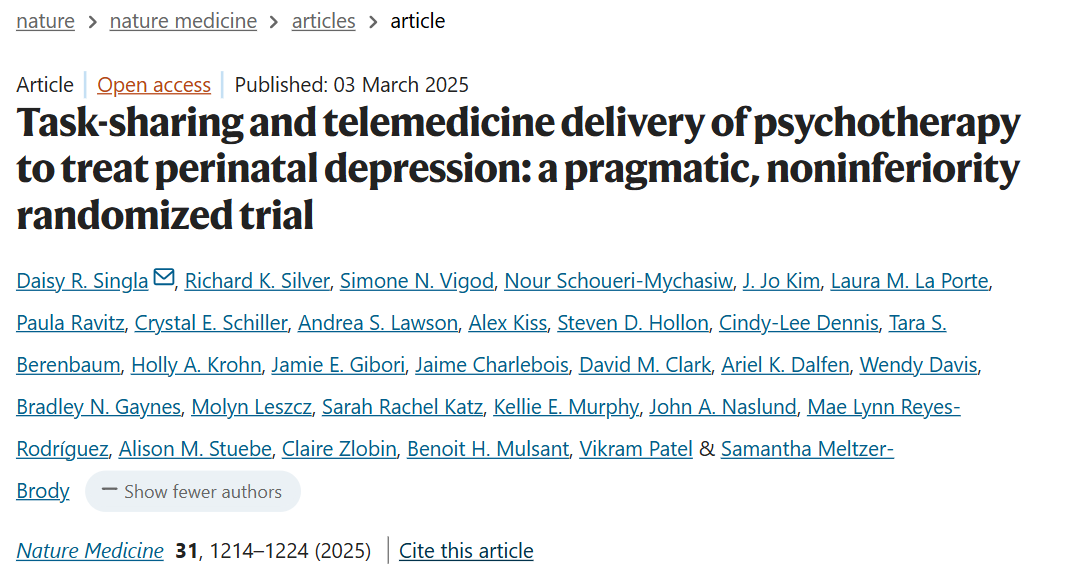
Title: Sustained clinical and cost-effectiveness of task-sharing and telemedicine for perinatal depression: a secondary analysis of a pragmatic, factorial, randomised controlled trial
Authors: Daisy R. Singla, Claire de Oliveira, Richard K. Silver, Sean M. Murphy, Samantha Meltzer-Brody, Margaret Jamieson, Alex Kiss, Sandeep Shelly, Andrea S. Lawson, Simone N. Vigod, Aditya Anand, Cindy-Lee Dennis, Laura M. La Porte, Paula Ravitz, Maya Zaidan, Tara S. Berenbaum, Jaime Charlebois, David M. Clark, Wendy Davis, Sona Dimidjian, Steven D. Hollon, Sarah Rachel Katz, Holly A. Krohn, Paul Kurdyak, Rina Lamba, Benoit H. Mulsant, Kellie E. Murphy, John A. Naslund, Danielle A. Ryan, Crystal E. Schiller, Alison M. Stuebe, Sharon Szmuilowicz, Claire Zlobin, Sarah Byford, Vikram Patel
You can read the Full Article in The Lancet Obstetrics, Gynaecology, and Women’s Health.
Stay informed with the latest updates in fertility and reproductive medicine on Fertility News.
-
Sep 25, 2026, 17:57Devyanshi Dixit: Next-Gen Women’s Health at GFWH 2026
-
Sep 25, 2026, 17:53Szabó Gábor: Ultrasound vs MRI for Preoperative Detection of Endometriosis
-
Sep 25, 2026, 17:45Robert Gilchrist: Is There Anything More Important in IVF Than Eggs?
-
Sep 25, 2026, 17:41Justin Houman: How I Run a Men’s Health Practice Inside an Academic Medical Center
-
Sep 25, 2026, 17:39Kristen Williams: The Hills I Will Die on as a Women’s Healthcare Founder
-
Sep 25, 2026, 17:36Thankful to Everyone Who Attended the Current Practice in Therapeutic Sperm Preparation Day – ARCS
-
Sep 25, 2026, 17:27Akash Verma: Sperm Cryopreservation with FertiPro SpermFreeze
-
Sep 25, 2026, 17:21Rafael Trinchant: Thrilled to Share Our Article on Semen, Stigma, and Spectacle
-
Sep 25, 2026, 17:14Eric Lameignere: Are We Measuring the Right Sperm DNA Fragmentation?