

Tony Gordon: Is It All Over for Non-Invasive PGT-A?
Tony Gordon, Senior Director of Clinical Strategy and Market Development at CooperSurgical Fertility Solutions, shared on LinkedIn:
“Is it all over for non-invasive PGT-A? Probably not, but it’s not been a good couple of weeks for the NI-PGT-A field.
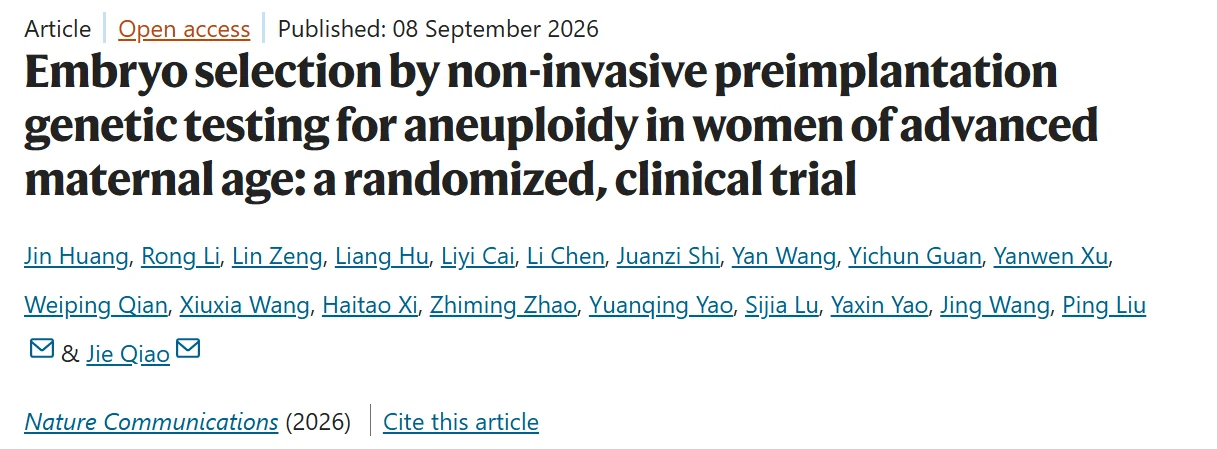
I do like to see a good RCT, and Huang, J., Li, R., Zeng, L., et al.
Embryo selection by non-invasive preimplantation genetic testing for aneuploidy in women of advanced maternal age: a randomized, clinical trial.
Nat Commun (2026) was undoubtedly an impressive RCT.
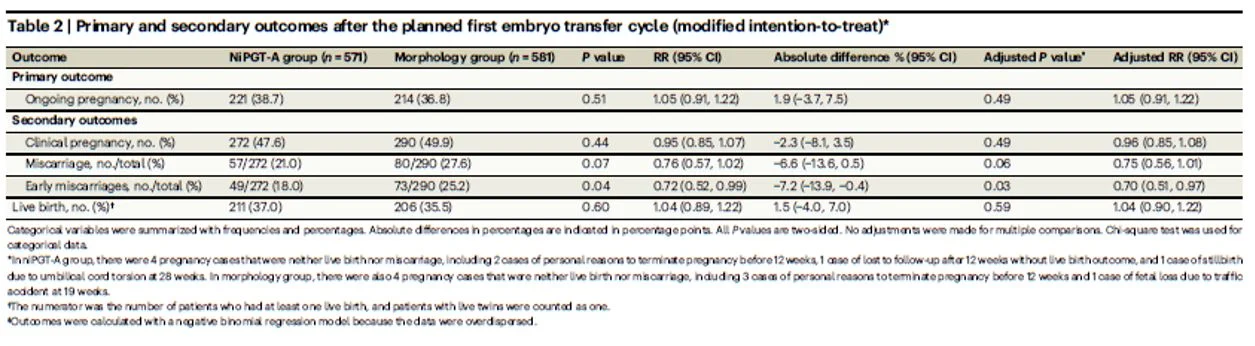
Approximately 600 patients per arm, advanced maternal age intention-to-treat, 13 IVF centres, double-blinded, NI-PGT-A vs morphology, 12 weeks on-going pregnancy.
From the paper: ‘1152 randomised patients, OPR was 38.7% (221/571) in the niPGT-A group and 36.8% (214/581) in the morphology group (adjusted p = 0.49). There were no statistically significant between-group differences in the rates of clinical pregnancy (47.6% vs 49.9%, adjusted p = 0.49), miscarriage (21.0% vs 27.6%, adjusted p = 0.06) and live birth (37.0% vs 35.5%, adjusted p = 0.59).’
There was a minimal difference in late miscarriage, but in every other metric the NI-PGT-A did no better or worse than standard embryo grading.
The NI-PGT-A scoring was definitely curious. Embryos were scored A or B (no results included in B, but I couldn’t see the number of NR) or C. No karyotypes, just grading, whilst previous studies had shown grade C embryos had poorer outcomes. But just 8% of the embryos in this study were graded C. Only 8% presumably more likely to be aneuploid in an AMA PGT-A RCT?
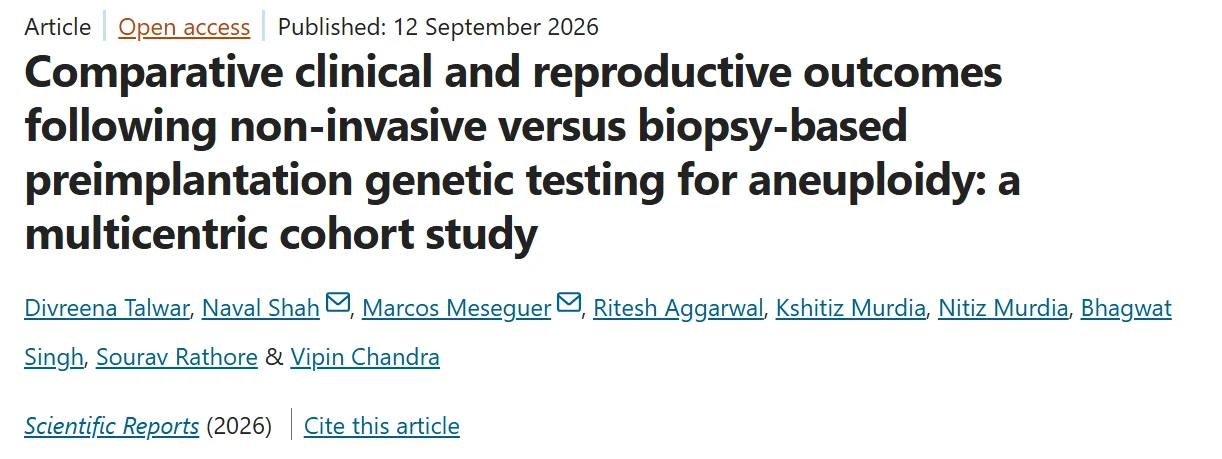
Also recently published was Talwar, D., Shah, N., Meseguer, M. et al.
Comparative clinical and reproductive outcomes following non-invasive versus biopsy-based preimplantation genetic testing for aneuploidy: a multicentric cohort study.
Sci Rep (2026), a large retrospective multicentric cohort study that evaluated reproductive outcomes after NI-PGT-A vs invasive PGT-A across 6,215 patients. In this study, the invasive PGT-A patients did better than the NI-PGT-A with LBT: 46.2% vs. 34.5%.
So how come the previous promise of NI-PGT-A hasn’t been shown? Is the issue the difficulty of the analyte, which is about a single-cell equivalent in IVF media (not a great solution for WGA!), leading to technology issues? Or is the DNA in sample media not representative of the state of the embryos?
I’m leaning towards the technology not being ready yet.
Hopefully there is still a future for NI-PGT-A since so many of us, patients/embryologists/scientists, would like to see it succeed.”
Title: Embryo selection by non-invasive preimplantation genetic testing for aneuploidy in women of advanced maternal age: a randomized clinical trial.
Authors: Jin Huang, Rong Li, Lin Zeng, Liang Hu, Liyi Cai, Li Chen, Juanzi Shi, Yan Wang, Yichun Guan, Yanwen Xu, Weiping Qian, Xiuxia Wang, Haitao Xi, Zhiming Zhao, Yuanqing Yao, Sijia Lu, Yaxin Yao, Jing Wang, Ping Liu and Jie Qiao.
You can read the Full Article in Nature Communications.
Title: Comparative clinical and reproductive outcomes following non-invasive versus biopsy-based preimplantation genetic testing for aneuploidy: a multicentric cohort study.
Authors: Divreena Talwar, Naval Shah, Marcos Meseguer, Ritesh Aggarwal, Kshitiz Murdia, Nitiz Murdia, Bhagwat Singh, Sourav Rathore and Vipin Chandra.
You can read the Full Article in Scientific Reports.
Other articles featuring Tony Gordon on Fertility News.
-
Sep 26, 2026, 18:20Rajeev Agarwal: Preconception Care Should Be about More than Preparing the Body for Pregnancy
-
Sep 26, 2026, 18:07Let’s Talk Access This World Contraception Day – FIGO
-
Sep 26, 2026, 17:57Nishad Tasnim and Iftekhar Ahmed Sakib: When Ultrasound and MRI Disagree in Septate Uterus
-
Sep 26, 2026, 17:53The Fertile Window: Why Your Best Days Come Before Ovulation – Fertility Plus
-
Sep 26, 2026, 17:47Kate Pleace: How You Are Told You Have POI Matters
-
Sep 26, 2026, 17:43Sarah Martins da Silva: Great to See Male Reproductive Health Front and Center at Gedeon Richter’s Future of Fertility
-
Sep 26, 2026, 17:37Paola Fasola: The Sound of Science and the Pulse of Humanity at the 5th Narture International Summit
-
Sep 26, 2026, 17:34Mostafa Maghraby: Is a ”Good Grade” Really a Good Embryo?
-
Sep 26, 2026, 17:31Emad Sedeek: Oocyte Quality and Developmental Competence Among the Most Critical Factors