

Nishad Tasnim and Iftekhar Ahmed Sakib: When Ultrasound and MRI Disagree in Septate Uterus
Iftekhar Ahmed Sakib, Clinical Research Coordinator at Emory University School of Medicine, and Nishad Tasnim, Vice President for Public Relations and Communication at Bangladesh Medical Students’ Society, shared a post on LinkedIn about a paper they co-authored published in Clinical Case Reports:
“Journal Publication.
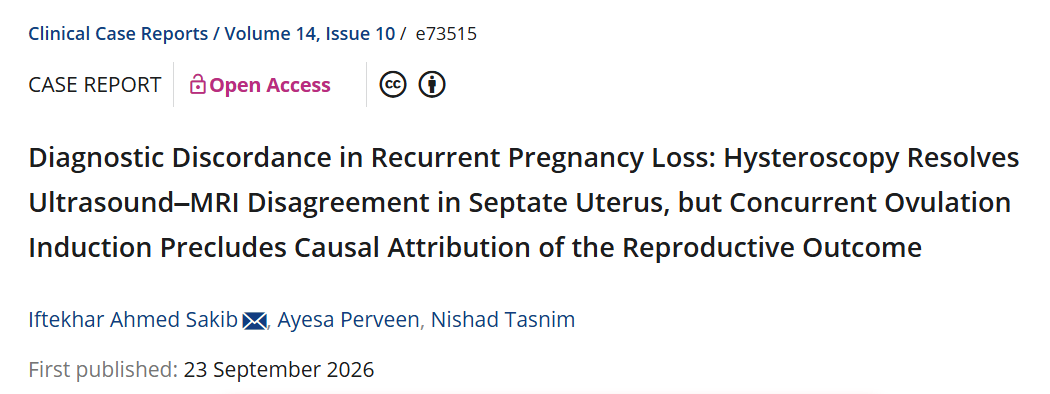
My case report titled ‘Diagnostic Discordance in Recurrent Pregnancy Loss: Hysteroscopy Resolves Ultrasound-MRI Disagreement in Septate Uterus, but Concurrent Ovulation Induction Precludes Causal Attribution of the Reproductive Outcome’ has been published in Wiley’s Clinical Case Reports.
This case is especially meaningful to me because it represents the first case report I ever worked on-and the beginning of my journey into clinical research and scientific writing.
The case involved a 23-year-old woman with recurrent first-trimester pregnancy loss whose transvaginal ultrasound suggested a septate uterus, while MRI favored an arcuate uterus.
This diagnostic disagreement created an important clinical dilemma because the management of these two uterine configurations is very different.
Ultimately, hysteroscopy directly visualized a thick fibrous partial uterine septum and allowed simultaneous hysteroscopic septoplasty.
What makes this case particularly important is not simply the successful pregnancy that followed, but the diagnostic lesson behind it.
It demonstrates how hysteroscopy can help resolve uncertainty when non-invasive imaging modalities provide conflicting information about intrauterine anatomy.
At the same time, the report emphasizes an equally important principle of scientific interpretation: a favorable clinical outcome should not automatically be attributed to a single intervention.
Because the patient subsequently received ovulation induction with letrozole, and because the recurrent pregnancy-loss and endocrine evaluations were incomplete, the eventual live birth could not scientifically be attributed to septoplasty alone.
She ultimately conceived following treatment and delivered a healthy male infant at term, making the clinical journey gratifying while also reminding us of the complexity of reproductive medicine and the importance of multidisciplinary management.
For me personally, this publication carries another kind of significance.
Watching a clinical encounter gradually become a scientific question, then a manuscript, and finally a peer-reviewed publication taught me how much patience, critical thinking, revision, and intellectual honesty are required in academic medicine.
The long review process made the final publication even more meaningful.
I am grateful to my co-authors whose cooperation made it possible to share this clinical experience with the wider medical community.”
Title: Diagnostic Discordance in Recurrent Pregnancy Loss: Hysteroscopy Resolves Ultrasound–MRI Disagreement in Septate Uterus, but Concurrent Ovulation Induction Precludes Causal Attribution of the Reproductive Outcome
Authors: Iftekhar Ahmed Sakib, Ayesa Perveen, Nishad Tasnim
You can read the Full Article in Clinical Case Reports.
Stay informed with the latest updates in fertility and reproductive medicine on Fertility News.
-
Nov 21, 2026, 18:17Sean Lauber: Euploid and Live Birth Rates Vary Across PGT-A Labs
-
Nov 21, 2026, 18:13Your Next Career Opportunity in Reproductive Medicine – ASRM
-
Nov 21, 2026, 18:09Can Preeclampsia Increase Your Risk of Heart Disease Later in Life? – Preeclampsia Foundation
-
Nov 21, 2026, 18:05Natalie Tam: Officially a WEST Graduate
-
Nov 21, 2026, 18:02Lucy Froese: She Was Told to Expect Six Eggs, but They Collected 18
-
Nov 21, 2026, 17:57An Effective Regulatory Framework for Surrogacy, ALRC Report – The Fertility Society of Australia and New Zealand
-
Nov 21, 2026, 17:53Irfana Koita: Should Treatment Start With IUI or IVF?
-
Nov 21, 2026, 17:50Amit Mangal: India’s Biggest IVF Chain May Be Up for Sale
-
Nov 21, 2026, 17:48Sue Hammoud: Excited to Be Attending My 1st JPM Healthcare Week