
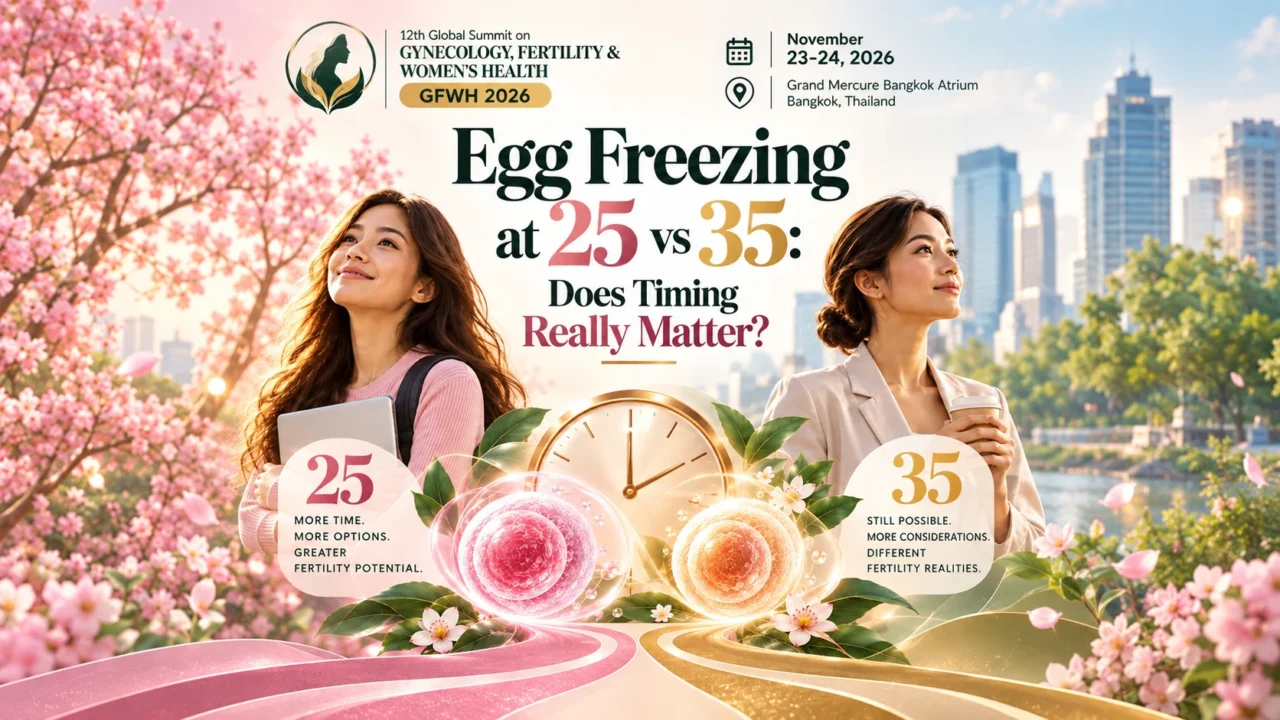
Devyanshi Dixit: Egg Freezing at 25 vs. 35 – Does Timing Really Matter?
Devyanshi Dixit, Program Manager at CLS Event and Publication and Conference Manager at the 12th Global Summit on Gynecology, Fertility and Women’s Health, shared on LinkedIn:
“Egg Freezing at 25 vs 35: Does Timing Really Matter?
Yes – but not in the way you might think.
Egg freezing is often discussed as a race against the biological clock. But the real story is more nuanced.
Age Can Affect Both Egg Quality and Quantity.
As ovarian aging progresses, the number of available eggs generally declines, while the proportion of eggs with chromosomal abnormalities tends to increase. That means an egg frozen at 25 and an egg frozen at 35 are not biologically identical starting points.
AT 25
- Oocytes are generally younger
- Chromosomal abnormality rates are generally lower
- More eggs may be available for retrieval in some women
But freezing eggs at 25 does not guarantee a future pregnancy.
AT 35
Egg freezing can still be an option.
But ovarian reserve and egg quality vary considerably between individuals, and age-related changes may mean fewer eggs are retrieved, or fewer ultimately develop into usable embryos.
Here’s What Many People Miss:
The number of eggs matters – but so does egg quality.
Not every frozen egg survives thawing. Not every surviving egg fertilizes. Not every fertilized egg becomes a viable embryo. And not every embryo results in a pregnancy.
So there is no magic number of frozen eggs that guarantees a baby.
What Should the Decision Consider?
Rather than asking only:
‘Am I 25 or 35?’
A fertility specialist may also consider:
- Ovarian reserve
- Reproductive history
- Medical conditions
- Previous treatments
- Individual fertility goals
- How long pregnancy may be postponed
The Bigger Message
Egg freezing is fertility preservation – not fertility insurance.
Earlier freezing may preserve younger eggs, but deciding whether and when to freeze them is a personal medical decision.
And ovarian-reserve tests such as AMH cannot tell you exactly how long you will remain fertile or guarantee future egg quality.
So does timing matter?
Biologically, yes.
Individually, the answer is more complicated.
The best time to discuss fertility preservation is not necessarily a specific birthday – it’s when your reproductive plans, age, ovarian biology, and medical circumstances make the conversation relevant.
Explore the future of fertility and reproductive medicine at GFWH 2026.
- November 23–24, 2026
- Bangkok, Thailand.”
Other articles featuring Devyanshi Dixit on Fertility News.
-
Nov 22, 2026, 17:01Insights from ISFP 2026
-
Nov 22, 2026, 16:17Khalil Faaed: The Dark Center of the Oocyte
-
Nov 22, 2026, 16:10Jyoti Gupta: Proud to Join Cloudnine Fertility, Golf Course Road, Gurugram, as Director
-
Nov 22, 2026, 15:45Francine Freitas Fernandes: 3D and 4D Hysterosalpingo-Contrast Sonography
-
Nov 22, 2026, 15:25New RBMO Study Links Microfluidic Sperm Sorting to Higher Blastocyst Formation and Lower Miscarriage Rates
-
Nov 22, 2026, 15:21Michelle Mason: Pleased to Attend the Annual SWIGS Conference with the Care Fertility Cardiff Team
-
Nov 22, 2026, 15:18Rajeev Agarwal: The Lining Is 6.5 mm – Will the Embryo Transfer Fail?
-
Nov 22, 2026, 15:11The Automated IVF Laboratory Lecture by Jacques Cohen at the 5th Narture – Conceivable Life Sciences
-
Nov 22, 2026, 15:07Laura Rienzi: Same Message, 2 Slides – Which One Would You Rather See at a Congress?