
Khalil Faaed: Vitrification Prevents Ice, but Does It Prevent Oocyte Damage?
Khalil Faaed, Embryologist at Modern IVF Center, shared on LinkedIn։
“Vitrification Prevents Ice but Does It Prevent Oocyte Damage?
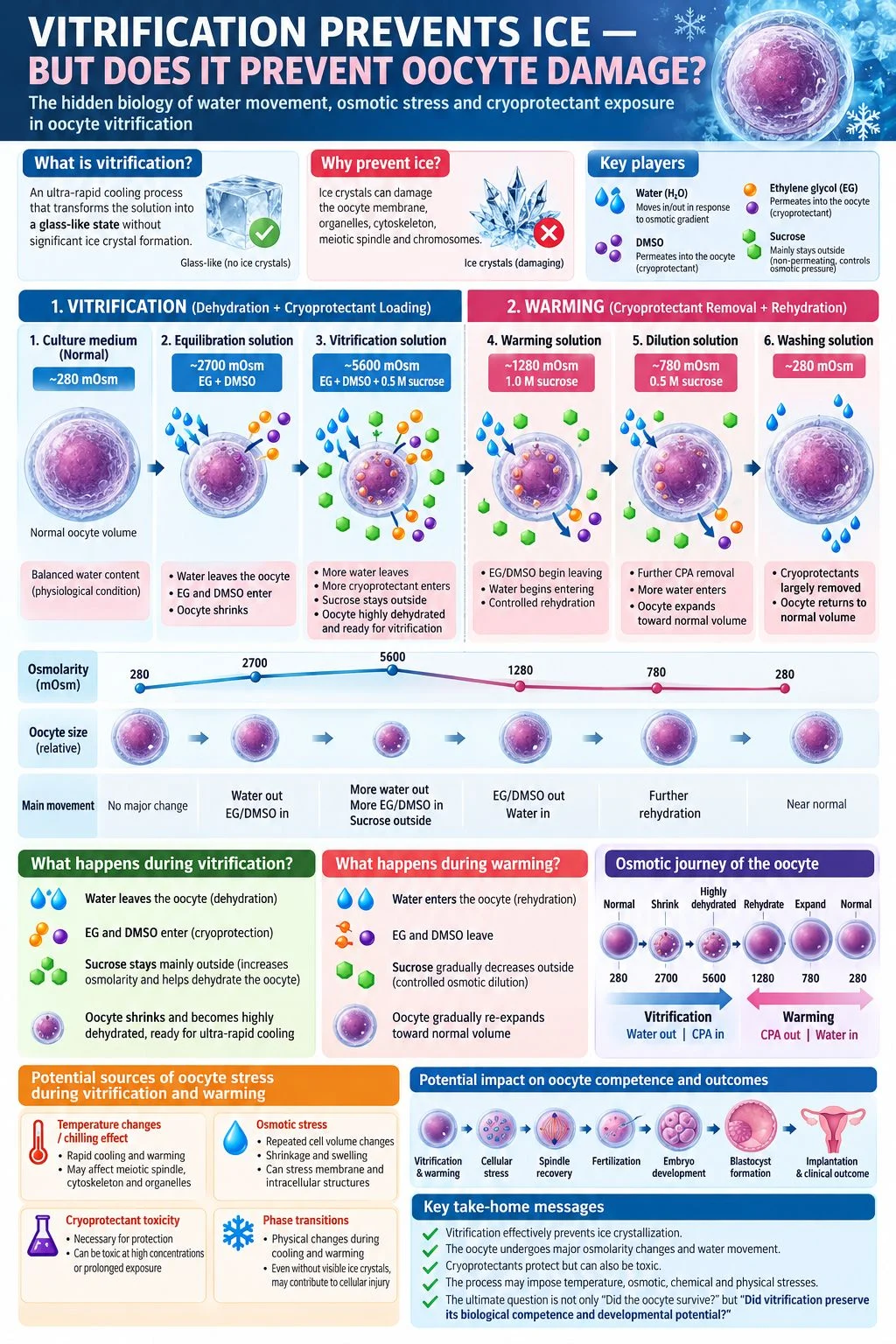
Oocyte vitrification has transformed cryopreservation by allowing ultra-rapid cooling of the oocyte into a glass-like state with minimal ice-crystal formation. But eliminating ice does not necessarily mean eliminating stress.
The oocyte undergoes a remarkable physical journey before, during, and after vitrification.
During equilibration, the extracellular osmolarity rises dramatically from approximately 280 mOsm in culture medium to ~2700 mOsm, while permeating cryoprotectants such as ethylene glycol (EG) and DMSO enter the oocyte. Water moves outward, causing the oocyte to shrink.
Then, in the vitrification solution, osmolarity reaches approximately 5600 mOsm, with EG, DMSO, and sucrose. Further water loss and cryoprotectant loading prepare the oocyte for ultra-rapid cooling. But the story does not end with cooling. During warming, the direction of osmotic movement begins to reverse.
The oocyte must progressively remove cryoprotectants while allowing water to return.
This is why the warming process uses a controlled osmotic sequence:
- 1.0 M sucrose – ~1280 mOsm
- 0.5 M sucrose – ~780 mOsm
- ~280 mOsm washing solution
The oocyte gradually rehydrates and returns toward its original volume. And this is where the deeper question begins.
Vitrification successfully addresses one of the greatest threats to cryopreservation ice crystallization. But the oocyte may still encounter several forms of stress:
- Temperature changes/chilling effects
- Osmotic stress and rapid volume changes
- Cryoprotectant toxicity
Physical phase transitions during cooling and warming
Therefore, the real question is not simply:
Did the oocyte survive vitrification?
A more important question is: Did vitrification preserve the biological competence of the oocyte?
Because survival is only the beginning.
The ultimate biological consequences may extend to:
oocyte survival – spindle recovery – fertilization – embryo development – blastocyst formation – implantation – clinical outcome.
This is why understanding the physics of water movement is not just theoretical knowledge for an embryologist.
It is part of understanding what happens to the biology of the oocyte.
No Ice Does Not Mean No Stress.
The challenge for modern cryobiology is therefore not merely to prevent ice formation but to determine how effectively we can preserve the structural and functional competence of the oocyte throughout the entire vitrification warming journey.
What do you think is the most critical variable in oocyte vitrification: osmotic stress, cryoprotectant toxicity, temperature, or the warming process?”
Other articles featuring Khalil Faaed on Fertility News.
-
Nov 22, 2026, 17:01Insights from ISFP 2026
-
Nov 22, 2026, 16:17Khalil Faaed: The Dark Center of the Oocyte
-
Nov 22, 2026, 16:10Jyoti Gupta: Proud to Join Cloudnine Fertility, Golf Course Road, Gurugram, as Director
-
Nov 22, 2026, 15:45Francine Freitas Fernandes: 3D and 4D Hysterosalpingo-Contrast Sonography
-
Nov 22, 2026, 15:25New RBMO Study Links Microfluidic Sperm Sorting to Higher Blastocyst Formation and Lower Miscarriage Rates
-
Nov 22, 2026, 15:21Michelle Mason: Pleased to Attend the Annual SWIGS Conference with the Care Fertility Cardiff Team
-
Nov 22, 2026, 15:18Rajeev Agarwal: The Lining Is 6.5 mm – Will the Embryo Transfer Fail?
-
Nov 22, 2026, 15:11The Automated IVF Laboratory Lecture by Jacques Cohen at the 5th Narture – Conceivable Life Sciences
-
Nov 22, 2026, 15:07Laura Rienzi: Same Message, 2 Slides – Which One Would You Rather See at a Congress?