

Rima Dhillon-Smith: Progesterone Capsules Boost ART Success Rates
Rima Dhillon-Smith, Consultant Gynaecologist and subspecialist in Reproductive Medicine at NHS, shared a post on LinkedIn about a paper published in Human Reproduction:
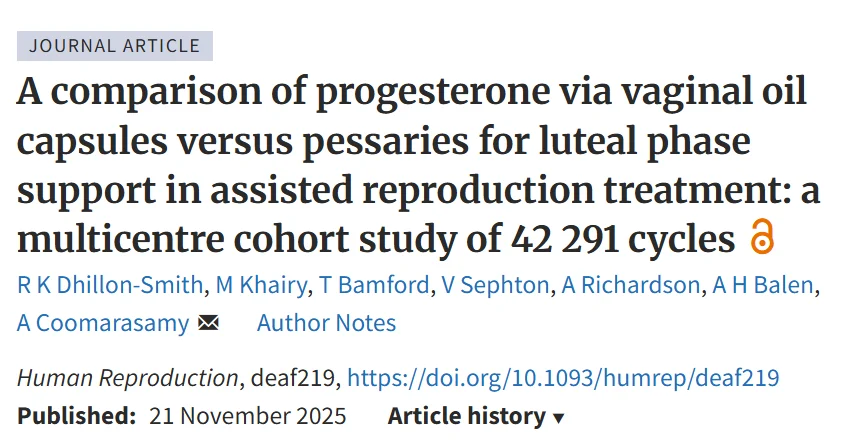
“I’m really pleased to share that our study ‘A comparison of progesterone via vaginal oil capsules versus pessaries for luteal phase support in assisted reproduction treatment: a multicentre cohort study of 42 291 cycles’ has been published in Human Reproduction.
Key findings:
- We found that using vaginal oil capsules of progesterone for luteal phase support in ART (both fresh IVF/ICSI and HRT-FET) was associated with higher live birth rates compared to pessary forms: 34.3% vs 27.8% in fresh cycles, aRR 1.11 (95% CI 1.04-1.19); 36.7% vs 32.9%, aRR 1.09 (95% CI 1.04-1.14) in HRT-FET cycles after adjustment for confounders.
- In HRT-FET cycles, the miscarriage rate was significantly lower in the oil-capsule group compared to pessaries (adjusted risk ratio 0.87; 95% CI 0.82–0.93), though for fresh cycles the adjusted difference did not reach statistical significance.
- This study is retrospective and observational, so while we adjusted for many confounders, we cannot account for residual confounding.
What’s next:
We hope this work lays the foundation for a well-powered RCT comparing these progesterone modalities directly, with a focus on live birth and miscarriage rates. In clinical practice, the findings encourage fertility clinics and patients to discuss the route/formulation of progesterone support as part of shared decision-making.
Thank you to all our co-authors at Care Fertility (Birmingham, Manchester, Nottingham, Northampton), the University of Birmingham/NIHR Birmingham Biomedical Research Centre, and the University of Oxford for their collaboration, and to all the Care Fertility patients whose data made this research possible.”
Title: A comparison of progesterone via vaginal oil capsules versus pessaries for luteal phase support in assisted reproduction treatment: a multicentre cohort study of 42 291 cycles
Authors: R. K. Dhillon-Smith, M. Khairy, T. Bamford, V. Sephton, A. Richardson, A. H. Balen, A. Coomarasamy
Read the full article.
Stay updated on all scientific advances in the field of fertility with Fertility News.
-
Sep 13, 2026, 15:11Sachintha Alwis: From Impaired Sperm Motility to Microrobotics
-
Sep 13, 2026, 15:08Laurence Orbuch: Before Endometriosis Surgery, Ask…
-
Sep 13, 2026, 15:05Ademola Ayodele: IUI, IVF or Egg Freezing – Which One Is Right for You?
-
Sep 13, 2026, 14:59Fiona Pathiraja-Møller: Tennis Players No Longer Have to Choose Between Career and Family
-
Sep 13, 2026, 14:571-Day Virtual Experience for People Impacted by PMOS – PCOS Awareness Association
-
Sep 13, 2026, 14:53Ozor Victor: Behind Every Embryo Is a Story of Science, Precision, and Hope
-
Sep 13, 2026, 14:50Diana Kayal: What They Don’t Tell You About IVF
-
Sep 13, 2026, 14:44Vikram Sinai Talaulikar: A Heartfelt Thank You to All Who Donated and Supported “Menopause and Cancer”
-
Sep 13, 2026, 14:41Nicole McPherson: Changing IVF Practices Is Hard – Integration Needs to Be Easy