

Abhijit Kulkarni: IVF vs. IUI in Unexplained Infertility – Does Starting with IVF Make a Difference?
Abhijit Kulkarni, Senior Consultant at Avenues, shared a post on LinkedIn about a paper by Lucy R. Prentice et al. published in NEJM:
“IVF vs IUI in Unexplained Infertility: Does Starting with IVF Make a Difference?
A new randomised controlled trial published in the New England Journal of Medicine (October 2026) provides important evidence for the ongoing debate about first-line treatment in unexplained infertility.
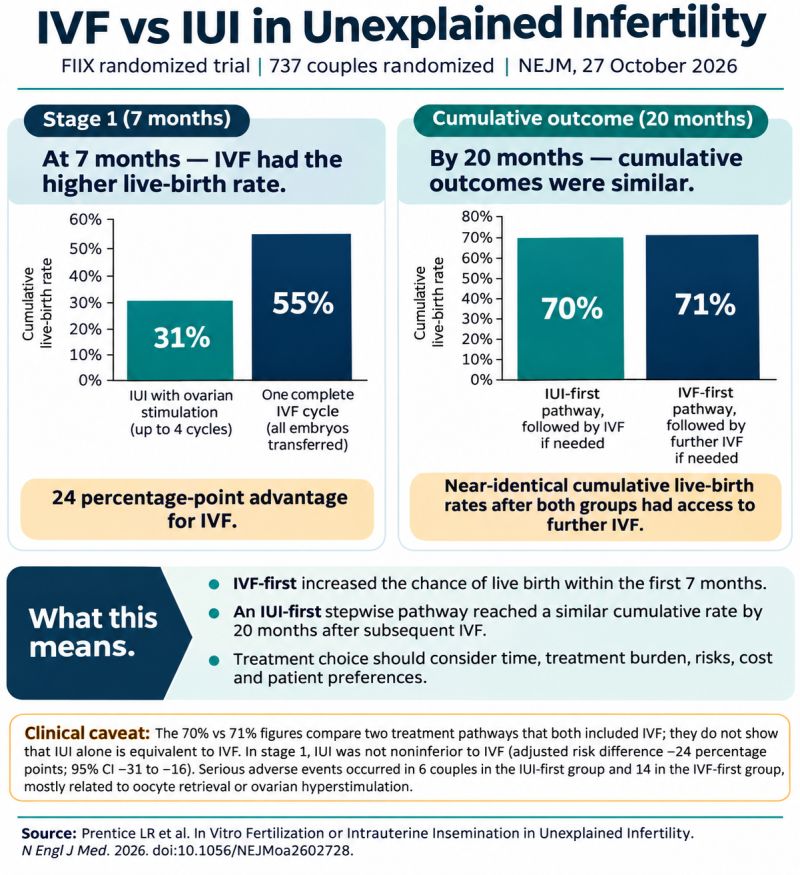
The FIIX trial compared up to four cycles of stimulated intrauterine insemination (IUI) with one complete IVF cycle in 737 couples.
The findings are particularly interesting:
At 7 months:
- IUI with ovarian stimulation: 31% cumulative live birth rate.
- IVF: 55% cumulative live birth rate.
- IVF demonstrated a 24-percentage-point advantage.
At 20 months, after further IVF treatment:
- IUI-first strategy: 70% cumulative live birth rate.
- IVF-first strategy: 71% cumulative live birth rate.
- The difference had virtually disappeared.
What does this mean for clinical practice?
- IVF offers a higher probability of achieving a live birth earlier.
- Starting with IUI followed by IVF can achieve a similar cumulative live birth rate over a longer treatment pathway.
- The choice should consider time to pregnancy, treatment burden, costs, risks and patient preferences.
- IVF is not automatically the right first choice for every couple with unexplained infertility.
My key takeaway:
The question is not simply whether IUI or IVF produces more babies. It is whether couples should prioritise a higher chance of success sooner or pursue a stepwise approach with comparable cumulative outcomes.
Fertility treatment should be individualised, evidence-led and centred on the patient’s priorities.
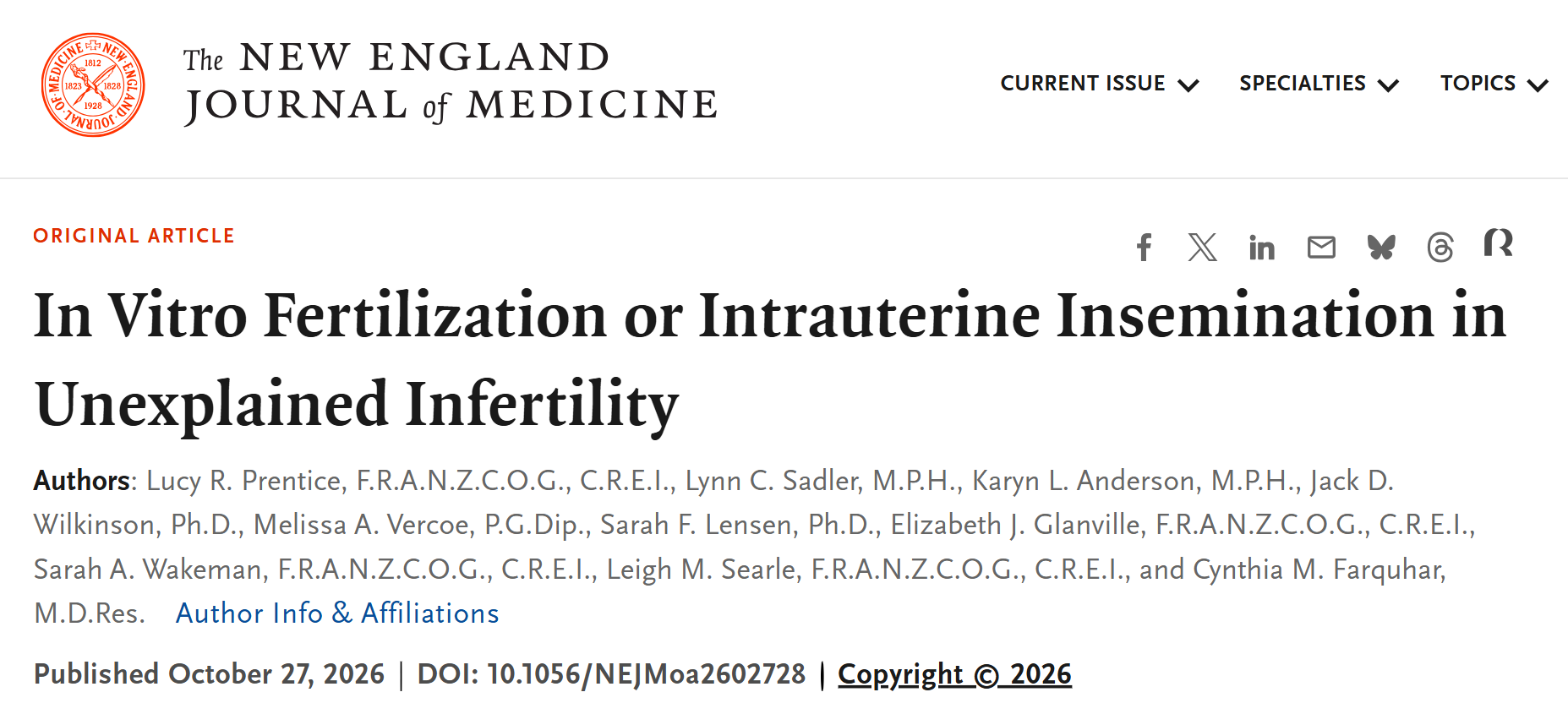
Reference: Prentice LR et al. In Vitro Fertilization or Intrauterine Insemination in Unexplained Infertility. New England Journal of Medicine. 2026.”
Title: In Vitro Fertilization or Intrauterine Insemination in Unexplained Infertility
Authors: Lucy R. Prentice, Lynn C. Sadler, Karyn L. Anderson, Jack D. Wilkinson, Melissa A. Vercoe, Sarah F. Lensen, Elizabeth J. Glanville, Sarah A. Wakeman, Leigh M. Searle, Cynthia M. Farquhar
You can read the Full Article in the New England Journal of Medicine (NEJM).
Other articles featuring Abhijit Kulkarni on Fertility News.
-
Nov 16, 2026, 19:39Ting Yuan: Rethinking Endometrial Preparation in FET
-
Nov 16, 2026, 19:35Rima Dhillon-Smith: Feeling Inspired After the ESHRE Campus on Comprehensive Approaches to Pregnancy Loss
-
Nov 16, 2026, 19:32Nominations for ARCS Awards 2027 Close 30th November
-
Nov 16, 2026, 19:30Suganya Venkat: Let Me Say This Clearly – PMS Is Real
-
Nov 16, 2026, 19:28Elena Milner: Exploring Emerging Technologies in the IVF Laboratory
-
Nov 16, 2026, 19:24Serena H. Chen: How Individuals Working Together Can Truly Make a Difference
-
Nov 16, 2026, 19:22Rajeev Agarwal: An Open Tube Is Not Always A Working Tube
-
Nov 16, 2026, 19:20Karthik Raj: DuoStim in IVF
-
Nov 16, 2026, 19:16Rana Mondal: Navigating Reproductive Decision-Making Alongside Elevated Hereditary Cancer