
Mazen Al-Obaidi: Semen Color – Clinical Significance, Causes of Variation, and Male Reproductive Health
“Semen color is the first feature a clinician and a patient notice in a semen sample. Normal semen appears cream, gray, opalescent, or off-white (Mason et al., 2022). Many men worry when the shade changes to yellow, pink, or brown. Most changes are harmless, and a few signal infection, bleeding, or liver disease. This article explains the clinical significance of semen color, the causes of color variation, and what color means for male reproductive health.
What is the clinical significance of semen color?
Color is one of several macroscopic findings in a semen analysis, the standard first test of male fertility (Mason et al., 2022). A clinician reads color together with other findings:
- A volume under 1.4 mL is hypospermia (World Health Organization, 2021). A volume over 6.3 mL is hyperspermia (Mason et al., 2022).
- Hyperviscosity, or thick semen, affects 12% to 29% of men (Mason et al., 2022).
- Delayed liquefaction means the sample has not started to liquefy at 30 minutes. Non-liquefaction means it is not complete at 60 minutes (Mason et al., 2022).
- The normal pH range is 7.2 to 7.8. A pH above 8.0 links to infection or inflammation (Mason et al., 2022).
The clinical value of color is limited. Experts do not agree that color or opacity reflects sperm concentration (Mason et al., 2022). The semen analysis itself predicts reproductive outcomes poorly, and results vary with collection method and days of abstinence (Mason et al., 2022). Color acts as a prompt for further questions, not as a diagnosis.
What causes variations in semen color?
Normal semen color comes from secretions of the prostate and the seminal vesicles (Mason et al., 2022). Sperm cells add little color. Variations fall into four groups.
Why is semen sometimes yellow or orange?
Yellow is the most common concern. The causes range from normal to medical:
- A mild yellow tint is normal with age and after long abstinence. Lipofuscin, a pigment in granules from shed cells in seminal vesicle fluid, causes it (Mason et al., 2022).
- Urine retained in the urethra adds a yellow tone (Mason et al., 2022).
- An orange tint was reported with rifampin, an antibiotic (Mason et al., 2022).
- In jaundice, excess bilirubin, a yellow liver pigment, changes semen color (Mason et al., 2022).
- Orchitis and prostatitis, which are inflammations of the testis and the prostate, lead to pyospermia. Pyospermia means white blood cells accumulate in semen (Mason et al., 2022).
Alcohol is a popular explanation, but no primary study supports it. In a study of 100 men, semen stayed white in men who drank regularly (Mason et al., 2022). Foods, drugs, and environmental exposures are also reported to change color, and research does not clearly support these reports (Mason et al., 2022).
Why is semen sometimes pink or red?
Pink or red semen usually signals hematospermia, which means blood in the semen (Mason et al., 2022):
- It accounts for about 1% of urologic symptoms.
- It is often painless and resolves on its own.
- Most causes are benign, especially under age 30, and about 20% of cases have no identified cause.
- Common causes are infection, medical procedures, and trauma. Blood appears in semen after about 36% of prostate biopsies (Berger et al., 2004).
Two studies show the range of causes. Inflammation was the most common cause in 199 men, at 38.1% (Gönültaş et al., 2025). Genitourinary cancer caused 3.2% of 342 cases (Efesoy et al., 2020).
Why is semen sometimes brown or black?
Brown or black semen points to older blood (Mason et al., 2022). Fresh blood looks light red to brownish, and old blood looks dark brown or black. Other reported causes are schistosomiasis, a parasite infection, spinal cord injury, heavy metals, and uric acid crystals. One man with reddish-brown semen and uric acid crystals improved on a low-purine diet (Motrich et al., 2006).
Why is semen sometimes clear?
Clear, mucus-like fluid is usually pre-ejaculatory fluid, not semen (Mason et al., 2022).
What does semen color mean for male reproductive health?
The reproductive meaning of color depends on the cause, not on the shade.
Leukocytospermia means that semen contains too many white blood cells, the cells the body uses to fight infection. The World Health Organization sets the upper limit at 1 million of these cells in each millilitre of semen (Henkel, 2024). About 30% of men with fertility problems have it, and so do up to 20% of men with normal fertility (Henkel, 2024).
White blood cells release reactive oxygen species, which harm sperm DNA and function (Sharma et al., 2021; Dutta et al., 2024). Men with leukocytospermia also show a different semen microbiome and worse sperm parameters (Yao et al., 2021). In 253 infertile men, Ureaplasma and Chlamydia infections linked to lower semen quality and more sperm DNA damage (Liu et al., 2021).
Most blood in semen is benign. A doctor orders tests in selected cases, and an extensive workup is not commonly encouraged without strong clinical reasons (Mason et al., 2022).
A mild yellow tint has no known effect on fertility. Mason et al. (2022) state that a clearer picture of normal color reduces anxiety for patients and clinicians.
A persistent color change, or any blood in semen, is a reason to see a doctor. The doctor diagnoses the cause, not the color alone.”
Written by Mazen Al-Obaidi
Assistant Professor, University of Technology and Applied Sciences
References
Berger AP, et al. (2004). Complication rate of transrectal ultrasound-guided prostate biopsy: a comparison among 3 protocols with 6, 10 and 15 cores. The Journal of Urology.

Dutta S, et al. (2024). Role of leukocytospermia in the management of male infertility: decoding a mystery for the busy clinicians. The World Journal of Men’s Health.
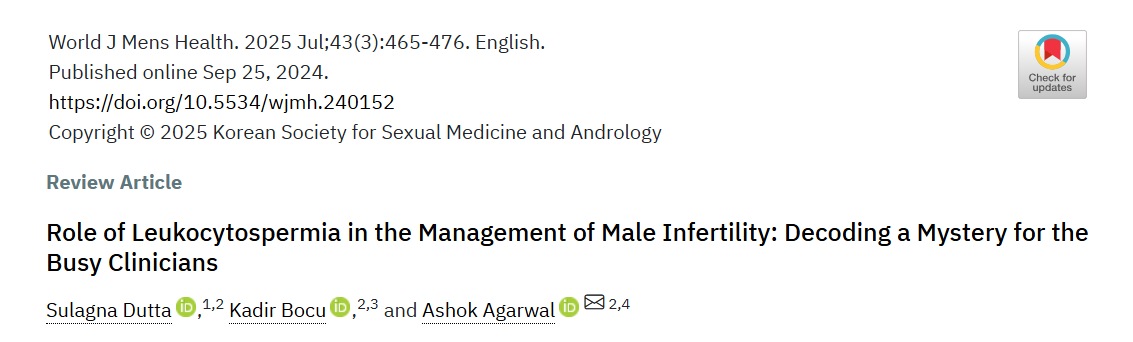
Efesoy O, et al. (2020). Hematospermia is rarely related to genitourinary cancer: lessons learned from 15 years of experience with 342 cases. International Journal of Impotence Research.
Gönültaş S, et al. (2025). Etiology of hematospermia in Turkish men: multicentric study. Balkan Medical Journal.

Henkel R. (2024). Leukocytospermia and/or bacteriospermia: impact on male infertility. Journal of Clinical Medicine.
Liu et al. (2021). Effect and mechanisms of reproductive tract infection on oxidative stress parameters, sperm DNA fragmentation, and semen quality in infertile males. Reproductive Biology and Endocrinology.
Mason MM, et al. (2022). Ejaculation: the process and characteristics from start to finish. Current Sexual Health Reports.

Motrich RD, et al. (2006). Uric acid crystals in the semen of a patient with symptoms of chronic prostatitis. Fertility and Sterility.
Sharma R, et al. (2021). Relevance of leukocytospermia and semen culture and its true place in diagnosing and treating male infertility. The World Journal of Men’s Health.
Yao et al. (2021). Semen microbiota in normal and leukocytospermic males. Asian Journal of Andrology.
World Health Organization. (2021). WHO laboratory manual for the examination and processing of human semen (6th ed.). World Health Organization.
Stay informed with the latest updates in fertility and reproductive medicine on Fertility News.
FAQ
Is yellow semen normal?
A mild yellow tint is normal with age and after long abstinence.
Does yellow semen mean an infection?
Not by itself. Infection of the prostate or testis leads to white blood cells in semen, but a slight tint alone does not show infection.
Does alcohol turn semen yellow?
No primary study shows this.
Does blood in semen mean cancer?
Rarely. Genitourinary cancer caused 3.2% of 342 hematospermia cases.
Does semen color show how many sperm are present?
No. Experts do not agree that color or opacity reflects sperm concentration.
When does semen color need a medical check?
A persistent color change or any blood in semen needs a doctor's review.
-
Nov 19, 2026, 16:54Clare Mansfield: Pleased to Attend the Launch of the Future Fertility Show 2027 at Dobbins
-
Nov 19, 2026, 16:47Arsiak Vartenian: People Ask If It Was Hard to Trust My Surrogate…
-
Nov 19, 2026, 16:16Resa Nabor: Healing Begins When You Refuse to Let PCOS Erase Who You Are
-
Nov 19, 2026, 16:01Daniel Vicente Castellví: First Wet Lab of the Master in Human ART at UPF Barcelona School of Management
-
Nov 19, 2026, 15:51Huzaifa Gulzar: Where Do Errors Occur in Semen Analysis?
-
Nov 19, 2026, 15:38Elizabeth Day: One of The Hardest Things About Fertility Is That It Feels Like a Total Loss of Control
-
Nov 19, 2026, 15:35Lowell Ku: Infertility Can Feel Like a Puzzle, but One Piece at a Time, We Can See the Bigger Picture
-
Nov 19, 2026, 15:17Vasiliki A. Moragianni: Back from COGI Congress 2026 in Athens
-
Nov 19, 2026, 15:13Katie Rollings: An Absolute Pleasure to Join This Group of Incredible Women at SMBC Day