

Nibhash Kumar: Embryo Development Is Not Controlled by 1 Factor
Nibhash Kumar, Junior Embryologist and Quality Manager at Indira IVF Group, shared on LinkedIn:
“We retrieved a good number of mature eggs, but why didn’t we get even a single embryo?
This is probably one of the most difficult questions an embryologist or fertility specialist has to answer.
Imagine a couple undergoing an IVF/ICSI cycle.
The stimulation response is satisfactory.
A good number of oocytes are retrieved.
Most of them are mature (MII).
Fertilisation is achieved.
But then something unexpected happens.
Some embryos stop developing. Some fail to progress beyond the cleavage stage. And sometimes, not a single embryo makes it to the next stage of development.
The next questions are almost inevitable:
- Where did things go wrong?
- Was it the sperm?
- Was it the oocyte?
- Was there a problem with fertilisation?
- And perhaps the most difficult question: Will embryos develop in our next cycle?
Unfortunately, there isn’t always one straightforward answer.
Let’s understand what might be happening biologically.
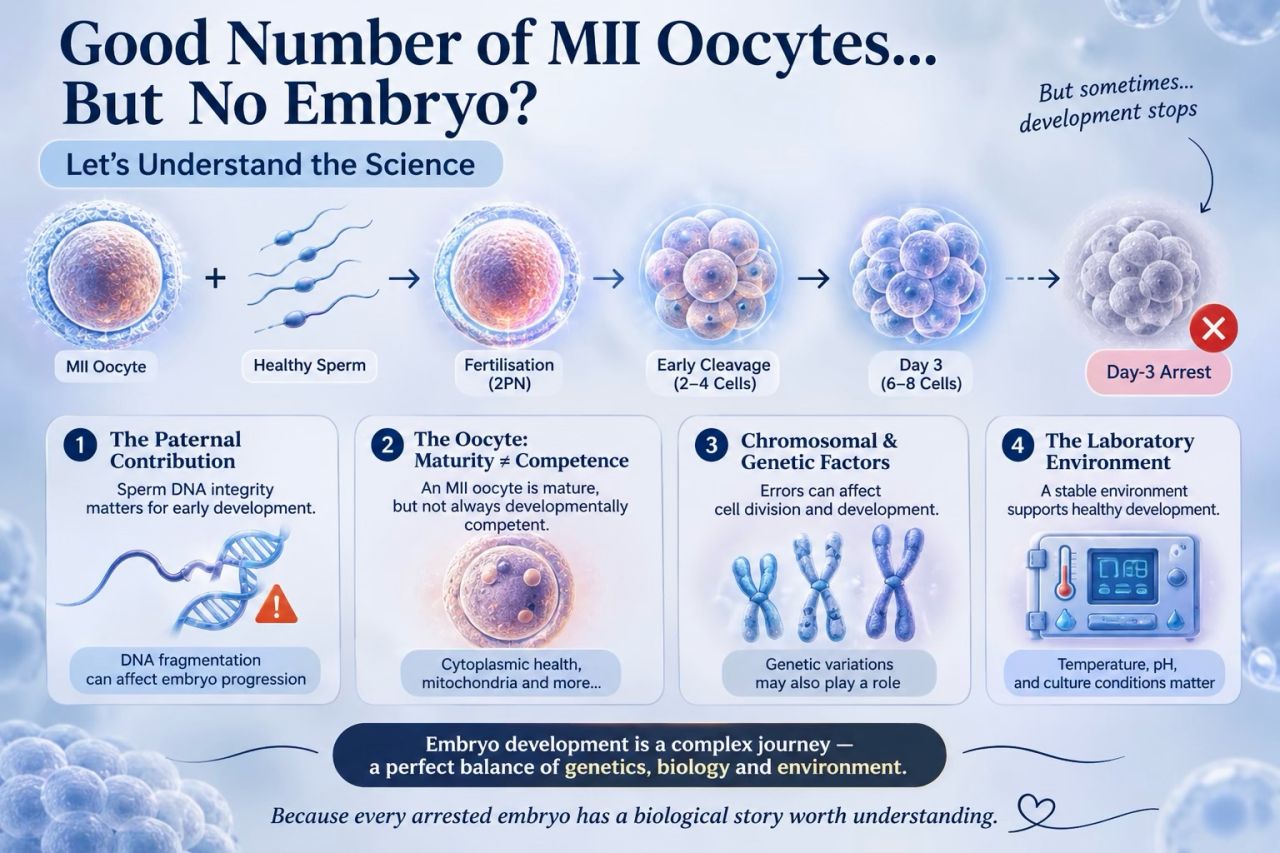
1. The paternal contribution
Around the 4–8-cell stage, human embryos undergo major embryonic genome activation (EGA).
Sperm DNA integrity may also influence subsequent development. DNA fragmentation can compromise embryonic development, although the oocyte has mechanisms to repair certain types of sperm DNA damage.
2. The oocyte: Maturity doesn’t always mean competence
An MII oocyte indicates nuclear maturity, but it doesn’t necessarily guarantee developmental competence.
Cytoplasmic maturity, mitochondrial function, calcium signalling, maternal RNA and protein stores, and chromosome segregation all contribute to successful early development.
3. Chromosomal and genetic factors
Errors during maternal meiosis or early embryonic mitotic divisions can affect chromosome distribution and subsequent cleavage.
Certain genetic variations, particularly those involving maternal-effect genes and embryonic genome activation, can also contribute to recurrent early embryonic arrest.
4. Laboratory environment- gas temperature, pH, osmolarity lab environment and many more
So, what about the next cycle?
Will embryos develop next time?
Honestly, we cannot promise that.
But one unsuccessful cycle should not automatically define the outcome of the next one.
My takeaway
Embryo development is not controlled by one factor.
It is the outcome of a highly coordinated interaction between the oocyte, sperm, embryonic genome and the surrounding environment.
And perhaps the most important thing we should remember as embryologists and clinicians:
When a couple asks, ‘Why didn’t we get even a single embryo?’, they are not simply asking about laboratory results.
They are asking for an explanation, reassurance and hope.
We may not always have a definitive answer, but we should always have a scientific approach to finding one.
Because understanding why an embryo stops developing is just as important as understanding how to help it develop.”
Other articles featuring Nibhash Kumar on Fertility News.
-
Nov 19, 2026, 17:08Ashley Evans: Proud to Win the She Inspires 2026 Women in Wellbeing and Holistic Practice Award
-
Nov 19, 2026, 16:54Clare Mansfield: Pleased to Attend the Launch of the Future Fertility Show 2027 at Dobbins
-
Nov 19, 2026, 16:47Arsiak Vartenian: People Ask If It Was Hard to Trust My Surrogate…
-
Nov 19, 2026, 16:38Mazen Al-Obaidi: Semen Color – Clinical Significance, Causes of Variation, and Male Reproductive Health
-
Nov 19, 2026, 16:16Resa Nabor: Healing Begins When You Refuse to Let PCOS Erase Who You Are
-
Nov 19, 2026, 16:01Daniel Vicente Castellví: First Wet Lab of the Master in Human ART at UPF Barcelona School of Management
-
Nov 19, 2026, 15:51Huzaifa Gulzar: Where Do Errors Occur in Semen Analysis?
-
Nov 19, 2026, 15:38Elizabeth Day: One of The Hardest Things About Fertility Is That It Feels Like a Total Loss of Control
-
Nov 19, 2026, 15:35Lowell Ku: Infertility Can Feel Like a Puzzle, but One Piece at a Time, We Can See the Bigger Picture