

Lawrence Gobetz: Counting Antral Follicles Adds About a Minute to a Scan You’re Already Doing
Lawrence Gobetz, Founder and Medical Director of Vitalab Fertility Clinic, shared a post on LinkedIn about a paper by K. Birch Petersen et al. published in Human Reproduction:
“Most of the new female patients I see for infertility are 38 or older.
I’ve been in reproductive medicine for 37 years, and that number bothers me more every year. These women didn’t neglect their fertility. They just never got the information while they still had time to act on it.
The pattern is almost always the same. A woman in her twenties or early thirties goes for her annual check-up and Pap smear. Often, she has a pelvic ultrasound as well.
Her ovaries are right there on the screen, but nobody counts the antral follicles, and nobody mentions an AMH. She walks out reassured, knowing nothing more about her ovarian reserve than when she walked in.
To my gynaecology colleagues:
Counting antral follicles adds about a minute to a scan you’re already doing. Add an AMH and you have a reasonable sense of where she sits on her reproductive timeline. It can also pick up early premature ovarian insufficiency, which affects around 3.5% of women, and it’s useful when you’re assessing for PCOS.
I’m not suggesting this tells her whether she’ll fall pregnant this month. It doesn’t, and ACOG and ASRM are right to make that point. What it does is identify the women whose window may be shorter than they think.
Those are the women who need to be thinking about timing, or about egg freezing, now, not at 38.
One practical point: the pill and other hormonal contraception lower AFC and AMH by roughly 20-30%. If the result comes back low, repeat it two to three months after she stops.
To the women reading this:
At your next gynae visit, ask: ‘What’s my antral follicle count, and should I have an AMH?’ A good result isn’t permission to wait forever. A worrying one gives you time to choose.
A Copenhagen study found that women aged 35 to 43 consistently overestimated their own fertility. I see exactly that in my rooms every day.
The best time to have this conversation is long before anyone needs a fertility specialist.”
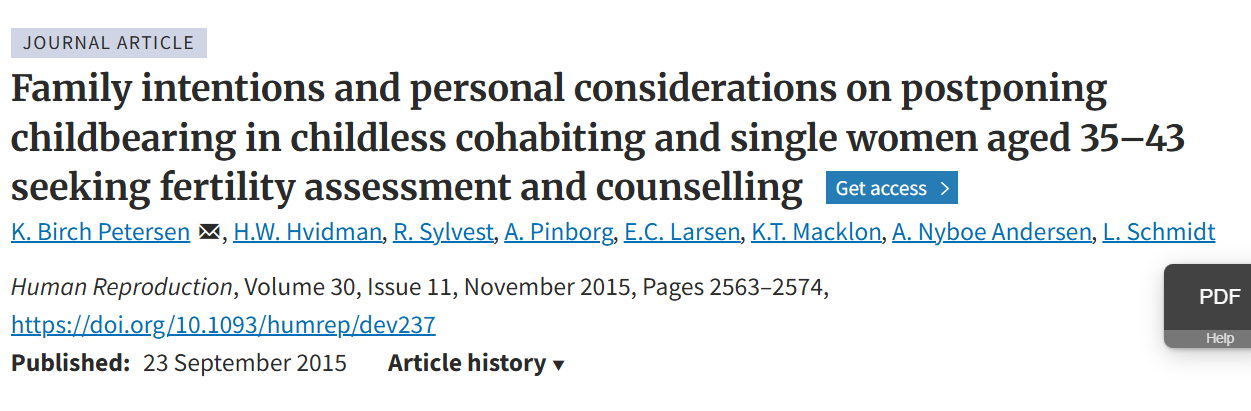
Title: Family intentions and personal considerations on postponing childbearing in childless cohabiting and single women aged 35–43 seeking fertility assessment and counselling
Authors: K. Birch Petersen, H.W. Hvidman, R. Sylvest, A. Pinborg, E.C. Larsen, K.T. Macklon, A. Nyboe Andersen, L. Schmidt
You can read the Full Article in Human Reproduction.
Stay informed with the latest updates in fertility and reproductive medicine on Fertility News.
-
Nov 24, 2026, 17:42Peris Njoga-Kagotho: Who Bears the Responsibility When Assisted Reproduction Goes Wrong?
-
Nov 24, 2026, 17:35Sanketh Dhumal Satya: From Embryology to the Cosmos, the Journey Continues
-
Nov 24, 2026, 17:31Grishma Desai: The Great Embryo Debate – Day 3 or Day 5?
-
Nov 24, 2026, 17:14Elias M. Dahdouh: Declining Fertility Rates and the Role of ART
-
Nov 24, 2026, 16:48Asima Ahmad: Discussing Fertility Preservation for Cancer Patients with Kate Chappell
-
Nov 24, 2026, 16:35Pregnancy Loss: An Interview with Henriette Svarre Nielsen – ESHRE
-
Nov 24, 2026, 16:30The Results of the Study on Endometrial Microbiota from Laura Medina-Ruiz and Colleagues – RBMO
-
Nov 24, 2026, 16:24Ashley Evans: Not Everyone Experiencing Infertility Talks About It
-
Nov 24, 2026, 16:20Lucy Froese: So Many Women Are Exhausted From Trying to Get Everything Right