
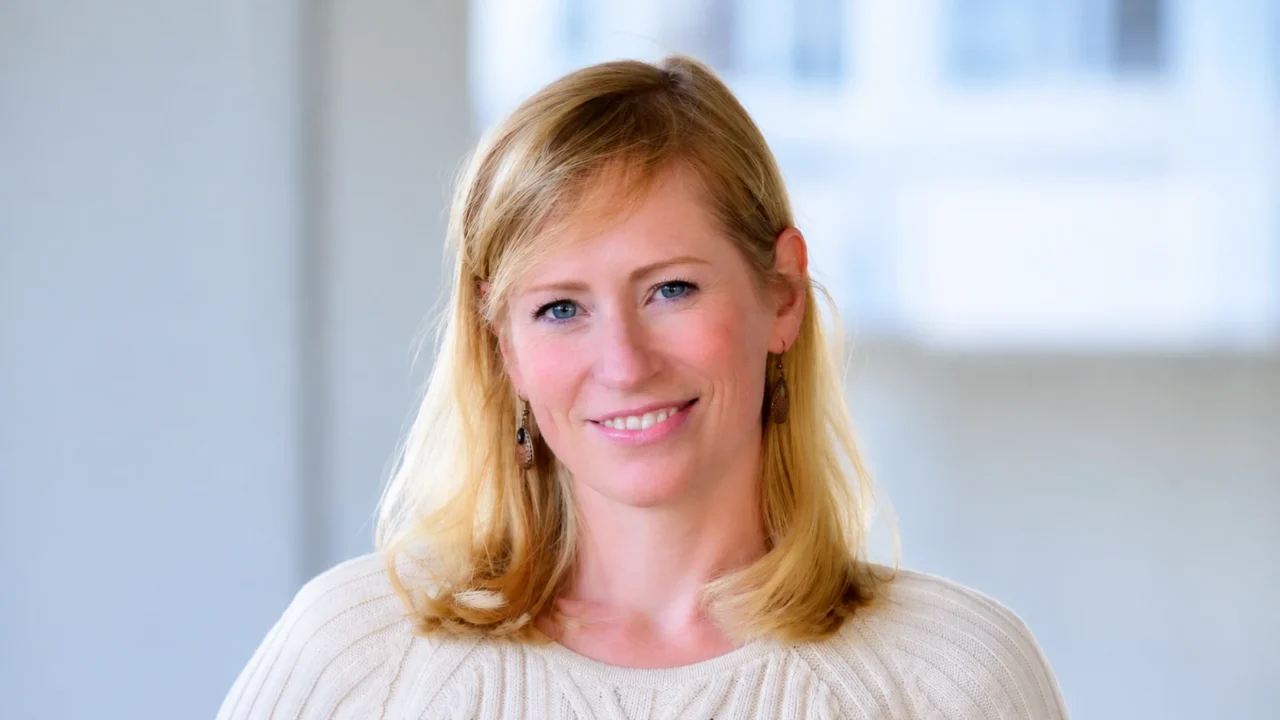
Melina Schuh: Can We Restore the Molecular Glue That Holds Chromosomes Together in Ageing Eggs?
Melina Schuh, Co-Founder and Chairwoman at Ovo Labs and Director of Max Planck Institute for Multidisciplinary Sciences, shared a post on LinkedIn about a paper she co-authored with collegues, published in Science:
“Can we restore the molecular glue that holds chromosomes together in ageing eggs?
I am very excited to share our new paper in Science Magazine, in which we introduce TALhesin, an engineered chromosome cohesion system.
As women age, their eggs gradually lose cohesin, the molecular glue that holds sister chromatids together.
This is a major cause of chromosome abnormalities in eggs and a key reason why female fertility declines from the mid-30s onwards.
We asked ourselves: Could we engineer an artificial glue to restore this lost cohesion?
With TALhesin, we were able to do just that in mouse eggs.
In eggs from 17-month-old mice, TALhesin increased the proportion of eggs without premature sister chromatid separation from 47% to 74% – remarkably close to the 75% observed in young mice.
We also engineered TALhesin to be released by the egg’s own molecular machinery at the right time during cell division.
Importantly, we adapted the system to human chromosomes and obtained initial proof-of-principle data in donated human eggs.
With TALhesin, we have shown that an engineered system can functionally replace lost chromosome cohesion in mouse eggs.
While further development and safety studies are needed, our long-term goal is to improve the quality of aged human eggs and make fertility treatments more successful.
Huge congratulations to our four joint first authors Alexandre Webster, Halima Yusuf, Nina Schweizer and Chloe Charalambous, and to all our co-authors!
We are particularly grateful to the women who donated eggs for this research and to the wonderful clinical teams at the Kinderwunschzentrum Göttingen (Fertility Center Göttingen), Bourn Hall Fertility Clinic UK and Fertility Center Berlin. None of this would have been possible without you.
The technology has been licensed to Ovo Labs for further development.
As a co-founder, I am excited to take the next steps towards exploring its potential for future fertility treatments.”
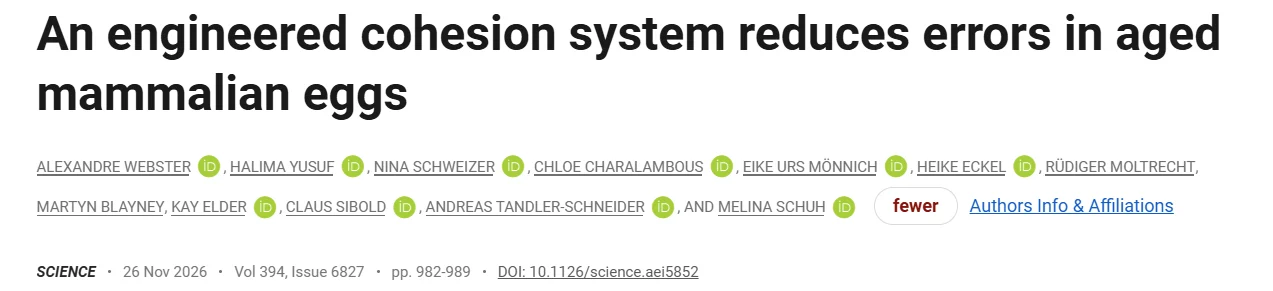
Title: An engineered cohesion system reduces errors in aged mammalian eggs.
Authors: Alexandre Webster, Halima Yusuf, Nina Schweizer, Chloe Charalambous, Eike Urs Mönnich, Heike Eckel, Rüdiger Moltrecht, Martyn Blayney, Kay Elder, Claus Sibold, Andreas Tandler-Schneider, Melina Schuh.
You can read the Full Article in the Science.
Other articles featuring Melina Schuh on Fertility News.
-
Nov 27, 2026, 17:28Science Is Better Together and So Is Growth – ESHRE
-
Nov 27, 2026, 17:19Hugo Manoukian: The Paradox of IVF Reimbursement and Fertility Access in France
-
Nov 27, 2026, 17:09New RBMO Study Links Oocyte Donation to Increased Risk of Postpartum Haemorrhage
-
Nov 27, 2026, 16:57Nada Habeichi Shares New Research on Endometrial Immune Profiling and Reproductive Outcomes
-
Nov 27, 2026, 16:18In Vitro Maturation: Molecular Regulation, Oocyte Competence and Clinical Outcomes
-
Nov 26, 2026, 17:49Vrinda Trivedi: Honored to Contribute to the Issue of Obstetrics and Gynecology Clinics of North America
-
Nov 26, 2026, 17:46Simon Meagher: A Vanishing Twin, a High-Risk NIPT Result and a Reassuring Co-Twin
-
Nov 26, 2026, 17:42Jiří Hrdý: The Immunological Effects of Progesterone Therapy in Pregnant Women at Risk of Spontaneous Preterm Birth
-
Nov 26, 2026, 17:35Maternal Age as the Primary Driver of Embryo Aneuploidy – RBMO