
AI’s Role in Advancing Women’s Mental Health Explored – Archives of Women’s Mental Health
Archives of Women’s Mental Health Social Media Editorial Team shared a post on LinkedIn about a paper by Rawan AlSaad et al. publishedin in Archives of Women’s Mental Health:
“New Open-Access Review | Archives of Women’s Mental Health
Can advanced AI help us understand and support women’s mental health across reproductive transitions? This new review explores how multimodal large language models (MLLMs) may reshape reproductive psychiatry.
In this forward-looking review, AlSaad and colleagues examine the potential role of multimodal large language models, a new generation of AI systems capable of integrating text, images, physiological signals, audio, and longitudinal data, in advancing women’s reproductive mental health research and clinical care.
What this review addresses
Women’s mental health risk fluctuates across hormonally mediated reproductive stages, yet clinical tools often fail to integrate the biological, psychological, and social dimensions involved. This article maps how MLLMs could help bridge these gaps by synthesizing complex, multimodal data across the reproductive lifespan.
Seven key application domains explored
- Menstruation and premenstrual mood syndromes
- Pregnancy and perinatal mental health
- Abortion, miscarriage, and recurrent pregnancy loss
- The postpartum period
- Perimenopause and menopause
- Psychiatric comorbidities in infertility
- Gynecologic conditions such as endometriosis and polycystic ovary syndrome
What MLLMs could enable
- Multimodal risk stratification across reproductive stages
- Longitudinal modelling of symptom trajectories
- Context-aware clinical decision support
- Personalized patient education and self-management tools
- Integration of EHRs, hormonal data, wearables, imaging, genetics, and patient-reported outcomes
Critical challenges highlighted
The authors emphasize that responsible deployment requires:
- Addressing bias in training datasets
- Safeguarding privacy and informed consent for sensitive reproductive data
- Ensuring high-quality longitudinal data across life stages
- Developing well-governed, standardized multimodal repositories focused on women’s health
Why this matters
This review positions reproductive psychiatry as a domain uniquely suited for multimodal AI approaches and provides a structured framework to guide clinicians, researchers, and technologists toward ethical, equitable, and clinically meaningful integration of AI in women’s mental health care.
Read the full open-access article.”
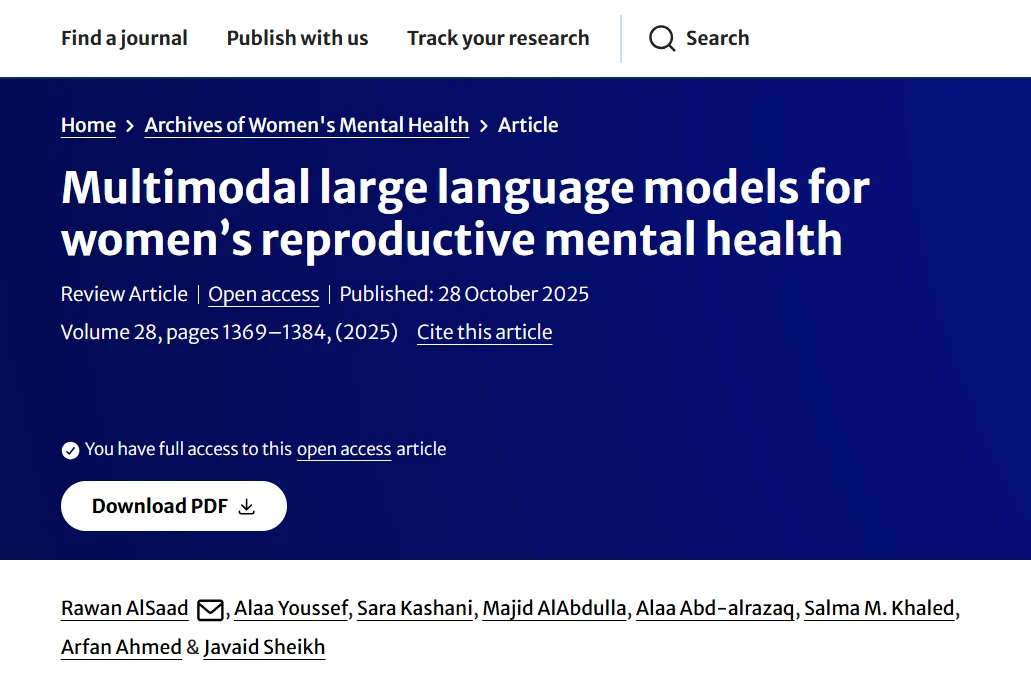
Title: Multimodal large language models for women’s reproductive mental health
Authors: Rawan AlSaad, Alaa Youssef, Sara Kashani, Majid AlAbdulla, Alaa Abd-alrazaq, Salma M. Khaled, Arfan Ahmed, Javaid Sheikh
Stay updated on all scientific advances in the field of fertility with Fertility News.
-
Sep 28, 2026, 17:35Saeed Fathi: Turning AI Innovation into Meaningful Clinical Impact in Fertility Care
-
Sep 28, 2026, 17:31Caspian Ostadian: Fresh vs Frozen Embryo Transfer – Which One Is Better?
-
Sep 28, 2026, 17:28Keshav Malhotra: Bringing the 2nd Edition of RESET to Da Nang, Vietnam
-
Sep 28, 2026, 17:25Christina Walker: Novel Biomarkers for PCOS and DOR
-
Sep 28, 2026, 17:18An Opportunity to Raise Awareness of the Importance of Safe, Accessible Abortion Care – RCOG
-
Sep 28, 2026, 17:13Stephany El-Hayek: From Embryology Intern to Mama and Founder of A Good Start
-
Sep 28, 2026, 17:09Apratim Arora: The Confidence Graph of a Clinical Embryologist
-
Sep 28, 2026, 17:06Vikrant Bhatia: Healthcare Has the Data, But Are We Truly Learning From It?
-
Sep 28, 2026, 17:02Abdelrahman H. Daifalla: DISS IVF – Clinical Intelligence for Reproductive Medicine