

Yannick Hurni: Comparative Insights on IVF Stimulation Phases
Yannick Hurni, Clinical and Research Fellow in Gynecologic Surgery at Dexeus University Hospital, shared a post on LinkedIn:
“This retrospective cohort study compared luteal-phase versus follicular-phase ovarian stimulation in IVF cycles. Using propensity score matching, mixed-effects negative binomial regression, and a within-woman sensitivity analysis, the authors report comparable mature oocyte yield, blastocyst development, and euploid embryo numbers, with slightly higher gonadotropin consumption in luteal-phase cycles.
Overall, I genuinely enjoyed reading this paper and learned a lot of interesting clinical and scientific information. It is methodologically mature, statistically thoughtful, and clinically relevant.
Two elements, in particular, strengthen the work.
1) Doubly robust approach with mixed-effects modeling
The authors combined propensity score matching with multivariable regression adjustment, a so-called doubly robust strategy. In practical terms, if either the treatment assignment model or the outcome model is correctly specified, the treatment effect estimate can remain unbiased. This adds an additional layer of protection in observational research.
They also used mixed-effects models, appropriately accounting for clustering (multiple cycles per patient and potential physician-level variability). In IVF datasets, ignoring this structure can artificially narrow confidence intervals. Here, the modeling choice is statistically sound and well aligned with the data structure.
2) Within-woman sensitivity analysis
For me, this is the strongest aspect of the paper. Comparing cycles performed in the same woman under different conditions inherently controls for stable biological characteristics — genetics, intrinsic ovarian reserve dynamics, and many unmeasured confounders. This design substantially strengthens causal credibility and goes beyond what standard regression adjustment can achieve.
A couple of methodological nuances are worth reflecting on:
1) Including both AMH and AFC in the propensity score and regression models.
These markers are highly correlated measures of ovarian reserve. Including both may introduce collinearity, potentially reducing model stability and precision. While this likely does not bias the main findings, selecting a single well-measured reserve marker is often sufficient and can simplify the modeling framework.
2) Adjustment for type of medication in the propensity score.
If medication choice is determined after the decision regarding stimulation phase, it may function as a post-treatment variable. Conceptually, such variables should not enter the propensity model because they may lie on the causal pathway or alter the estimand. The practical impact here is probably limited, but it is an important causal distinction to consider.
Overall, this is a rigorous and carefully executed study. The analytical framework is strong, the sensitivity analyses are convincing, and the conclusions are proportionate to the data.
Kudos to the authors for producing consistently high-quality methodological works.”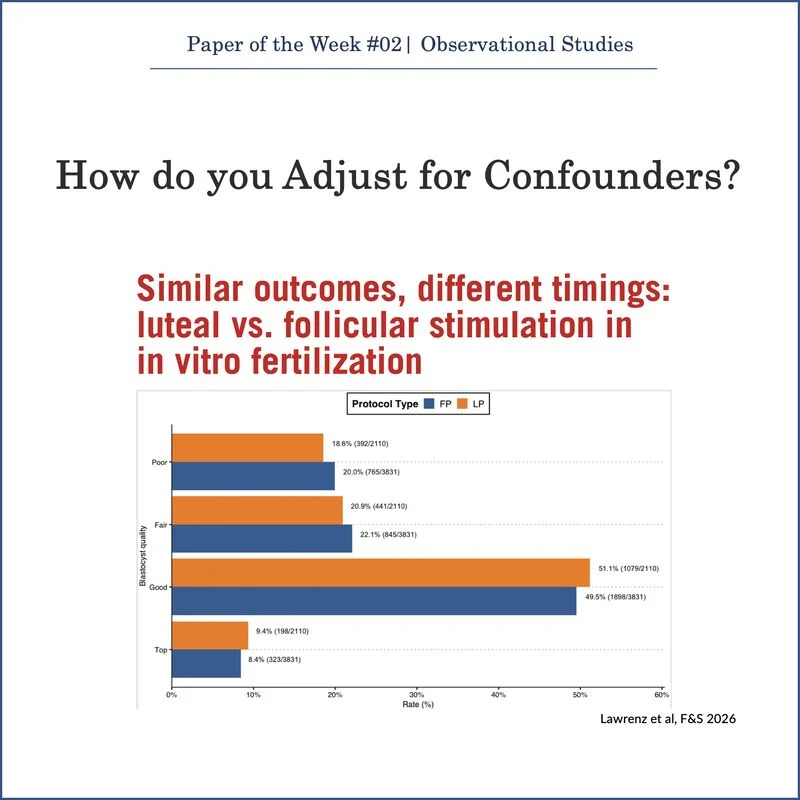
Stay updated on all scientific advances in the field of fertility with Fertility News.
-
Oct 8, 2026, 17:18Khalil Faaed: Vitrification Prevents Ice, but Does It Prevent Oocyte Damage?
-
Oct 8, 2026, 17:16Ritu Anand: Better Conversations Ultimately Lead to Better Care in Fertility
-
Oct 8, 2026, 17:14Mark Trolice: Excited to Speak at Women’s HealthX
-
Oct 8, 2026, 17:12Delighted to Welcome Dr. Róisín Mortimer – Waterstone Clinic-IVF and Fertility
-
Oct 8, 2026, 17:09Deirdre Zander-Fox: Pleased to Be an Invited Speaker at ESHRE Precision ART
-
Oct 8, 2026, 17:06Roohi Jeelani: Is Modern Life Actually Making It Harder to Get Pregnant?
-
Oct 8, 2026, 17:04Robert Borowczyk: We Judge the Newest IVF Consultation Group Too Quickly…
-
Oct 8, 2026, 17:01Carlos Guerrero: Great Couple of Days Visiting the Team at New Leaders in Fertility and Endocrinology
-
Oct 8, 2026, 17:00Sarah Banks: Improving Patient Experience Isn’t Always About Making Huge Changes…