

Esther Eleboh: IUI or IVF?
Esther Eleboh, Reproductive Health Nurse (Head of Nursing Department) at Viva Fertility Clinic, shared on LinkedIn:
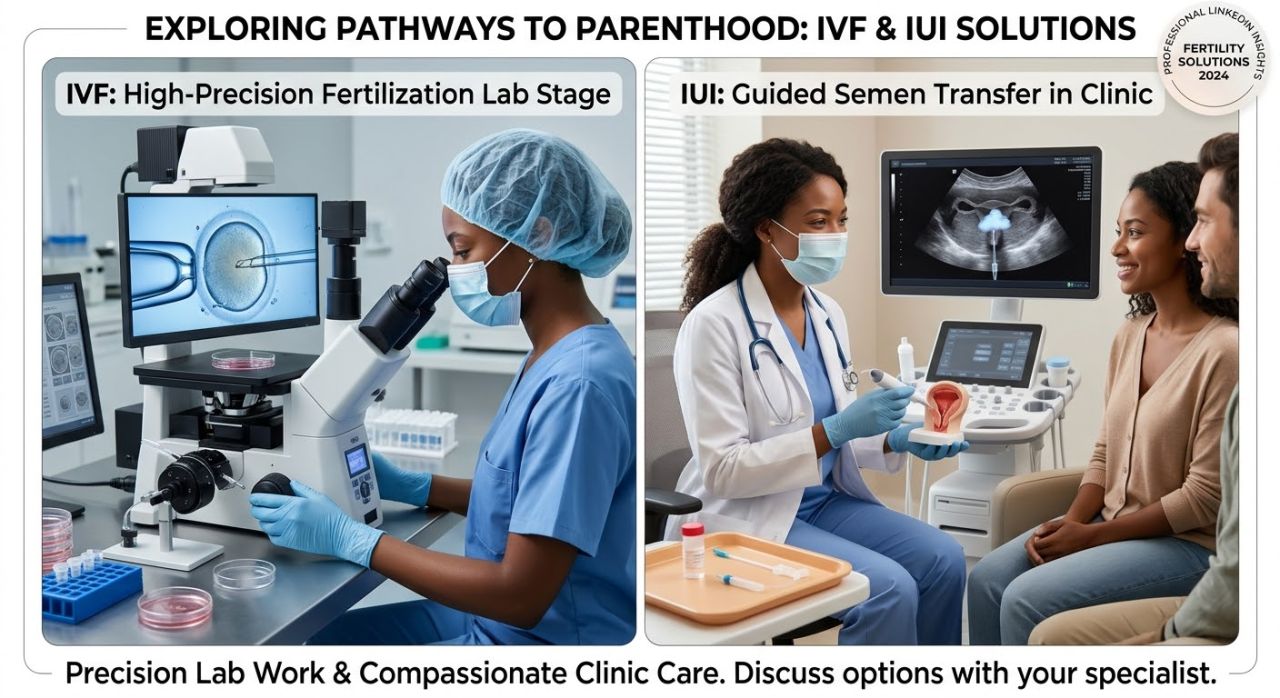
“IUI or IVF? Understanding which treatment is appropriate for different fertility patients.
One important aspect of fertility treatment is understanding that not every couple should be directed towards the same treatment option.
Let’s look at a few clinical scenarios.
1. When IUI may be appropriate. Consider a woman with:
- Patent fallopian tubes.
- Regular ovulation.
- A healthy uterine cavity and suitable endometrial development.
No significant female reproductive factor that would make IUI unsuitable.
If her partner also has an adequate total motile sperm count and acceptable semen parameters, IUI may be a reasonable first-line treatment option, depending on the couple’s overall fertility assessment.
2. What happens when sperm morphology is abnormal?
Imagine a male partner with normal sperm concentration and motility but significantly abnormal sperm morphology. This is where treatment selection requires careful consideration.
IUI does not correct abnormal sperm morphology. Although sperm preparation selects a motile sperm population, it does not guarantee that sperm with normal morphology will be selected.
If there is severe teratozoospermia, particularly alongside other fertility challenges, IVF with ICSI may be a more appropriate option.
However, isolated abnormal morphology does not automatically mean that IUI should be ruled out. The severity of the abnormality, total motile sperm count and other clinical factors matter.
3. What about low sperm motility? Now consider a different scenario: A male partner has:
- Normal sperm concentration.
- Acceptable sperm morphology.
- Reduced sperm motility.
IUI may still be considered if sperm preparation produces an adequate number of progressively motile sperm. The key is whether sufficient functional sperm can be recovered for insemination.
Think of it this way:
If fertility treatment were a football match, we would want to understand the quality and fitness of the players before deciding which team strategy to use.
We cannot simply send every couple onto the same treatment pathway and expect the same outcome.
IUI and IVF are not interchangeable treatment options. Treatment decisions should be individualised based on female reproductive factors, semen parameters, duration of infertility, age and previous treatment history.”
Other articles featuring Esther Eleboh on Fertility News.
-
Nov 23, 2026, 19:00Dawn Chan: Why We Built Sow Fertility as An Asia-Native Platform
-
Nov 23, 2026, 18:58Karthik Raj: Pregnancy Presents a Remarkable Immunological Challenge…
-
Nov 23, 2026, 18:56Justin Houman: Honored to Receive Yelp’s 2026 People Love Us on Yelp Recognition
-
Nov 23, 2026, 18:53Julia Woodward: Deeply Honored to Have Been Named to the ASRM Gestational Carrier Task Force
-
Nov 23, 2026, 18:49Filipa Rafael: Predicting Euploid Blastocysts Is Not the Same as Predicting Live Birth
-
Nov 23, 2026, 18:35Clare Mansfield: Grateful for Fertility News, Its Encouragement, and the Conversations It Has Opened Up
-
Nov 23, 2026, 18:20Luca Arecco: Truly a Pleasure Sharing These Days at ISFP 2026
-
Nov 23, 2026, 18:10The IVF Guide Is Hiring a General Manager of Fertility Consulting
-
Nov 23, 2026, 18:05Shazia Iqbal: From Pixels to Precision – Transforming the Future of Women’s Healthcare with AI