
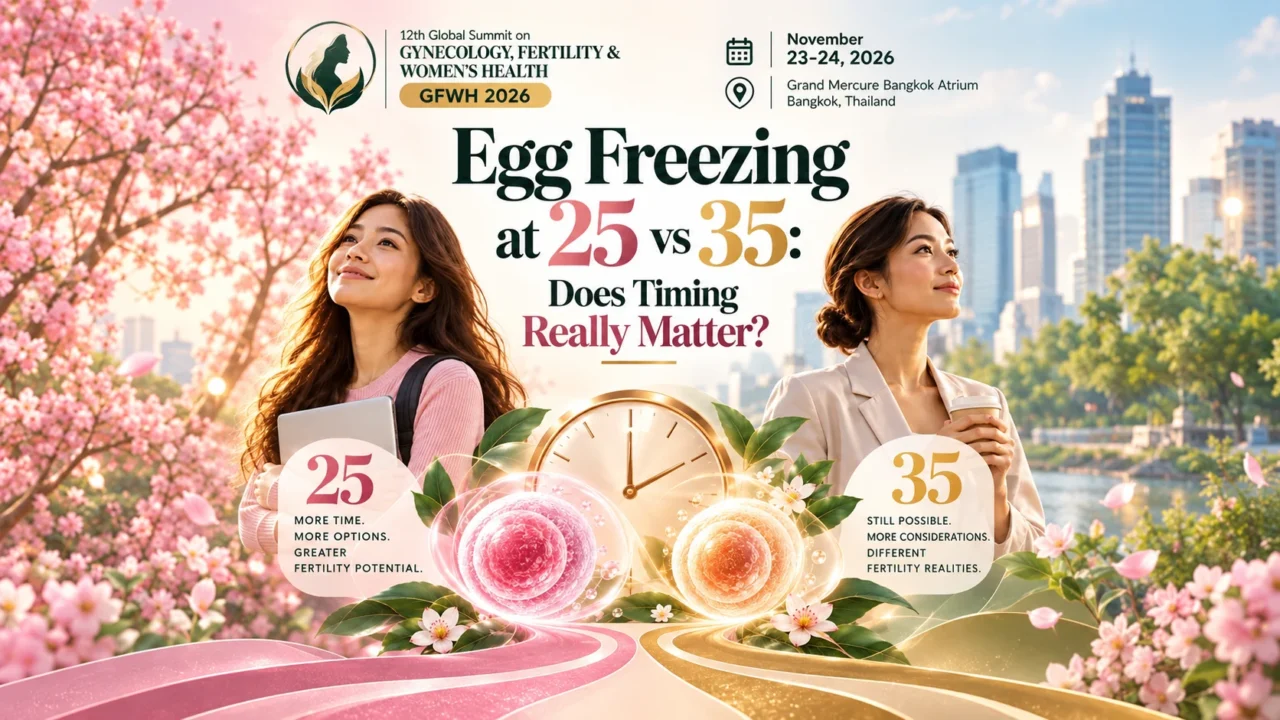
Devyanshi Dixit: Egg Freezing at 25 vs. 35 – Does Timing Really Matter?
Devyanshi Dixit, Program Manager at CLS Event and Publication and Conference Manager at the 12th Global Summit on Gynecology, Fertility and Women’s Health, shared on LinkedIn:
“Egg Freezing at 25 vs 35: Does Timing Really Matter?
Yes – but not in the way you might think.
Egg freezing is often discussed as a race against the biological clock. But the real story is more nuanced.
Age Can Affect Both Egg Quality and Quantity.
As ovarian aging progresses, the number of available eggs generally declines, while the proportion of eggs with chromosomal abnormalities tends to increase. That means an egg frozen at 25 and an egg frozen at 35 are not biologically identical starting points.
AT 25
- Oocytes are generally younger
- Chromosomal abnormality rates are generally lower
- More eggs may be available for retrieval in some women
But freezing eggs at 25 does not guarantee a future pregnancy.
AT 35
Egg freezing can still be an option.
But ovarian reserve and egg quality vary considerably between individuals, and age-related changes may mean fewer eggs are retrieved, or fewer ultimately develop into usable embryos.
Here’s What Many People Miss:
The number of eggs matters – but so does egg quality.
Not every frozen egg survives thawing. Not every surviving egg fertilizes. Not every fertilized egg becomes a viable embryo. And not every embryo results in a pregnancy.
So there is no magic number of frozen eggs that guarantees a baby.
What Should the Decision Consider?
Rather than asking only:
‘Am I 25 or 35?’
A fertility specialist may also consider:
- Ovarian reserve
- Reproductive history
- Medical conditions
- Previous treatments
- Individual fertility goals
- How long pregnancy may be postponed
The Bigger Message
Egg freezing is fertility preservation – not fertility insurance.
Earlier freezing may preserve younger eggs, but deciding whether and when to freeze them is a personal medical decision.
And ovarian-reserve tests such as AMH cannot tell you exactly how long you will remain fertile or guarantee future egg quality.
So does timing matter?
Biologically, yes.
Individually, the answer is more complicated.
The best time to discuss fertility preservation is not necessarily a specific birthday – it’s when your reproductive plans, age, ovarian biology, and medical circumstances make the conversation relevant.
Explore the future of fertility and reproductive medicine at GFWH 2026.
- November 23–24, 2026
- Bangkok, Thailand.”
Other articles featuring Devyanshi Dixit on Fertility News.
-
Sep 28, 2026, 17:35Saeed Fathi: Turning AI Innovation into Meaningful Clinical Impact in Fertility Care
-
Sep 28, 2026, 17:31Caspian Ostadian: Fresh vs Frozen Embryo Transfer – Which One Is Better?
-
Sep 28, 2026, 17:28Keshav Malhotra: Bringing the 2nd Edition of RESET to Da Nang, Vietnam
-
Sep 28, 2026, 17:25Christina Walker: Novel Biomarkers for PCOS and DOR
-
Sep 28, 2026, 17:18An Opportunity to Raise Awareness of the Importance of Safe, Accessible Abortion Care – RCOG
-
Sep 28, 2026, 17:13Stephany El-Hayek: From Embryology Intern to Mama and Founder of A Good Start
-
Sep 28, 2026, 17:09Apratim Arora: The Confidence Graph of a Clinical Embryologist
-
Sep 28, 2026, 17:06Vikrant Bhatia: Healthcare Has the Data, But Are We Truly Learning From It?
-
Sep 28, 2026, 17:02Abdelrahman H. Daifalla: DISS IVF – Clinical Intelligence for Reproductive Medicine