

Kothwal Jabeen: Do Antidepressants Affect Fertility?
Kothwal Jabeen, Research and Documentation Intern at Clinivance TechLabs, shared on LinkedIn:
“Do antidepressants affect fertility?
Claims such as ‘antidepressants cause infertility’ or ‘people taking antidepressants cannot have children’ can create unnecessary fear.
But what does the evidence actually say?
In this article, I explore the possible effects of antidepressants on male and female fertility, including sexual side effects, sperm parameters, hormonal changes, and the difference between temporary reproductive effects and permanent infertility.
Mental health treatment and reproductive health are both important. Understanding the evidence can help us make informed decisions instead of relying on Myths.
Know the evidence. Don’t let Myths create unnecessary fear.
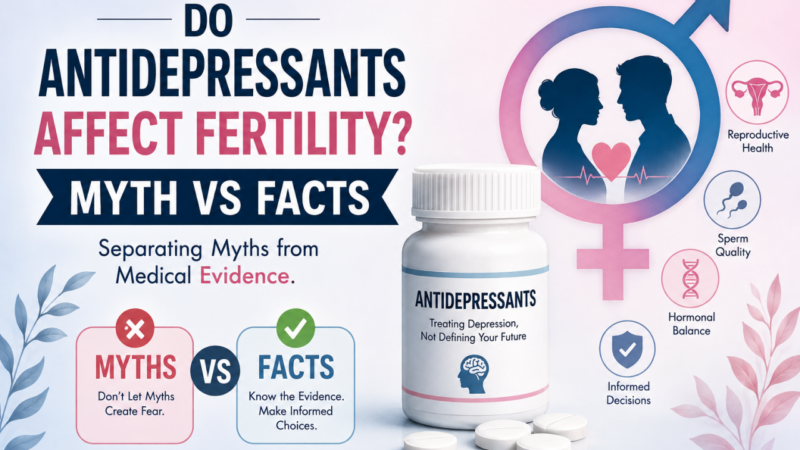
Do Antidepressants Affect Fertility? Myths vs Facts
‘Men taking antidepressants will have poor sperm quality’.
‘Women who consume depression tablets cannot have children later’.
‘Antidepressants cause infertility’.
These were the common claims we hear in our daily life, but the truth is more nuanced.
Antidepressants will not automatically cause permanent infertility in women or men. However, some of the antidepressants will affect sexual function, and they may influence certain reproductive Factors in some people.
What are antidepressants?
Antidepressants are the medicines that used to treat the medicines that used to treat the depression and the several other conditions, including the anxiety and the panic disorders.
Some of the common antidepressants will include esctitalopram, sertaline, fluoxetine, paroxetine, and citalopram.
The drugs effects that can differ depending on the medicine, dose, duration, and the individual.
Can antidepressants affect fertility in women?
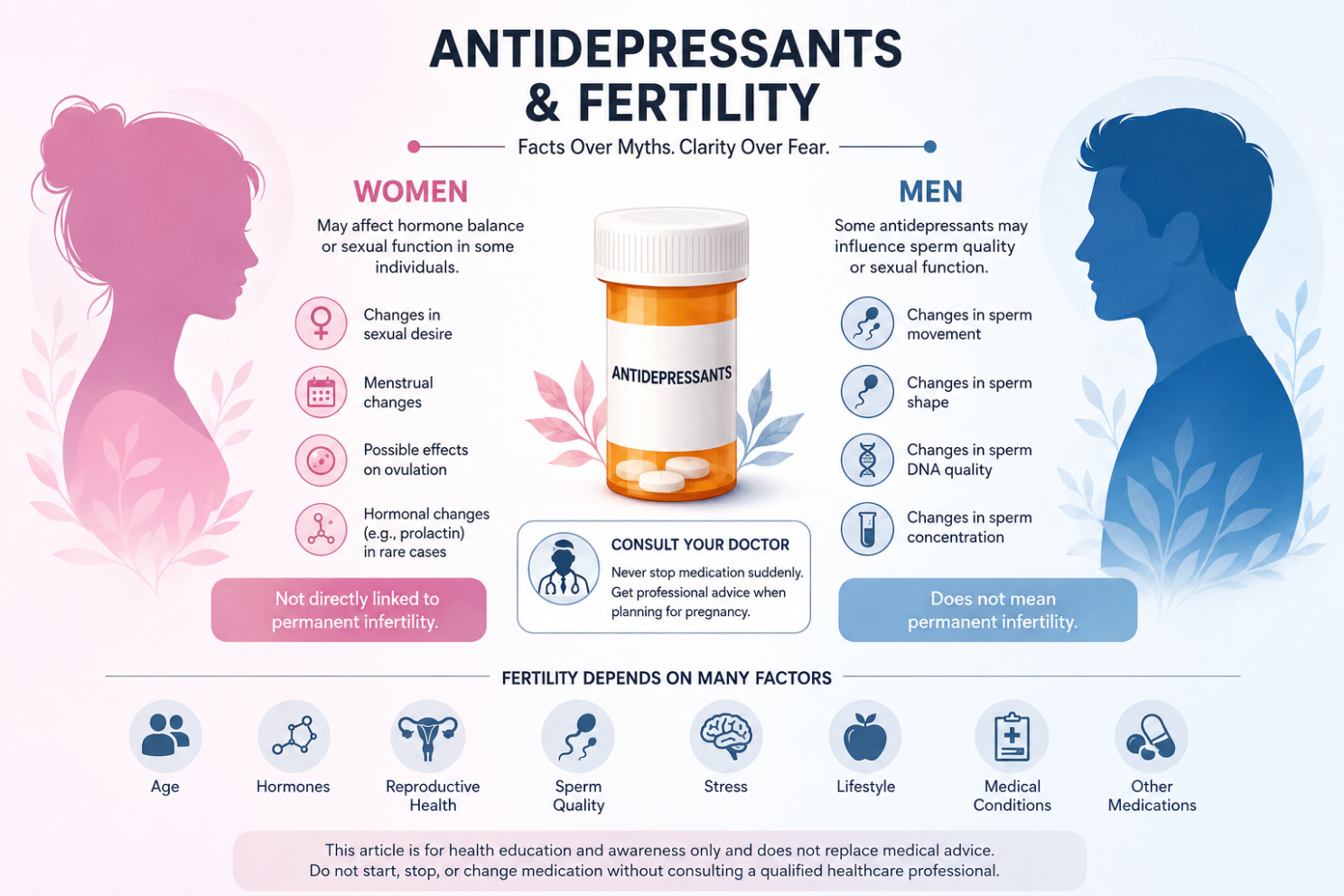
Some of the antidepressants may affect the sexual function or else the reproductive hormone regulation in certain women.
Possible effects may include:
- Changes in sexual desire.
- Menstrual changes in some of the individuals.
- Possible effects on ovulation.
- Changes happen in certain hormones, such as prolactin, in some rare cases.
However, the above effects do not directly mean that the woman has permanently lost her fertility.
Myth – Taking antidepressants at a young age means you don’t have children later.
Fact – There is no evidence that simply taking antidepressants at a young age will automatically cause permanent infertility.
Can Antidepressants Affect Fertility in Men?
Some of the antidepressants particularly the SSRIS, have been studied for the possible effects on the sperm in men.
Research has reported some possible changes in:
- Sperm movement.
- Sperm shape.
- Sperm DNA Quality.
- Sperm concentration.
However, the evidence is still in the developing stage, and this does not finally prove that antidepressants will cause permanent male infertility.
Antidepressants will also cause sexual side effects such as:
- Erectile Difficulties.
- Delayed ejaculation.
- Reduced sexual desire.
- Difficulty in reaching orgasm.
The above effects will some times makes the conception more difficult, not directly but indirectly.
Myths vs Facts
- Myth – Antidepressants will permanently damage the fertility.
Fact – Some may affect sexual function or certain reproductive Factors, but the permanent infertility will not be established.
- Myth – Women taking antidepressants cannot become the pregnant.
Fact – Antidepressants do not automatically prevent the pregnancy.
- Myth – Men taking the antidepressants cannot father children.
Fact – Some of the antidepressants will affect the sexual function or the semen parameters in some of the men, but this will does not mean the permanent infertility.
- Myth – Antidepressants should be stopped when planning for the pregnancy.
Fact – Never stop the medication suddenly without the medical Advice. A doctor will assess the safe option.
Some of the points to remember:
- The relationship between antidepressants and fertility is not simply ‘Medicine = Infertility’.
- Fertility will also be influenced by age, hormones, reproductive health, sperm quality, stress, lifestyle, underlying medical conditions and other medicines.
- If you are taking antidepressant drugs and are concerned about fertility or planning a pregnancy, consult your doctor about the specific medicine and the dose rather than stopping by yourself.
Conclusion:
Antidepressants do not automatically mean infertility.
They may cause sexual side effects, and in a few people it may influence reproductive Factors. But this is a different way of saying that they permanently prevent a women or a man from having children.
Know the evidence.
Don’t let myths create unnecessary fear.
Note: This article is for health education and awareness and does not replace individual medical advice. Do not start, stop, or change the medication without consulting a qualified healthcare professional.”
Stay informed with the latest updates in fertility and reproductive medicine on Fertility News.
-
Sep 21, 2026, 16:53Georges Raad: Could Oocyte Yield Be Associated with DNA Fragmentation in Cumulus Cells?
-
Sep 21, 2026, 16:50Wael Saab: A Wonderful and Enriching Experience at the BFS Study Week 2026
-
Sep 21, 2026, 16:46Farah Yasin: Proud to Be Part of the 2nd Trust Fertility Clinic Conference
-
Sep 21, 2026, 16:43Khalil Faaed: Embryo Arrest – The Stage Matters, the Biology Tells the Story
-
Sep 21, 2026, 16:35Filipa Rafael: What Is More Convenient for a Clinic Is Not Necessarily Better for a Patient
-
Sep 21, 2026, 16:27Konstantinos Stavridis: An Observational Study on Fetal Exposure to Paracetamol
-
Sep 21, 2026, 16:23Shining a Spotlight on the Challenges Women Face During the Menopause Transition – IMS
-
Sep 21, 2026, 16:20What Can Genetics Tell Us About Pregnancy Loss? – ESHRE SIG Reproductive Genetics
-
Sep 21, 2026, 16:11Advancing India’s Fertility MedTech Landscape Through Innovation and Accessibility – Startup Story