
Hajar Vahabzadeh: Before Embryo Arrest – 5 Morphokinetic Signals Worth Paying Attention To
Hajar Vahabzadeh, Clinical Embryologist at Mehr Medical Center for Assisted Reproduction Techniques, shared on LinkedIn:
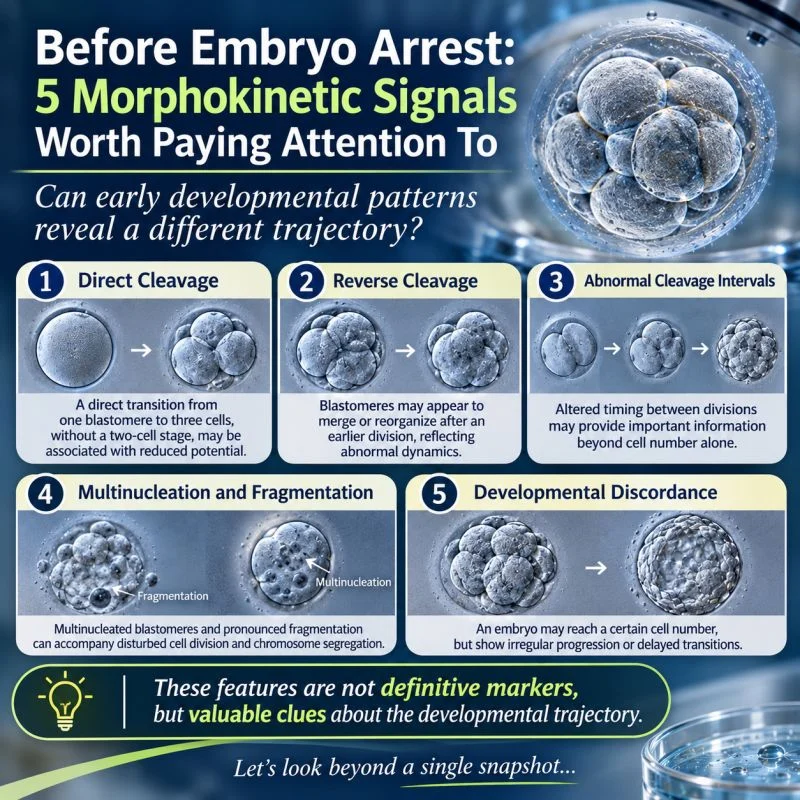
”Before Embryo Arrest: 5 Morphokinetic Signals Worth Paying Attention To
Embryonic developmental arrest is often recognized retrospectively. But time-lapse imaging allows us to observe cellular events that may precede impaired development.
Which early morphokinetic patterns deserve closer attention?
1.Direct cleavage
The transition from one blastomere directly to three cells, without an intermediate two-cell stage, is an atypical cleavage pattern associated with reduced developmental potential in several studies.
2. Reverse cleavage
Blastomeres may appear to merge or reorganize following an earlier division. These events may reflect abnormal cellular dynamics and have been associated with adverse developmental outcomes, although their underlying mechanisms remain incompletely understood.
3. Abnormal cleavage intervals
The timing and coordination of consecutive cell divisions matter. Altered intervals between cleavage events, including cell-cycle duration and synchrony, may provide information beyond cell number alone.
4. Multinucleation and fragmentation
Multinucleated blastomeres and pronounced fragmentation can accompany disturbed cell division, cytoplasmic organization and chromosome segregation. However, their prognostic significance depends on the pattern, extent and developmental context.
5. Developmental discordance
An embryo may reach a particular cell number but demonstrate irregular progression, asynchronous divisions or delayed developmental transitions. Cell count alone may therefore fail to capture the developmental trajectory.
The important distinction:
These features are not definitive markers of embryo arrest, aneuploidy or implantation failure. They are observations that may contribute to a broader assessment of embryo development.
Time-lapse imaging enables us to move from isolated observations toward a more dynamic interpretation of embryonic development. Yet, predictive associations do not necessarily translate into improved clinical outcomes.
Perhaps the most valuable question is not whether an embryo has an abnormal event, but how that event fits into its overall developmental trajectory.
Embryo assessment is evolving – from morphology at a single time point toward a more integrated understanding of developmental dynamics.”
Stay informed with the latest updates in fertility and reproductive medicine on Fertility News.
-
Nov 28, 2026, 17:25Michal Masternak: Young Ovarian Tissue Transplantation Supports Immune Health Beyond Reproduction
-
Nov 28, 2026, 17:18Elias M. Dahdouh: Supporting Families on Their Path to Parenthood Deserves a Place on the National Agenda
-
Nov 28, 2026, 17:11M.Sukanya Mohan: Can a Woman Carry a Pregnancy in the Very Same Uterus in Which She Herself Was Once Carried?
-
Nov 28, 2026, 16:55Jakub Dejewski: 49 Families Across Europe – 11 Clinics Have Already Joined
-
Nov 28, 2026, 16:45Why Are Stable Chromosomes So Important for Female Fertility? – Max Planck Institute for Multidisciplinary Sciences
-
Nov 28, 2026, 16:40Marwa Fakhreldin: Exploring a Novel, Minimally Invasive Treatment for Women with PMOS
-
Nov 28, 2026, 16:27Rajeev Agarwal։ Are Heavy Periods in the 40s Just a Sign of Perimenopause?
-
Nov 28, 2026, 13:43The IVF Center Celebrates Thanksgiving with Gratitude for Its Medical Community
-
Nov 28, 2026, 13:05Yifei Liu: The Embryologist’s Debrief of ASRM 2026