
Khalil Faaed: Are We Measuring the Sperm That Actually Matter in DNA Fragmentation Testing?
Khalil Faaed, Embryologist at Modern IVF Center, shared on LinkedIn:
“We keep measuring sperm DNA fragmentation, but are we measuring the sperm that actually matter?
Sperm DNA fragmentation (SDF) has become an important parameter in the evaluation of male reproductive potential.
But conventional SDF measurements generally consider the sperm population as a whole.
And this raises an important biological question:
Does DNA fragmentation in a dead sperm carry the same clinical meaning as DNA fragmentation in a viable sperm?
Probably not.
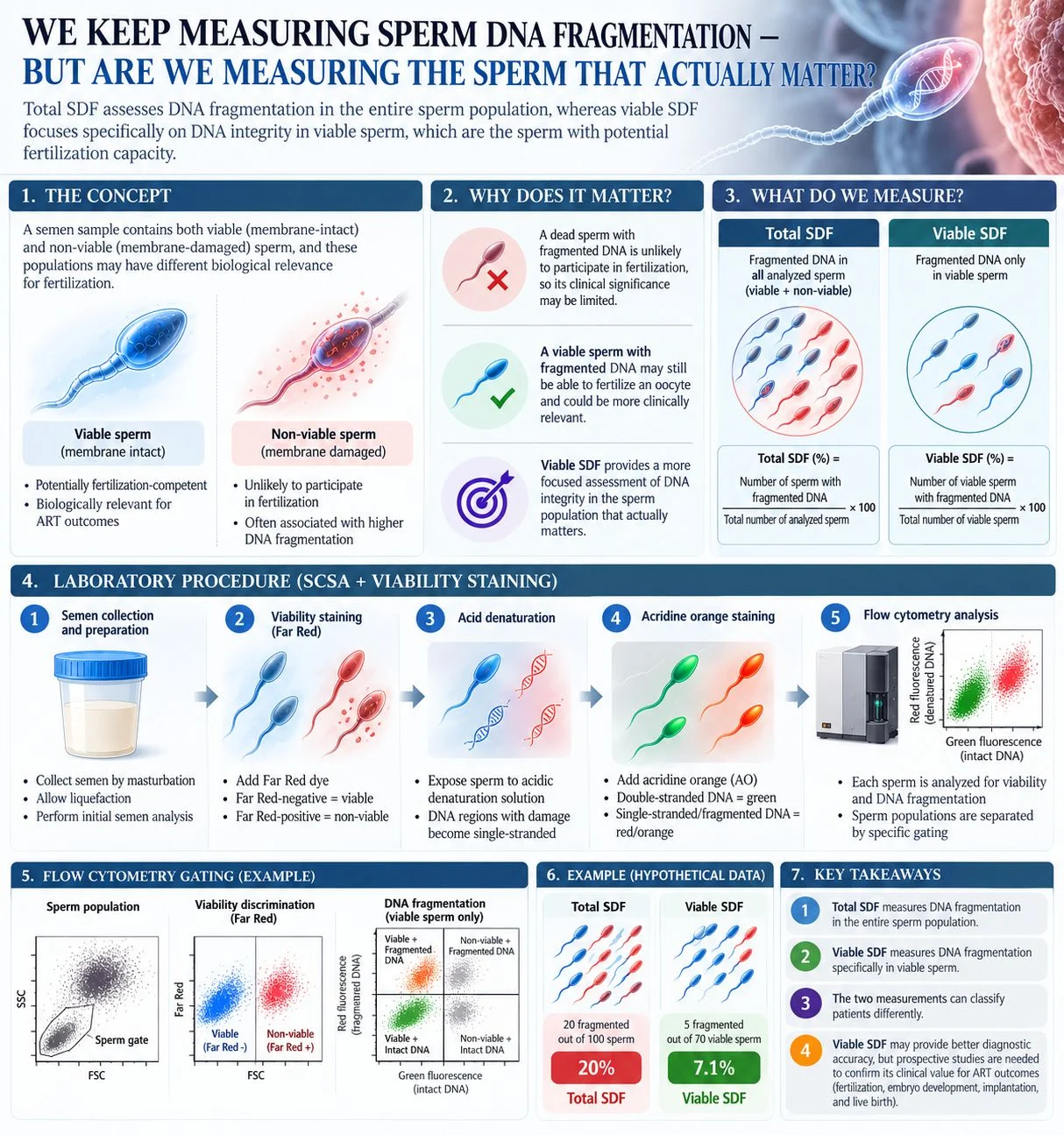
A sperm sample is not a uniform population. It contains viable and non-viable sperm, and these populations may have very different biological relevance.
This is where viable sperm DNA fragmentation (viable SDF) becomes particularly interesting.
Instead of asking only:
How much DNA fragmentation is present in the sample? we can ask:
How much DNA fragmentation is present specifically among the sperm that remain viable?
Technically, this approach combines sperm viability assessment with DNA fragmentation analysis, allowing viable sperm to be distinguished from non-viable sperm during the analysis.
The distinction can be substantial.
- A high total SDF value may partly reflect DNA damage in sperm that are already non-viable.
- Conversely, a relatively low total SDF could potentially mask a clinically relevant level of DNA fragmentation within the viable sperm population.
This does not mean that viable SDF has already replaced conventional SDF or that it is definitively a superior predictor of pregnancy or live birth.
Rather, it introduces a more biologically focused question:
Are we measuring DNA damage in the entire sperm population or are we measuring DNA integrity in the sperm population that still has reproductive potential?
The recent cross-sectional evidence suggesting that viable SDF may provide additional diagnostic information is therefore worth watching closely.
The next step is prospective validation:
Can viable SDF better predict fertilization, embryo development, blastocyst formation, implantation, clinical pregnancy, and live birth?
Perhaps the future of sperm DNA assessment will not simply be about measuring how much DNA is damaged.
It may also be about understanding which sperm carry that damage and whether those sperm are still viable.
The question may no longer be only ‘How fragmented is the sperm DNA?’
It may become:
‘Whose DNA is fragmented and does that sperm still matter?’”
Other articles featuring Khalil Faaed on Fertility News.
-
Sep 26, 2026, 18:20Rajeev Agarwal: Preconception Care Should Be about More than Preparing the Body for Pregnancy
-
Sep 26, 2026, 18:07Let’s Talk Access This World Contraception Day – FIGO
-
Sep 26, 2026, 17:57Nishad Tasnim and Iftekhar Ahmed Sakib: When Ultrasound and MRI Disagree in Septate Uterus
-
Sep 26, 2026, 17:53The Fertile Window: Why Your Best Days Come Before Ovulation – Fertility Plus
-
Sep 26, 2026, 17:47Kate Pleace: How You Are Told You Have POI Matters
-
Sep 26, 2026, 17:43Sarah Martins da Silva: Great to See Male Reproductive Health Front and Center at Gedeon Richter’s Future of Fertility
-
Sep 26, 2026, 17:37Paola Fasola: The Sound of Science and the Pulse of Humanity at the 5th Narture International Summit
-
Sep 26, 2026, 17:34Mostafa Maghraby: Is a ”Good Grade” Really a Good Embryo?
-
Sep 26, 2026, 17:31Emad Sedeek: Oocyte Quality and Developmental Competence Among the Most Critical Factors