
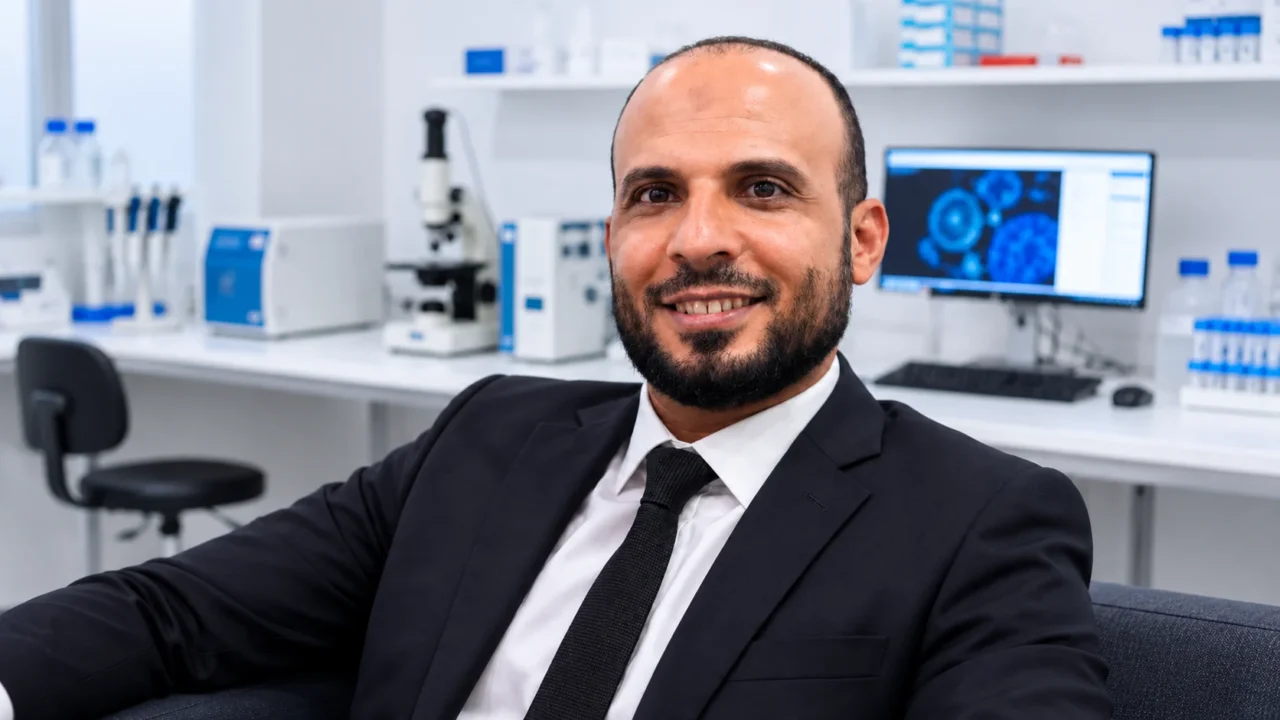
Khalil Faaed: Retinoic Acid – The Signal that Could Change How We Think about Sperm Production
Khalil Faaed, Embryologist at Modern IVF Center, shared on LinkedIn:
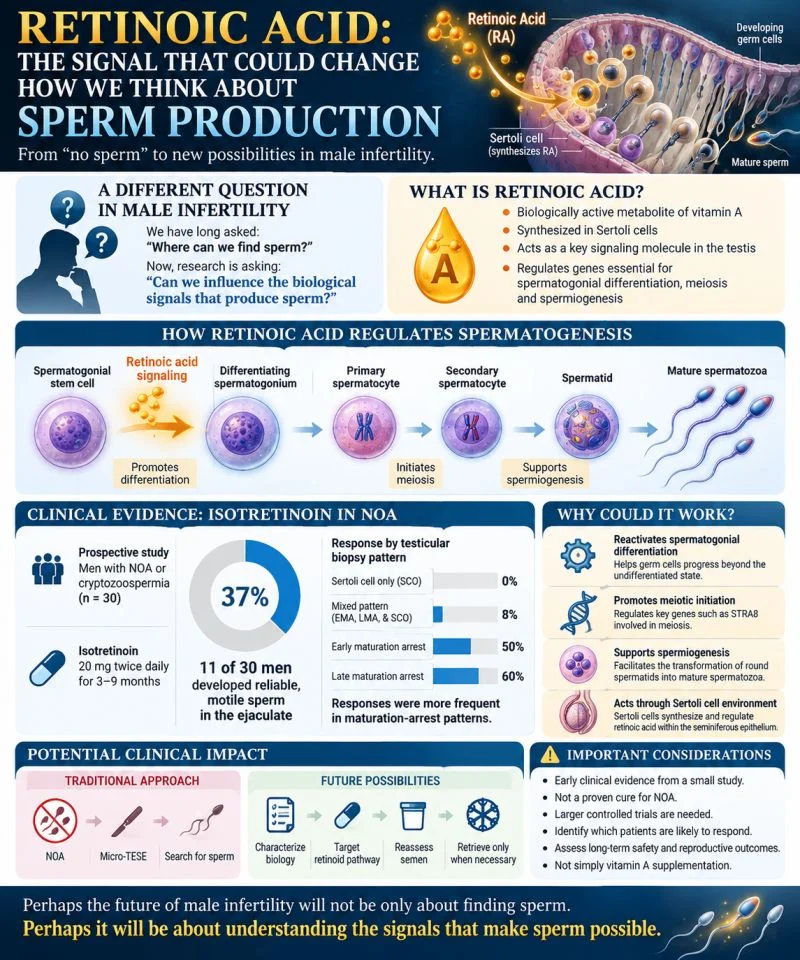
”Retinoic acid: the signal that could change how we think about Sperm Production
What if the problem in some cases of severe male infertility is simply no sperm but a developmental program that has stopped?
That question is putting retinoic acid, a metabolite of vitamin A, under an increasingly interesting spotlight in reproductive biology.
Spermatogenesis is not a single event.
It is a carefully coordinated biological sequence:
Spermatogonial differentiation – meiosis – spermiogenesis – spermatozoa
And retinoic acid is one of the signaling molecules involved in this process.
That makes the concept fascinating:
Could manipulating retinoic acid signaling help some patients restart a stalled spermatogenic process?
Recent clinical research provides an intriguing early signal.
In a prospective study of men with non-obstructive azoospermia or cryptozoospermia, treatment with the retinoid isotretinoin was associated with the appearance of reliable, motile sperm in the ejaculate in 11 of 30 participants (37%).
The most interesting observation?
Responses were particularly observed among patients with maturation-arrest patterns.
And that leads to a much bigger question:
If germ cells are present but fail to progress, could the problem sometimes be the signaling environment rather than the complete absence of spermatogenic potential?
This could represent a different philosophy of male infertility treatment.
Instead of always asking:
How can we retrieve the sperm?
We may increasingly ask:
Can we understand and potentially influence the biology that produces the sperm?
That is where precision andrology becomes exciting.
Imagine a future in which:
- Genetics
- Testicular histology
- Hormonal profiles
- Epigenetic signatures
- Cell-free DNA/RNA
Spermatogenic signaling pathways are integrated to determine which biological pathways are disrupted and which patients may be responsive to targeted intervention.
But this is where scientific discipline matters.
Retinoic acid is not a proven cure for NOA.
The current clinical evidence is preliminary, based on a small study, and requires validation through larger controlled trials.
So the real story is not: We found a cure for azoospermia.
It is much more interesting than that:
We may be moving from sperm retrieval toward sperm biology.
And perhaps one day, before asking:
Where can we find the sperm?
We will first ask:
What stopped the sperm from being produced, and can we change that signal?
Retinoic acid may be giving us a new way to ask that question.”
Other articles featuring Khalil Faaed on Fertility News.
-
Oct 5, 2026, 17:51Registration Is Open for the Procreation Symposium Naples 2026 by IVIRMA Italia
-
Oct 5, 2026, 17:42Margaret Cali: You’re Allowed to Rest Without Having Earned It First…
-
Oct 5, 2026, 17:39Chadi Yazbeck: Fibroids and Infertility – Do You Really Need Surgery?
-
Oct 5, 2026, 17:33Nina Brown: Until a Few Weeks Ago, I Didn’t Even Know Silent Endometriosis Existed…
-
Oct 5, 2026, 17:27Theofano Bounartzi: Professional Growth in Embryology Comes from Continuously Investing in Learning
-
Oct 5, 2026, 17:22Alessandro Bartolacci: bART and Friends Journal Club – Developmental Competence of Atypically Fertilized Oocytes
-
Oct 5, 2026, 17:13K. Reshma Reddy: Clinical Embryology Is Changing – Are You Ready for What’s Next?
-
Oct 5, 2026, 17:08Aishling Burke: Why Are Women Turning to TikTok and Social Media for Menopause Advice in the First Place?
-
Oct 5, 2026, 17:01Lucy Froese: Why My Clients Have Access to Me for SOS Calls During Their IVF Cycles