

Priyadatt Patel: Recurrent Pregnancy Loss Should Be Assessed After 2 Losses
Priyadatt Patel, Senior Gynecologist, Advanced Laparoscopic Surgeon, IVF and Endometriosis Programme Lead at Balaji Horizon Women’s Hospital, shared on LinkedIn:
“Being told to wait until you have lost three pregnancies before anyone will investigate is one of the harder things a couple can hear. That threshold has changed – and it’s worth knowing.
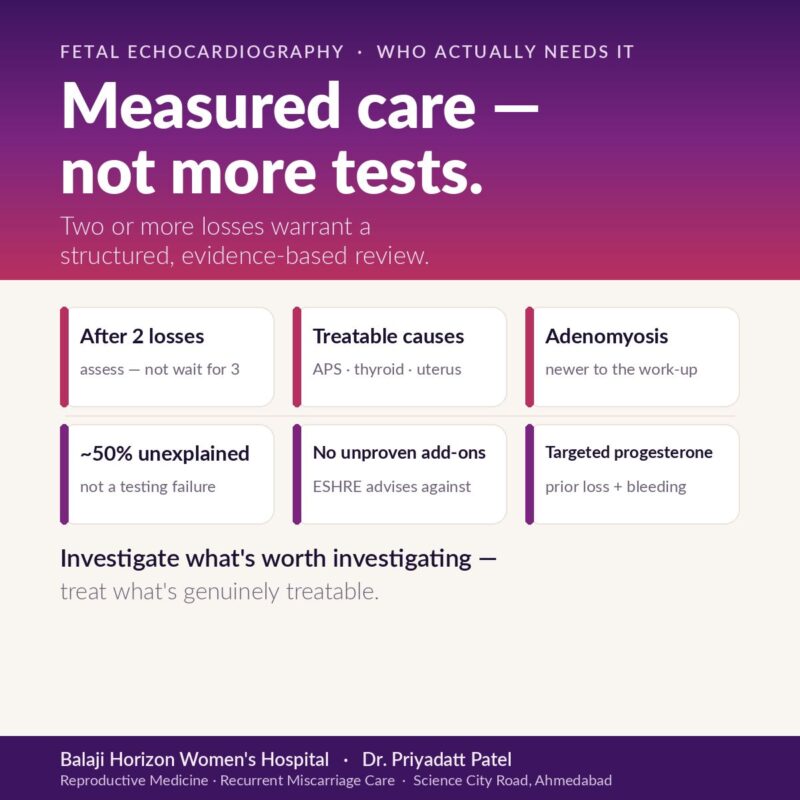
International guidance (ESHRE, 2023) now defines recurrent pregnancy loss as two or more losses, and supports beginning a structured assessment after two – not necessarily consecutive. Earlier, kinder, and more useful than waiting for a third.
A considered evaluation looks for the genuinely treatable things, or that change the plan: a clotting condition (antiphospholipid syndrome), thyroid and other hormonal factors, the shape of the uterus, and – a more recent addition to the guideline – adenomyosis. Genetic factors are weighed where relevant.
Two honest points matter as much as the tests themselves.
First, even after a complete, careful work-up, around half of recurrent losses have no identified cause. That is not a failure of testing – and ‘unexplained’ is not the same as ‘untreatable’ or ‘hopeless.’ For many couples in this group, the outlook for a future successful pregnancy is better than the fear suggests.
Second, more testing is not automatically better care. Many add-on investigations and immune ‘treatments’ marketed for miscarriage are not supported by good evidence, and ESHRE specifically advises against several of them. Where treatment does help, it is targeted: vaginal progesterone improves live-birth rates specifically for women who have both previous miscarriage(s) and current early-pregnancy bleeding – not for everyone.
Good care for recurrent loss is measured, evidence-based and honest: it investigates what is worth investigating, treats what is genuinely treatable, and offers realistic hope rather than a long list of unproven add-ons.
If you have had two or more losses, it is reasonable to ask for a structured assessment – and, of any test or treatment offered, to ask what the evidence actually shows.”
Stay informed with the latest updates in fertility and reproductive medicine on Fertility News.
-
Sep 21, 2026, 16:35Filipa Rafael: What Is More Convenient for a Clinic Is Not Necessarily Better for a Patient
-
Sep 21, 2026, 16:27Konstantinos Stavridis: An Observational Study on Fetal Exposure to Paracetamol
-
Sep 21, 2026, 16:23Shining a Spotlight on the Challenges Women Face During the Menopause Transition – IMS
-
Sep 21, 2026, 16:20What Can Genetics Tell Us About Pregnancy Loss? – ESHRE SIG Reproductive Genetics
-
Sep 21, 2026, 16:11Advancing India’s Fertility MedTech Landscape Through Innovation and Accessibility – Startup Story
-
Sep 21, 2026, 16:06Emilie Lassen: Worldwide Family Limits for Sperm Donors
-
Sep 21, 2026, 16:01Mohammed Nasur: Pleased to Attend the 2nd Trust Fertility and Gynecology Conference 2026
-
Sep 21, 2026, 12:59Nagi Rostom։ Privileged to Contribute to Expanding Access to Specialist Fertility Care for Patients in Salisbury
-
Sep 21, 2026, 12:54Commonly Asked Questions about Patient Engagement Forum – HFEA