

Svitlana Yashchenok: 4 Lessons from the Master’s Degree in Australia that Changed How I Think
Svitlana Yashchenok, Practice Manager at Reproductive Health Medical Centre LADA, shared on LinkedIn:
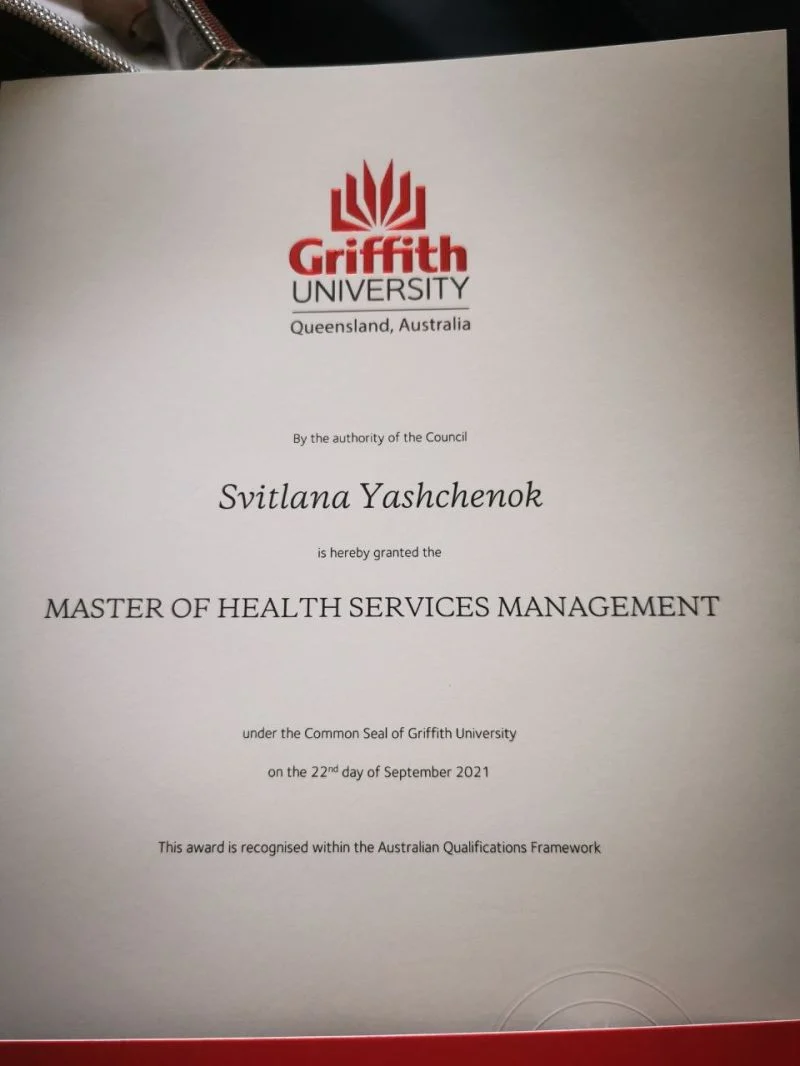
”Master’s Degree in Australia changed how I think. Here are four lessons in Western Management.
For the first three months, I felt like a student who had forgotten half the alphabet. It wasn’t the language. The way I’d run my clinic for 15 years was no longer the only right way: almost everywhere here, a different system was at work.
The master’s gave me more than a degree. It changed how I run my clinic.
SLAs: Clear Deadlines and Clear Owners.
Every Australian clinic is accredited against the National Safety and Quality Health Service (NSQHS) Standards. There are eight of them, from clinical governance to responding when a patient’s condition deteriorates. Compliance is mandatory, and inspections come without warning.
‘We’ll figure it out as we go’ doesn’t exist here. There are protocols, deadlines and named people responsible.
What I put in place: at LADA clinic, we set SLAs for every stage of the patient journey. These cover how quickly we answer a first enquiry, how long it takes to get from consultation to the start of a protocol, and when results are delivered. IVF is stressful enough. Predictability calms patients better than any reassurance.
Evidence-Based Medicine.
‘We’ve always done it this way’ doesn’t fly here. Every protocol has to rest on data, even when the data is uncomfortable.
What I put in place: we stopped offering add-on procedures with unproven benefit, even when patients asked for them. It makes selling harder, but it’s the only way to build long-term trust, and that kind of trust has no expiry date.
Honest Numbers.
Every IVF clinic in Australia must report the outcome of every cycle to the national registry, ANZARD. It’s a licensing requirement, not a voluntary initiative. The registry is independent and benchmarks clinics across the country. If a clinic’s results are consistently below the norm, it triggers a review.
The system isn’t perfect: publishing this data for patients is optional, and some clinics don’t.
But the habit of analysing every cycle, not just the successful ones, changes how you relate to data.
My takeaway: we review every failed protocol as carefully as a successful one. The numbers we use for marketing and the numbers our team learns from are the same numbers.
Boundaries as the Foundation of Sustainability.
The law limits shift length and regulates rest between shifts and the use of annual leave. Leaving on time and not answering messages at night is normal. At the same time, the hierarchy is flat: people talk to a junior doctor as directly as they do to a head of department.
We tend to romanticise burnout in medicine: ‘a real doctor is always on call.’ I stopped seeing team exhaustion as a sign of dedication. A team that isn’t burned out makes better-balanced decisions.
The bottom line: none of this works on its own. SLAs without evidence are just bureaucracy. Honest numbers without boundaries are burnout in a neat spreadsheet. The system only works as a whole.”

Other articles featuring Svitlana Yashchenok on Fertility News.

-
Oct 3, 2026, 18:11Devyanshi Dixit: Call for Speakers for GFWH 2026
-
Oct 3, 2026, 18:06Shaun Greenaway: The More We Understand Male Fertility, the Better Decisions We Can Make
-
Oct 3, 2026, 17:55Reproductive BioMedicine Online’s Latest Issue, 53.4, Is Out
-
Oct 3, 2026, 17:50Ananya Anand Kumar: Excited to Share that My Cryopreservation Abstract Was Accepted for Fertility 2027
-
Oct 3, 2026, 17:48Pregnancy of the Future: Predicting, Preventing, and Treating the Great Obstetric Syndromes – SMFM
-
Oct 3, 2026, 17:46PMOS Was Never Just About the Ovaries… – PCOS Awareness Association
-
Oct 3, 2026, 17:42Delighted to Have Been Part of the 3rd AIFertility World Conference – Conceivable Life Sciences
-
Oct 3, 2026, 17:38Carole Gilling-Smith: We Need to Understand the Technology Well Enough to Control What It Does Next
-
Oct 3, 2026, 17:35ASRM Thanks Sen. Patty Murray and Rep. Jimmy Gomez for Reintroducing the Invest in Women’s Health Act