

Alzubair Ahmed: Optimizing Centrifugation Dynamics in Swim-Up Protocols for ICSI
“Balancing Sperm Recovery, Incubation Time, and Diagnostic Accuracy.
Introduction
In Assisted Reproductive Technology (ART) and specifically Intracytoplasmic Sperm Injection (ICSI), sperm preparation is the final and most critical step before microinjection. The ultimate goal is to isolate a population of highly motile, morphologically normal spermatozoa free from seminal plasma, cell debris, and reactive oxygen species (ROS).
Among preparation protocols, the Pellet-Swim-Up technique is widely used. In standard laboratory workflows with normal semen parameters, the final Swim-up incubation phase is typically optimized for 10 minutes to retrieve top-tier motile gametes. However, the physical dynamics of the preceding centrifugation step—specifically rotation speed, relative centrifugal force (RCF/g-force), and spin duration – directly govern the success of this final 10-minute migration.
The Critical Bottleneck: Centrifugation Overload and the ’10-Minute’ Swim-Up Standard
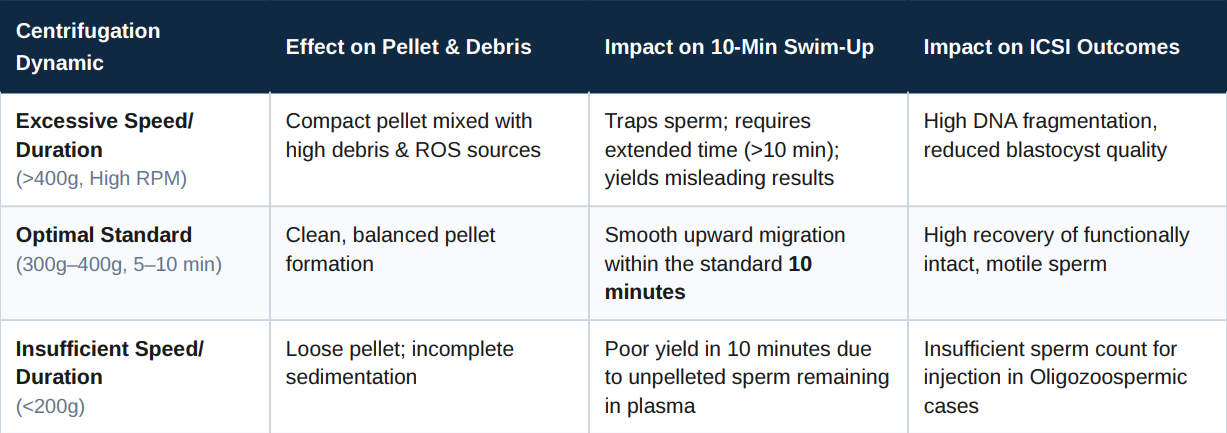
A common issue in andrology workflows occurs when centrifugation is conducted at excessively high speeds or prolonged durations. While intended to maximize pellet yield, aggressive rotation forces spermatozoa into tight physical aggregation alongside seminal debris, round cells, and leukocytes.
1. Entrapment in Debris and Impaired Upward Migration:
When the sperm pellet becomes over-compacted and contaminated with cellular debris due to strong centrifugation, motile spermatozoa become physically trapped. Instead of smoothly migrating upward into the overlay medium during the standard 10-minute Swim-up phase, their mechanical movement is restricted.
2. Time Extension and the Risk of False Results:
Because trapped spermatozoa cannot migrate effectively within the standard 10 minutes, embryologists are often forced to extend the Swim-up incubation time beyond 10 minutes. However, increasing incubation time introduces significant diagnostic and clinical errors:
- Elevated Oxidative Stress (ROS): Prolonged contact with debris and damaged cells in the lower phase releases high levels of Reactive Oxygen Species, leading to sperm DNA fragmentation (SDF) and membrane lipid peroxidation.
- Inconsistent and Misleading Results: Extending time alters the functional profile of the recovered sperm population. Gametes retrieved after prolonged exposure are often functionally impaired, yielding false impressions of sperm quality and motility that do not accurately represent the sample’s true physiological potential.
The Centrifugation Spectrum: Speed, Duration, and Recovery
Clinical Takeaways and Protocol Optimization
- Protect the 10-Minute Standard: To maintain diagnostic accuracy and prevent ROS exposure, centrifugation parameters must be calibrated so that optimal motile sperm recovery is naturally achieved within the standard 10-minute Swim-up window.
- Avoid Forced Incubation Extensions: Extending Swim-up time to compensate for a heavily compacted or debrisridden pellet distorts laboratory results and compromises genetic integrity.
- Standardize by RCF (g-force): Always calibrate centrifuges using g-force (300g–400g) rather than RPM to ensure consistent pellet density across different laboratory centrifuges.”
Written by Alzubair Ahmed
Senior Andrology Specialist and Research Assistant at Fakih IVF Fertility.
Other articles featuring Alzubair Ahmed on Fertility News.
FAQ
Why is 10 minutes considered the standard duration for the final Swim-up step in normal samples?
A 10-minute incubation provides sufficient time for highly motile, healthy spermatozoa to migrate into the clean overlay medium without unnecessary exposure to oxidative stress from the pellet below.
How does excessive centrifugation speed lead to false laboratory results?
Strong rotation packs debris and round cells tightly around the sperm. This traps motile sperm, artificially delaying their migration and forcing longer incubation times that alter the observed motility and DNA integrity, leading to inaccurate diagnostic conclusions.
Can extending the Swim-up incubation time harm sperm DNA?
Yes. Prolonged incubation over a pellet rich in debris and leukocytes significantly increases ROS production, leading to elevated sperm DNA fragmentation.
What is the best way to handle samples with high cellular debris?
Use moderate centrifugation (300g) for a strictly controlled duration (5–8 minutes) or consider density gradient centrifugation prior to Swim-up to separate debris before migration.
-
Nov 2, 2026, 15:44Saff Mitten: We Need to Build Greater Awareness of Infertility and the Impact Fertility Journeys Have on People
-
Nov 2, 2026, 15:24Resa Nabor: Could Your Symptoms Be Linked to PCOS?
-
Nov 2, 2026, 15:09Asima Ahmad: Working Hard to Ensure that Access to Fertility Care Is a Reality for People Across the Globe
-
Nov 2, 2026, 14:56Ashley Evans: Let’s Make Fertility Unfiltered This World Fertility Day
-
Nov 1, 2026, 12:18Giulio Garaffa: Male Infertility – From Assessment to Individualised Care
-
Nov 1, 2026, 12:16Thomas Stavrakis: Privileged to Dive Deep Into the Latest ESHRE Guidelines
-
Nov 1, 2026, 12:13Dina Ibrahem: Aneuploid Yesterday, Euploid Today?
-
Nov 1, 2026, 12:12Alex Price: Officially My Last Day as Group CEO of Fertility Associates
-
Nov 1, 2026, 12:10Sweta Gupta: Fertivision – The Annual Conference of the Indian Fertility Society