

Christopher Robinson: Incorporating Vascular Insights Into Cesarean Closure Discussions
Christopher Robinson, Associate Professor Maternal Fetal Medicine at University of South Carolina, shared a post on LinkedIn:
“Beyond sutures: incorporating vascular insights into cesarean closure discussions – Blood supply for the lower uterine segment
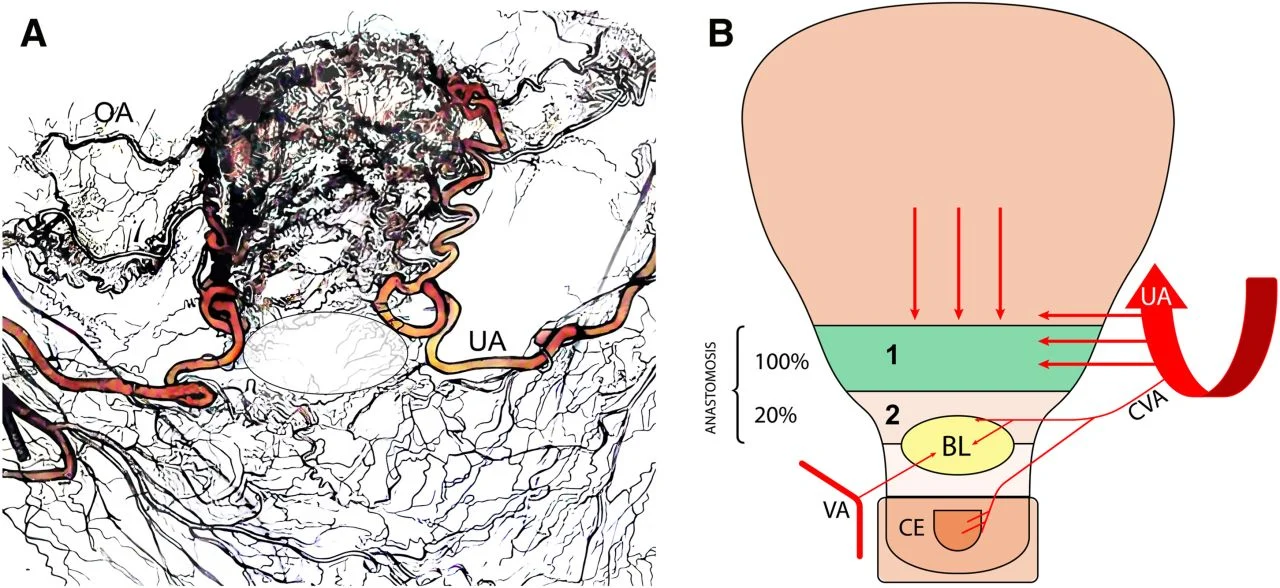
A, Uterine cast. The vascular cast illustrates the 3-dimensional architecture of the uterine and ovarian arterial systems, highlighting their distinct regional perfusion patterns. The uterine arteries (UA) course medially with their characteristic tortuosity before dividing into an extensive, highly anastomosed network that supplies the uterine body and fundus. In contrast, the lower uterine segment—represented here by a relatively avascular oval region corresponding to the typical site of cesarean delivery—receives only sparse collateral branches. This abrupt transition from the minimally perfused lower segment to the richly interconnected arterial plexus just a few centimeters above underscores the physiological rationale for incising the lower uterine segment during cesarean birth.
The OAs contribute additional collateral flow through the utero-ovarian arcade, further reinforcing the dense vascular supply of the upper uterus. B, Uterine blood supply. This schematic representation delineates the differential vascular supply of the lower and upper uterine segments. The lower part of the uterine segment, which receives blood supply by the CVA, is predominantly supplied by the descending branch of the uterine artery, receiving only limited collateral input—approximately 20%—from the vaginal arterial pedicle (VA). In contrast, the upper segment of the lower uterus (1, depicted in green) benefits from a far more robust perfusion pattern, with a fully developed anastomotic network supplied by 100% of the ascending uterine arterial branches. This clear distinction between the sparsely anastomosed cervicovaginal territory and the richly interconnected upper segment underscores the functional compartmentalization of uterine segment blood flow and helps explain the differences in oxygen delivery observed after surgical incisions in the lower and upper uterine segment sectors.”
Title: Beyond sutures: incorporating vascular insights into cesarean closure discussions (letter to the editor)
Authors: José Miguel Palacios-Jaraquemada, Álbaro José Nieto-Calvache, Nicolás Andrés Basanta
Read the full article.

Stay updated on all scientific advances in the field of fertility with Fertility News.
-
Sep 18, 2026, 20:27Hrishikesh Pai: Rethinking Male Infertility
-
Sep 18, 2026, 20:25Eric Verdin: Wrapping Up the Reproductive Aging Summit at the Center for Healthy Aging in Women
-
Sep 18, 2026, 20:21Investigating Pregnancy Outcomes in Women with Idiopathic POI – RBMO
-
Sep 18, 2026, 20:18Sue Ritchie: Why Aren’t We Talking About Male Fertility More?
-
Sep 18, 2026, 20:13Salma Yasin: Every Day of BFS Study Week 2026 Has Been an Exceptional Learning Experience
-
Sep 18, 2026, 20:01Qingcai Wang: Over 35 and Torn Between Trying Longer and Starting IVF?
-
Sep 18, 2026, 19:58Bhumika: Can a Woman Become Pregnant Again While Already Pregnant?
-
Sep 18, 2026, 19:5215 More Experts Join the International Fertility Forum Mumbai 2026
-
Sep 18, 2026, 19:50Curious About What Happens Behind the Scenes in the Labs? – Sims IVF