
Why a GnRH Agonist Trigger Can Still Cause OHSS – Fertility Plus
Fertility Plus shared a post on LinkedIn:
“Why a GnRH Agonist Trigger Can Still Cause OHSS — Even Though It’s the Gentler One
The GnRH agonist trigger is the safer choice — it’s why most women now avoid OHSS altogether. But it isn’t a cast-iron guarantee, and being honest about the small exception is part of good care. Here’s why a few strong responders still need a closer eye, and exactly what we do about it..
Simple explanation (for the post body)
The GnRH agonist trigger has been a real turning point in IVF. For most women, it’s the reason ovarian hyperstimulation (OHSS) has gone from a genuine worry to a rare event. So why does it still happen for a small few? Here’s the honest answer, step by step.
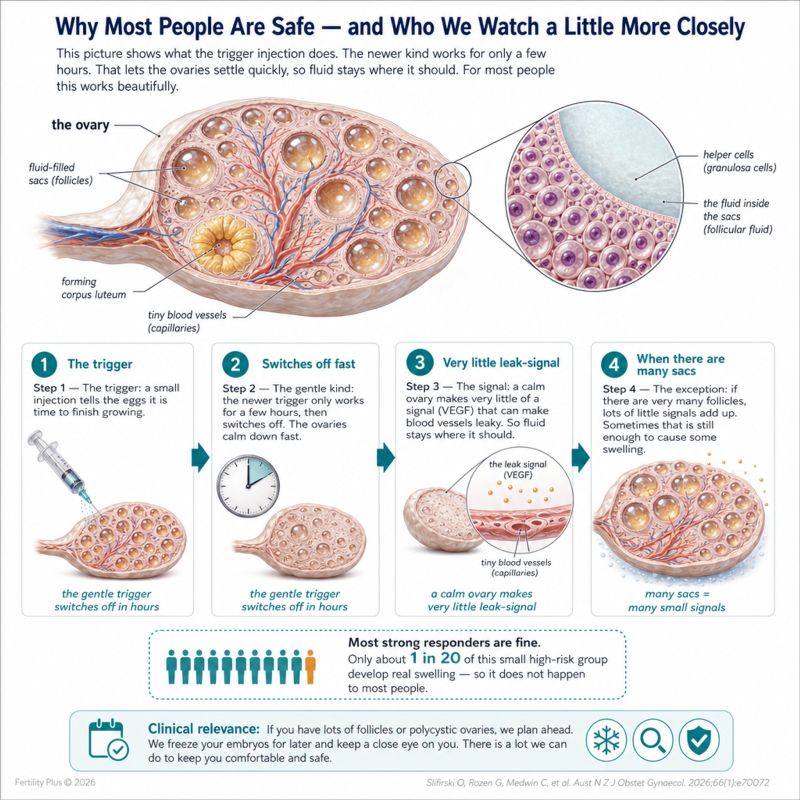
It starts with the trigger injection. This is the small dose that tells your eggs it’s time to finish maturing, just before collection.
The clever part is timing. The newer agonist trigger only works for a few hours, then switches off. That short window lets the ovaries settle quickly — and a calm ovary releases very little of a signal called VEGF, the thing that makes nearby blood vessels leaky. Less VEGF means fluid stays where it should, and that’s the whole reason most women feel well afterwards.
But there’s a numbers effect that the gentleness can’t always overcome. Every follicle is surrounded by helper cells (granulosa cells), and each one releases a little VEGF. When the ovaries hold a very high number of follicles, all those small signals add up at once. Past a certain point, even a short, gentle surge produces enough VEGF for the vessels to leak — and that’s when some swelling can appear.
So the trigger itself isn’t the problem. It’s the sheer number of follicles in the highest responders. The reassuring part: this stays uncommon.
Even within this small high-risk group, only around 1 in 20 develop real swelling — so it doesn’t happen to most people.
And it’s a risk we plan for, not react to. If you have lots of follicles or polycystic ovaries, we freeze your embryos for a calmer transfer later, keep a close eye on you, and step in early if ever needed. A high egg count is a sign of healthy reserve — we simply build your plan around it.
If that sounds like you, talk to us before you start.
0800 022 6038 · 92 Harley Street, London”
Stay updated on all scientific advances in the field of fertility with Fertility News.
-
Oct 8, 2026, 17:18Khalil Faaed: Vitrification Prevents Ice, but Does It Prevent Oocyte Damage?
-
Oct 8, 2026, 17:16Ritu Anand: Better Conversations Ultimately Lead to Better Care in Fertility
-
Oct 8, 2026, 17:14Mark Trolice: Excited to Speak at Women’s HealthX
-
Oct 8, 2026, 17:12Delighted to Welcome Dr. Róisín Mortimer – Waterstone Clinic-IVF and Fertility
-
Oct 8, 2026, 17:09Deirdre Zander-Fox: Pleased to Be an Invited Speaker at ESHRE Precision ART
-
Oct 8, 2026, 17:06Roohi Jeelani: Is Modern Life Actually Making It Harder to Get Pregnant?
-
Oct 8, 2026, 17:04Robert Borowczyk: We Judge the Newest IVF Consultation Group Too Quickly…
-
Oct 8, 2026, 17:01Carlos Guerrero: Great Couple of Days Visiting the Team at New Leaders in Fertility and Endocrinology
-
Oct 8, 2026, 17:00Sarah Banks: Improving Patient Experience Isn’t Always About Making Huge Changes…