

Emilie Lassen: Worldwide Family Limits for Sperm Donors
Emilie Lassen, Innovation Coordinator at Cryos International, shared a post on LinkedIn about a paper she co-authored with colleagues published in the Journal of Assisted Reproduction and Genetics (JARG):
“Our new study on worldwide family limits for sperm donors has just been published at a particularly relevant time, given the ongoing debate in Denmark.
We asked recipients of donor sperm and people with an interest in donor conception about their support for a worldwide family limit and how they weigh the potential benefits and downsides.
70% of respondents supported introducing a worldwide family limit.
The most common reason was concern about donor-conceived half-siblings unknowingly entering romantic relationships. However, the available evidence suggests that this risk is minimal, particularly when donor families are geographically dispersed.
A study estimates that up to 100 recipient families could be created without posing a significant consanguinity risk.
Genetic risk was the second most common concern (12%).
However, reducing the number of families per donor does not reduce the overall genetic risk. A donor with many offspring is replaced by several donors with fewer offspring, and since every donor (and all other humans) carries undetected pathogenic variants, the overall risk remains largely unchanged.
Our findings show that recipients generally support lower family limits, but that the reasons for this support are not always aligned with the available scientific evidence.
At the same time, reducing family limits has consequences. Fewer families per donor can mean reduced donor availability, longer waiting times, and higher treatment costs. These consequences are important to consider when discussing how international donor limits should be designed.”
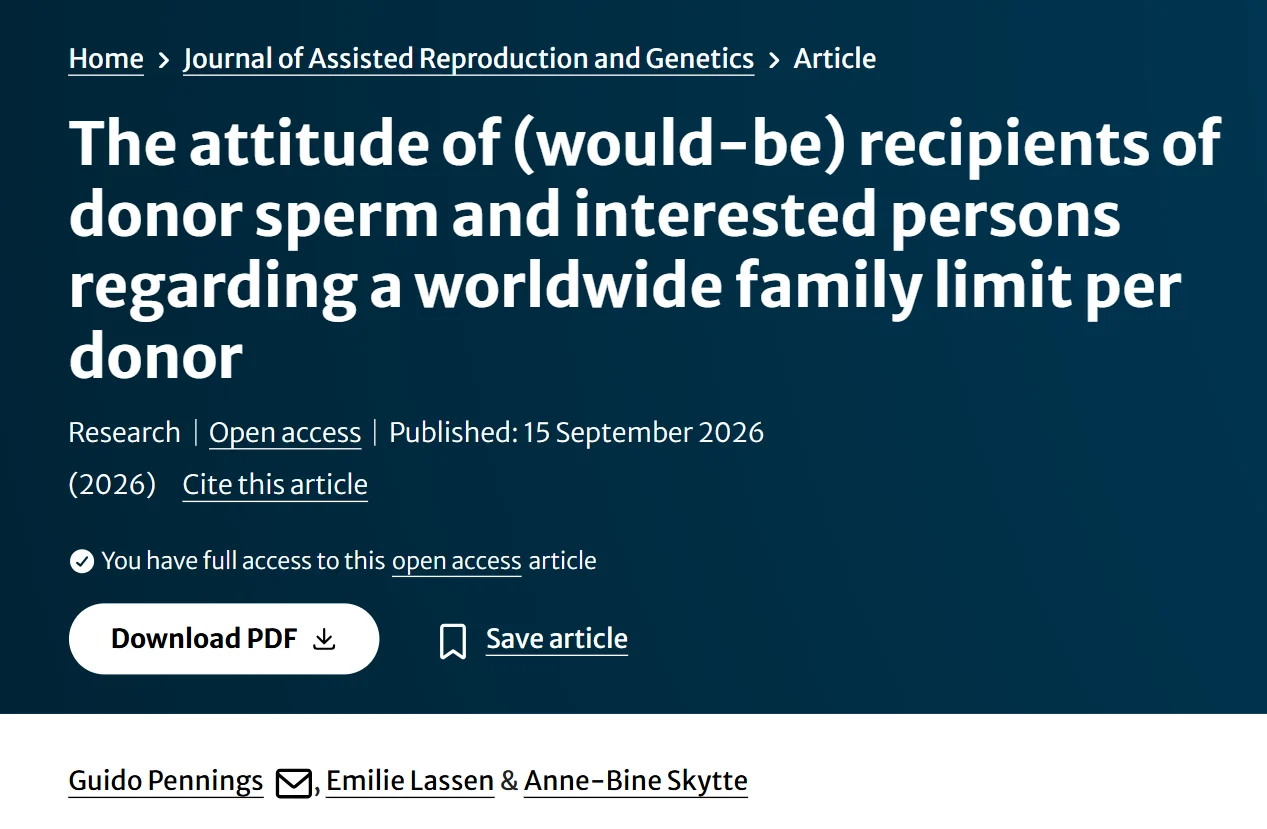
Title: The attitude of (would-be) recipients of donor sperm and interested persons regarding a worldwide family limit per donor
Authors: Guido Pennings, Emilie Lassen, Anne-Bine Skytte
You can read the Full Article in the Journal of Assisted Reproduction and Genetics.
Stay informed with the latest updates in fertility and reproductive medicine on Fertility News.
-
Sep 21, 2026, 18:01Mostafa Maghraby: What Makes a Good Embryologist?
-
Sep 21, 2026, 17:57Paweł Radwan: Meeting Fertility Leaders at the European Executive and Investors Fertility Meeting
-
Sep 21, 2026, 17:49Anna David: Can You Predict Pregnancy Outcome at Diagnosis of Early-Onset FGR?
-
Sep 21, 2026, 17:44Caspian Ostadian: Oocyte Abnormalities and Blastocyst Formation
-
Sep 21, 2026, 17:40Eric Lameignere: What If Part of the Sperm DNA Damage We Observe is Actually Created in the IVF Laboratory Itself?
-
Sep 21, 2026, 17:29Angelo Tocci: Paying More Without Improving Assisted Reproduction Outcomes
-
Sep 21, 2026, 17:22Santiago Munne: The Latest Bpisode of The Baby Blueprint, About the Worldwide Decline in Birth Rates
-
Sep 21, 2026, 17:12Zeinab Kazemianpour: 1 Embryo, 2 Different Biopsy Strategies
-
Sep 21, 2026, 17:10Diksha Kanekar: A Day in the Life of an Embryologist