

Shweta Rajani Goswami։ We Have to Call Experimental Fertility Treatments Experimental
Shweta Rajani Goswami, Founder and Medical Director of Zeeva Fertility, shared on LinkedIn։
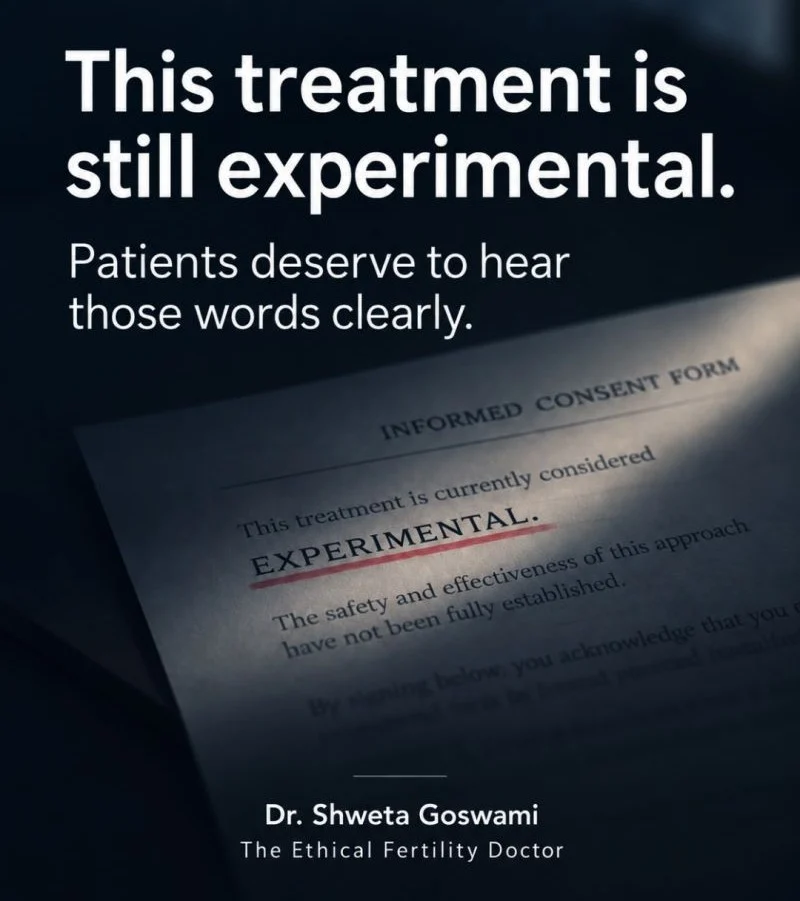
“I am not against experimental fertility treatments.
I think we just have to call them experimental.
Because medical science evolves like this.
New treatments come in. We try them. We study them. We see which patients may actually benefit. And sometimes, after years of research, they become part of regular treatment.
There is nothing wrong with that.
The problem starts when we give an experimental treatment to a patient as though we already know it works.
I see this particularly with what is now being called ovarian rejuvenation.
PRP. Stem cell therapies. Other newer treatments being offered to women with very low ovarian reserve.
And I can understand why a woman wants to try them.
When somebody has been told that her egg reserve is very low, and that she may eventually have to consider donor eggs, she wants to try everything possible before reaching that point.
Of course she does.
But that is exactly why we have to be very, very clear with her.
This is experimental.
- We are still studying it.
- We do not know with certainty which patient will benefit.
- We do not know that doing the procedure will improve the final outcome.
And it may still mean money, another procedure, and, importantly in fertility, time.
I am not saying nobody should do it.
There is no problem if a patient understands all of this and then says, ‘I still want to give it a try before I move on.’
That is her decision.
But it has to be an informed decision.
And I think sometimes we reduce informed consent to a form that a patient signs before a procedure.
For me that is not enough.
The patient sitting in front of us has to understand what we know.
She also has to understand what we don’t know.
- What are the possible benefits?
- What are the limitations?
- What other options does she have?
- And what may happen if this treatment does not work?
Because after hearing all of this, two patients may make completely different decisions.
One may still want to try the experimental treatment.
Another may decide that she does not want to lose more time and would rather move to the next option.
Both decisions can be reasonable.
What is not reasonable is allowing the patient to believe that an experimental treatment has the same evidence behind it as an established one.
Medical science will continue to experiment. It has to.
But the experimentation should never be hidden from the patient.
We should put the uncertainty on the table.
And then let the patient make her decision knowing exactly what she is choosing.”
Stay informed with the latest updates in fertility and reproductive medicine on Fertility News.
-
Sep 25, 2026, 17:57Devyanshi Dixit: Next-Gen Women’s Health at GFWH 2026
-
Sep 25, 2026, 17:53Szabó Gábor: Ultrasound vs MRI for Preoperative Detection of Endometriosis
-
Sep 25, 2026, 17:45Robert Gilchrist: Is There Anything More Important in IVF Than Eggs?
-
Sep 25, 2026, 17:41Justin Houman: How I Run a Men’s Health Practice Inside an Academic Medical Center
-
Sep 25, 2026, 17:39Kristen Williams: The Hills I Will Die on as a Women’s Healthcare Founder
-
Sep 25, 2026, 17:36Thankful to Everyone Who Attended the Current Practice in Therapeutic Sperm Preparation Day – ARCS
-
Sep 25, 2026, 17:27Akash Verma: Sperm Cryopreservation with FertiPro SpermFreeze
-
Sep 25, 2026, 17:21Rafael Trinchant: Thrilled to Share Our Article on Semen, Stigma, and Spectacle
-
Sep 25, 2026, 17:14Eric Lameignere: Are We Measuring the Right Sperm DNA Fragmentation?