
Khalil Faaed: Hashimoto’s Thyroiditis and IVF
Khalil Faaed, Embryologist at Modern IVF Center, shared on LinkedIn:
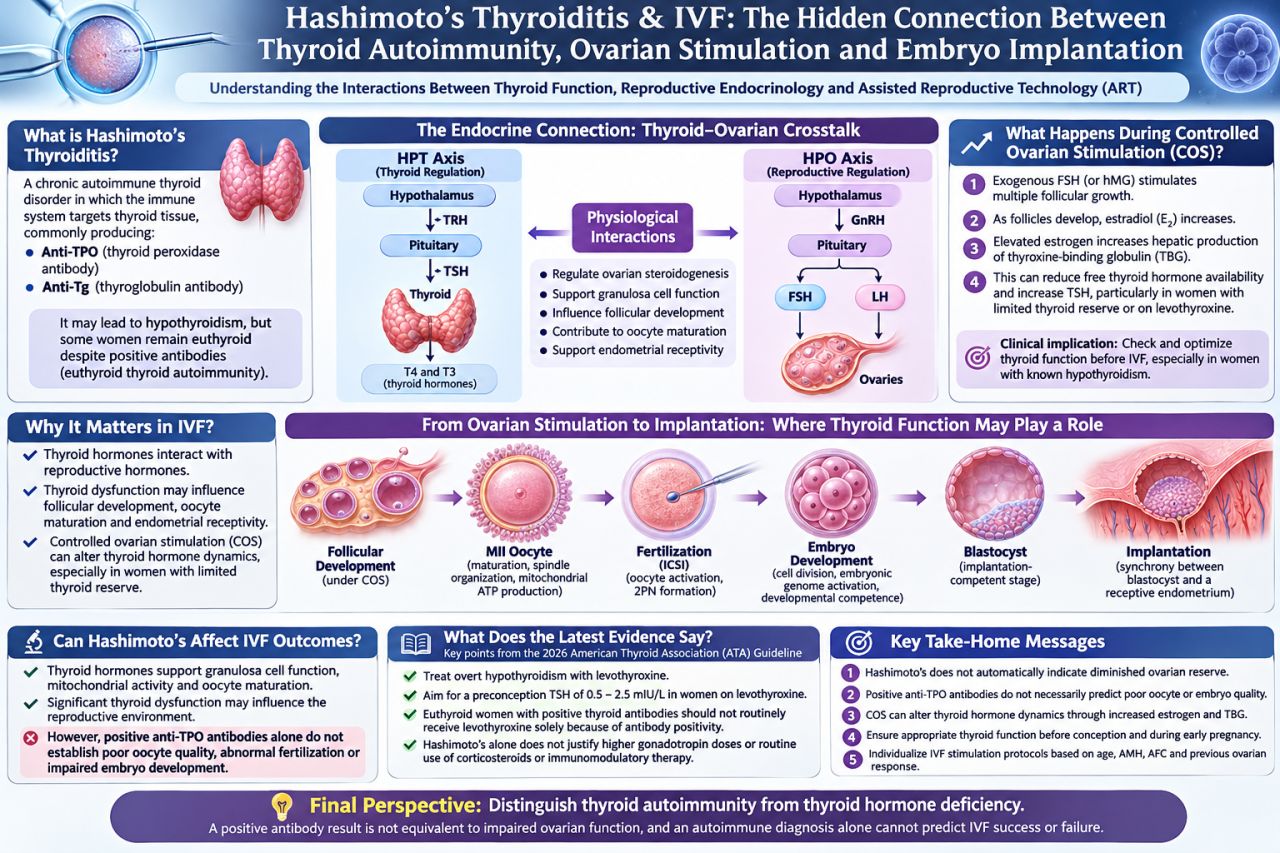
“Hashimoto’s Thyroiditis and IVF: The Hidden Connection Between Thyroid Autoimmunity, Ovarian Stimulation and Embryo Implantation.
In reproductive medicine, IVF outcomes depend on more than ovarian stimulation and embryo quality. The maternal endocrine environment also plays an important role.
1. Understanding Hashimoto’s Thyroiditis
Hashimoto’s is an autoimmune thyroid disorder associated with two major antibodies:
- Anti-TPO: Targets thyroid peroxidase.
- Anti-Tg: Targets thyroglobulin.
Although thyroid autoimmunity may lead to hypothyroidism, some women remain euthyroid despite positive antibodies.
2. The Thyroid–Ovarian Connection
The HPT axis regulates thyroid hormones (T3 and T4), while the HPO axis regulates reproductive hormones (FSH and LH). Thyroid dysfunction may influence ovarian steroidogenesis, follicular development, granulosa cell function and menstrual regulation. Significant hypothyroidism may also increase prolactin, potentially disturbing GnRH secretion.
3. What Happens During IVF Stimulation?
FSH or hMG stimulates multiple follicles, increasing estradiol (E2). Elevated estrogen increases hepatic thyroxine-binding globulin (TBG), potentially altering thyroid hormone availability and increasing TSH, particularly in women with limited thyroid reserve.
4. Does Hashimoto’s Affect Oocyte Quality?
Oocyte maturation requires mitochondrial ATP production, meiotic spindle organization and accurate chromosome segregation. Thyroid hormones contribute to ovarian cellular metabolism. However, positive anti-TPO antibodies alone do not establish poor oocyte quality or impaired embryo development.
5. Fertilization and Implantation
Successful fertilization requires oocyte activation, completion of meiosis II and formation of two pronuclei (2PN). Embryo development and implantation depend on embryonic competence and endometrial receptivity. Current evidence does not establish that thyroid antibodies directly cause fertilization or implantation failure.
6. Clinical Considerations: 2026 ATA Guidance
- Treat overt hypothyroidism with levothyroxine.
- Women taking levothyroxine and planning pregnancy should generally target a preconception TSH of 0.5–2.5 mIU/L.
- Euthyroid women with positive thyroid antibodies should not routinely receive levothyroxine solely because of antibody positivity.
Hashimoto’s does not automatically mean diminished ovarian reserve, poor oocyte quality or IVF failure.
For reproductive specialists and clinical embryologists, distinguishing thyroid autoimmunity from thyroid hormone deficiency is essential.
A positive antibody result is not a prediction of reproductive failure.
What is your perspective on routine thyroid assessment before IVF?”
Other articles featuring Khalil Faaed on Fertility News.
-
Nov 25, 2026, 18:38Yousef Alebrahim: Delighted to Stand for Junior Clinician Representative on the British Fertility Society
-
Nov 25, 2026, 18:33Theo Lemouton: Does Adenomyosis Have Symptoms of Its Own?
-
Nov 25, 2026, 18:27Rajeev Agarwal: Which Medicines You Should Stop Before Pregnancy
-
Nov 25, 2026, 18:23Helen O’Neill Presents First Findings from Hertility’s Proprietary Frontier Model at Harvard and MIT
-
Nov 25, 2026, 18:18Susanne Mitschke: When Fertility Clinics Close, Patients Absorb the Fallout
-
Nov 25, 2026, 18:16Paresh Makwana: Delighted to Pass the ESHRE Senior Clinical Embryologist Certification Exam
-
Nov 25, 2026, 18:12Ippokratis Sarris: Talking About Women Having Babies Later in Life with Shay Kaur Grewal
-
Nov 25, 2026, 18:06New RBMO Study Finds Comparable Rates of Rare Autosomal Aneuploidies in ART and the General Population
-
Nov 25, 2026, 17:56Lowell Ku: Protecting Your Peace Isn’t Rude, Sometimes It’s Necessary