
Caspian Ostadian/LinkedIn
Sep 21, 2026, 17:44
Caspian Ostadian: Oocyte Abnormalities and Blastocyst Formation
Caspian Ostadian, Embryologist at Mehr Assistant Reproductive Center, shared on LinkedIn:
”Oocyte Abnormalities and Blastocyst Formation
Does abnormal oocyte morphology always mean poor developmental potential?
Not necessarily. Some oocytes with morphological abnormalities can still develop into blastocysts.
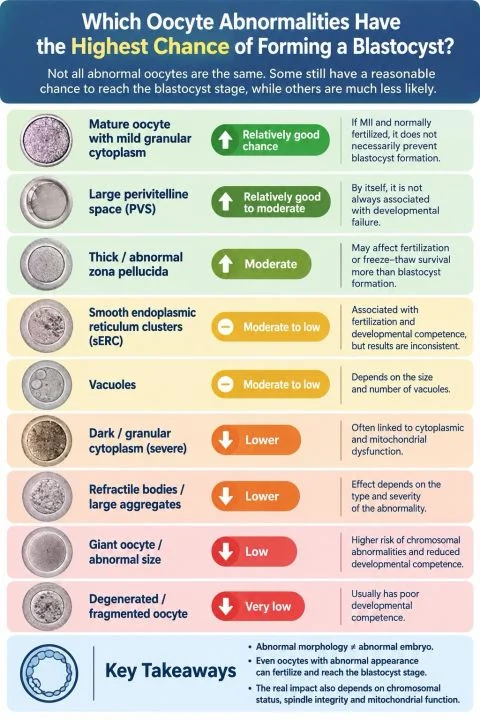
Relatively favorable potential
- Mild cytoplasmic granularity
- Large perivitelline space (PVS)
- Thick or abnormal zona pellucida
Moderate to potentially reduced potential
- Smooth endoplasmic reticulum clusters (sERC)
- Cytoplasmic vacuoles
Potentially poorer developmental outcomes
- Severe dark or granular cytoplasm
- Refractile bodies and large cytoplasmic aggregates
- Giant oocytes or abnormal oocyte size
- Degenerated or fragmented oocytes
Key Takeaways
- Abnormal morphology ≠ Abnormal embryo
- Some morphologically abnormal oocytes can reach the blastocyst stage.
- Developmental competence depends on multiple factors, including chromosomal status, spindle integrity, mitochondrial function, and cytoplasmic quality.
- The impact of each abnormality depends on its type, severity, and associated cellular mechanisms.
Important: These categories represent general observations, not a definitive ranking of blastocyst formation rates. Evidence varies across oocyte abnormalities and study populations.”
Stay informed with the latest updates in fertility and reproductive medicine on Fertility News.
-
Sep 21, 2026, 18:01Mostafa Maghraby: What Makes a Good Embryologist?
-
Sep 21, 2026, 17:57Paweł Radwan: Meeting Fertility Leaders at the European Executive and Investors Fertility Meeting
-
Sep 21, 2026, 17:49Anna David: Can You Predict Pregnancy Outcome at Diagnosis of Early-Onset FGR?
-
Sep 21, 2026, 17:40Eric Lameignere: What If Part of the Sperm DNA Damage We Observe is Actually Created in the IVF Laboratory Itself?
-
Sep 21, 2026, 17:29Angelo Tocci: Paying More Without Improving Assisted Reproduction Outcomes
-
Sep 21, 2026, 17:22Santiago Munne: The Latest Bpisode of The Baby Blueprint, About the Worldwide Decline in Birth Rates
-
Sep 21, 2026, 17:12Zeinab Kazemianpour: 1 Embryo, 2 Different Biopsy Strategies
-
Sep 21, 2026, 17:10Diksha Kanekar: A Day in the Life of an Embryologist
-
Sep 21, 2026, 17:06Elias Tsakos: IVF Does Not Increase the Risk of Breast Cancer