

Khalil Faaed: The Estradiol Paradox in IVF
Khalil Faaed, Embryologist at Modern IVF Center, shared on LinkedIn:
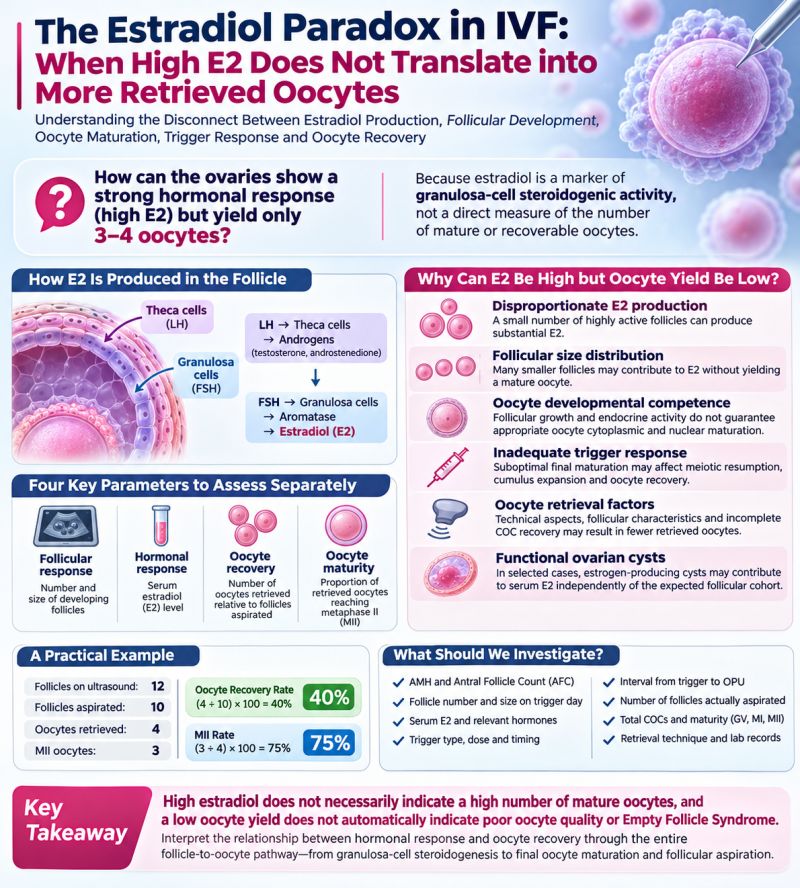
“The Estradiol Paradox in IVF: When High E2 Does Not Translate into More Retrieved Oocytes.
In IVF, high serum estradiol (E2) is often associated with a strong ovarian response. But what happens when a patient has elevated E2 levels yet only 3–4 oocytes are recovered during oocyte retrieval (OPU)?
How can high hormonal activity result in such a low oocyte yield?
The answer lies in understanding that follicular growth, estradiol production, oocyte maturation and successful oocyte recovery are related but distinct biological processes.
Why Can E2 Be High but Oocyte Yield Low?
Estradiol is produced by granulosa cells through aromatization of androgens supplied by theca cells under gonadotropin stimulation.
However, E2 reflects follicular steroidogenic activity, not the actual number of mature or recoverable oocytes.
Several factors may explain this discrepancy:
- Disproportionate E2 Production: A small number of highly active follicles may produce substantial estradiol.
- Follicular Size Distribution: Smaller follicles may contribute to E2 production without yielding mature oocytes.
- Oocyte Developmental Competence: Follicular growth does not guarantee adequate cytoplasmic or nuclear maturation.
- Inadequate Trigger Response: Suboptimal final maturation may affect meiotic resumption and cumulus expansion.
- Retrieval Factors: Technical difficulties or incomplete COC recovery may reduce oocyte yield.
- Functional Ovarian Cysts: Estrogen-producing cysts may contribute independently to circulating E2.
The Embryology Perspective
Four parameters must be distinguished:
- Follicular response: Number and size of developing follicles.
- Hormonal response: Serum E2 concentration.
- Oocyte recovery: Retrieved oocytes relative to follicles aspirated.
- Oocyte maturity: Percentage of retrieved oocytes reaching MII.
A Practical IVF Example
A patient has 12 follicles identified, 10 aspirated and 4 oocytes recovered, including 3 MII oocytes.
- Oocyte Recovery Rate = (4 ÷ 10) × 100 = 40%
- MII Rate = (3 ÷ 4) × 100 = 75%
These calculations help distinguish low oocyte recovery from reduced oocyte maturity.
What Should We Investigate?
- AMH and baseline AFC.
- Follicular number and size distribution.
- E2 and relevant hormonal measurements.
- Trigger type, dose and administration time.
- Trigger-to-OPU interval.
- Number of follicles aspirated.
- Total COCs and GV, MI and MII distribution.
- Retrieval technique and laboratory records.
High E2 does not necessarily mean more mature oocytes.
E2 reflects ovarian steroidogenic activity, ultrasound evaluates follicular development, and the embryology laboratory assesses actual oocyte recovery and maturity.
Understanding the discrepancy requires evaluating the entire follicle-to-oocyte pathway rather than relying on estradiol levels alone.”
Other articles featuring Khalil Faaed on Fertility News.
-
Nov 28, 2026, 19:36Amit Dhamapurkar: Upcoming Webinar on IMSI with Dr. Sarabpreet Singh
-
Nov 28, 2026, 19:25Karen Kong: Worried About the Injections Involved in IVF?
-
Nov 28, 2026, 19:19Rohan Lewis: Have Textbooks Got the Structure of the Human Umbilical Cord Wrong?
-
Nov 28, 2026, 19:08Beata Blazkova: Is a Specialised Embryo Transfer Medium a Routine Part of Your IVF Practice?
-
Nov 28, 2026, 18:36Cyril Djari: Where Do the Cells That Surround and Nurture the Oocyte Come From?
-
Nov 28, 2026, 18:24Laura Rienzi: Meeting Louise Brown, the World’s 1st IVF Baby
-
Nov 28, 2026, 18:12Mohammad Ismail: Excited to Share My Experience with Piezo-ICSI
-
Nov 28, 2026, 17:25Michal Masternak: Young Ovarian Tissue Transplantation Supports Immune Health Beyond Reproduction
-
Nov 28, 2026, 17:22Hajar Vahabzadeh: Before Embryo Arrest – 5 Morphokinetic Signals Worth Paying Attention To