
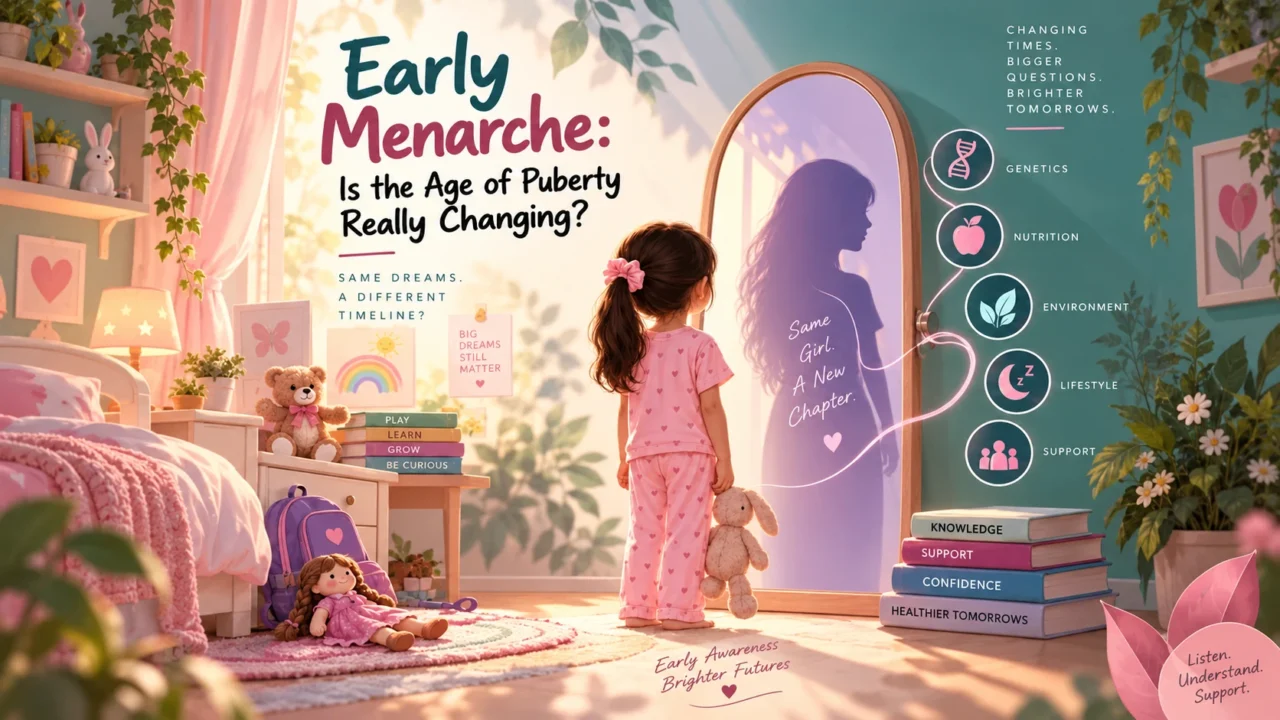
Devyanshi Dixit: Early Menarche – Is the Age of Puberty Really Changing?
Devyanshi Dixit, Program Manager at CLS Event and Publication and Conference Manager at the 12th Global Summit on Gynecology, Fertility and Women’s Health, shared on LinkedIn:
“Early Menarche: Is the Age of Puberty Really Changing?
A little girl stands in front of the mirror.
She is only 9…maybe 10 years old.
Still playing with toys. Still learning about the world.
And suddenly, her body begins to change.
For many families, the first period is a celebration of growing up.
But for researchers and healthcare professionals, an important question is emerging:
Are girls entering puberty earlier than previous generations?
Research from different parts of the world suggests that the average age of puberty and menarche (the first menstrual period) may be changing in some populations.
Scientists are exploring many possible reasons, including:
- Genetics
- Nutrition and childhood growth patterns
- Body composition and metabolic health
- Environmental exposures
- Sleep, lifestyle, and modern living conditions
But early menarche is not just about timing.
It may also influence health later in life.
Studies have examined associations between earlier puberty and:
- PCOS
- Metabolic health changes
- Cardiovascular risk factors
- Mental and emotional well-being
- Certain hormone-related diseases
This does not mean that every girl with early menarche will experience these conditions.
But it reminds us of something important:
And perhaps the most important question is not:
‘Why is puberty happening earlier?’
But:
‘How can we better support girls during this transition?’
Because every child deserves:
- Accurate health education
- Understanding instead of embarrassment
- Open conversations
- Support for both physical and emotional well-being
The first period should never be a source of fear.
It should be a moment met with knowledge, care, and compassion.
As research continues, understanding puberty may help us better understand the future of women’s health itself.
Explore emerging research in adolescent health, reproductive medicine, endocrinology, and women’s healthcare at GFWH 2026.
- November 23-24, 2026
- Bangkok, Thailand.”
Other articles featuring Devyanshi Dixit on Fertility News.
-
Sep 23, 2026, 18:05Position Statement on Venous Thromboembolism in Pregnancy – RCOG
-
Sep 23, 2026, 17:55Devora Lieberman: After Nearly 30 Years in IVF in Australia, I’m Retiring from Clinical Practice
-
Sep 23, 2026, 17:49Stacy Macpherson: 2 Conferences, Countless Conversations, 1 Passionate Fertility Community
-
Sep 23, 2026, 17:36Aiden Dashti: IVF and ART Labware Dishes at a Glance
-
Sep 23, 2026, 17:26The Professional Perspectives Sessions Happening at ASRM 2026 in Baltimore
-
Sep 23, 2026, 17:04Asma Khalil: A Fantastic Experience Delivering a Practical Session at the ISUOG World Congress
-
Sep 23, 2026, 17:01Alison Campbell։ A Great Weekend at the Trust Fertility Clinic Conference
-
Sep 23, 2026, 16:57Antonio Requena Miranda: An Exciting New Collaboration Between IVI RMA Global and Conceivable Life Sciences
-
Sep 23, 2026, 16:53An Amazing Weekend at the Canadian Fertility and Andrology Society’s 72nd Annual Meeting – Fairfax EggBank