

Sean Lauber: 0PN Embryos in IVF, What Does the Latest Evidence Tell Us?
Sean Lauber, Healthcare newsletter writer at SmartBrief, shared a post on LinkedIn:
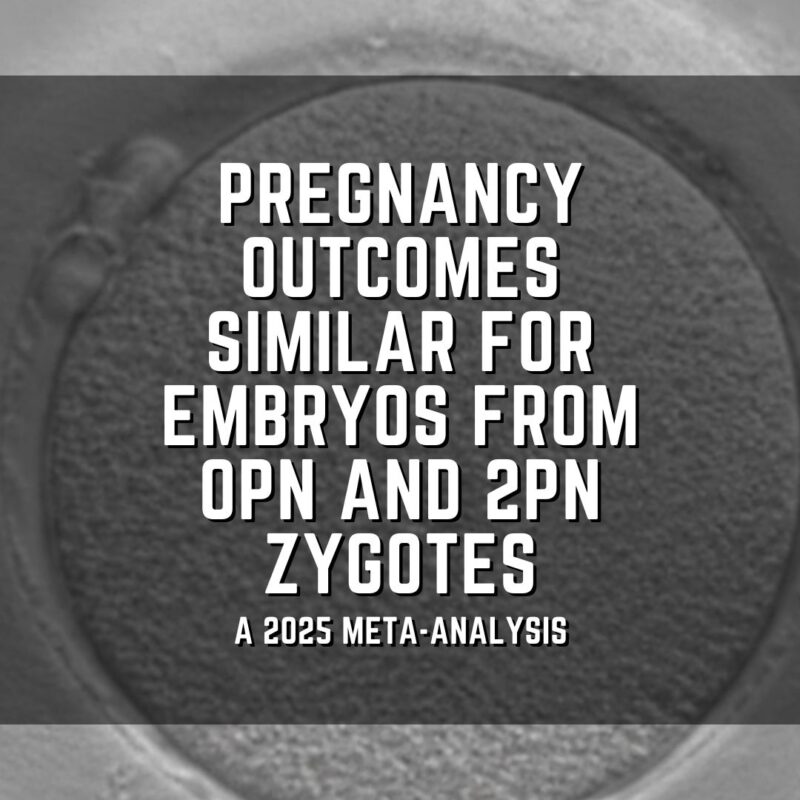
“Researchers combined the results of 9 studies and found that embryos from 0PN zygotes had similar pregnancy outcomes to embryos from normally fertilized (2PN) zygotes, despite being less likely to develop into blastocysts.
In IVF, fertilization is confirmed by seeing two pronuclei (2PN) in the fertilized egg (zygote) a day after insemination. Because these structures are only visible briefly, some normally fertilized zygotes may be mistakenly classified as 0PN (no visible pronuclei).
Chan et al. (2026) performed a meta-analysis and combined the results of 9 studies to see how embryos from 0PN zygotes compare to normally fertilized 2PN zygotes.
They found that embryos from 0PN zygotes that reach the blastocyst stage have pregnancy outcomes similar to embryos from 2PN zygotes, although they’re less likely to develop into blastocysts in the first place.
One possible explanation is that some 0PN zygotes are actually ‘false’ 0PNs, which are normally fertilized zygotes whose pronuclei formed or disappeared outside the standard 16–18 hour fertilization check.
They also compared IVF- and ICSI-derived 0PN zygotes. Pregnancy outcomes were lower for embryos from IVF-derived 0PN zygotes, but not ICSI-derived 0PN zygotes.
This may be because IVF-derived 0PN zygotes are more likely to include embryos resulting from polyspermy (fertilization by more than one sperm), although the subgroups were smaller and this finding should be interpreted with caution, the authors note.
Check out more details on Remembryo.
Like this post? Get a free weekly summary of the latest IVF research.”
Stay updated on all scientific advances in the field of fertility with Fertility News.
-
Sep 15, 2026, 18:18A PCOS Diagnosis Can Stay in the Background of Every Fertility Conversation – Banker IVF and Women’s Hospital
-
Sep 15, 2026, 18:15The Difference Between Ovulation Induction and Ovarian Stimulation – Fertility Plus
-
Sep 15, 2026, 18:13Ritu Anand: What Would I Tell an IVF Couple in the 1980s?
-
Sep 15, 2026, 18:11STP Curriculum Feedback Survey – The Association of Reproductive and Clinical Scientists
-
Sep 15, 2026, 18:09Khushi Mishra: ICSI – Where Precision Meets the Possibility of Life
-
Sep 15, 2026, 18:06Khalil Faaed: The Future of niPGT-A Is Not Just Non-Invasive…
-
Sep 15, 2026, 18:04Anuradha Housnur: ICSI Is Not About Injecting the Sperm…
-
Sep 15, 2026, 18:02Snehal Kaware: Can an Oocyte With a Vacuole Still Fertilize?
-
Sep 15, 2026, 17:59Kanishka Gaur: Amenorrhea Is a Symptom, Not a Diagnosis