

Dinesh Velu Rajan: Revolutionizing Male Infertility Diagnosis with Epigenetic Tools
Dinesh Velu Rajan, Junior embryologist at Dr Aravind’s IVF, shared a post on LinkedIn about a paper by Zesong Li et al. published in Scientific Reports:
“Fertility Frontline | Breaking News in Reproductive Medicine
Male infertility accounts for nearly 50% of infertility cases, and among its causes, non-obstructive azoospermia (NOA) remains one of the most complex and emotionally challenging conditions. In NOA, no sperm are detected in semen – not due to obstruction, but because of impaired or arrested spermatogenesis.
For years, clinicians have relied on hormonal evaluation, testicular biopsy, and surgical sperm retrieval (mTESE) to assess sperm production. These approaches, while useful, are often invasive and uncertain.
Where did this idea come from?
As early as 2015, research demonstrated that epigenetic regulation plays a critical role in spermatogenesis. A landmark study published in Scientific Reports showed that defects in genes involved in epigenetic regulation are strongly associated with spermatogenic failure in men with NOA.
Foundational research (2015):
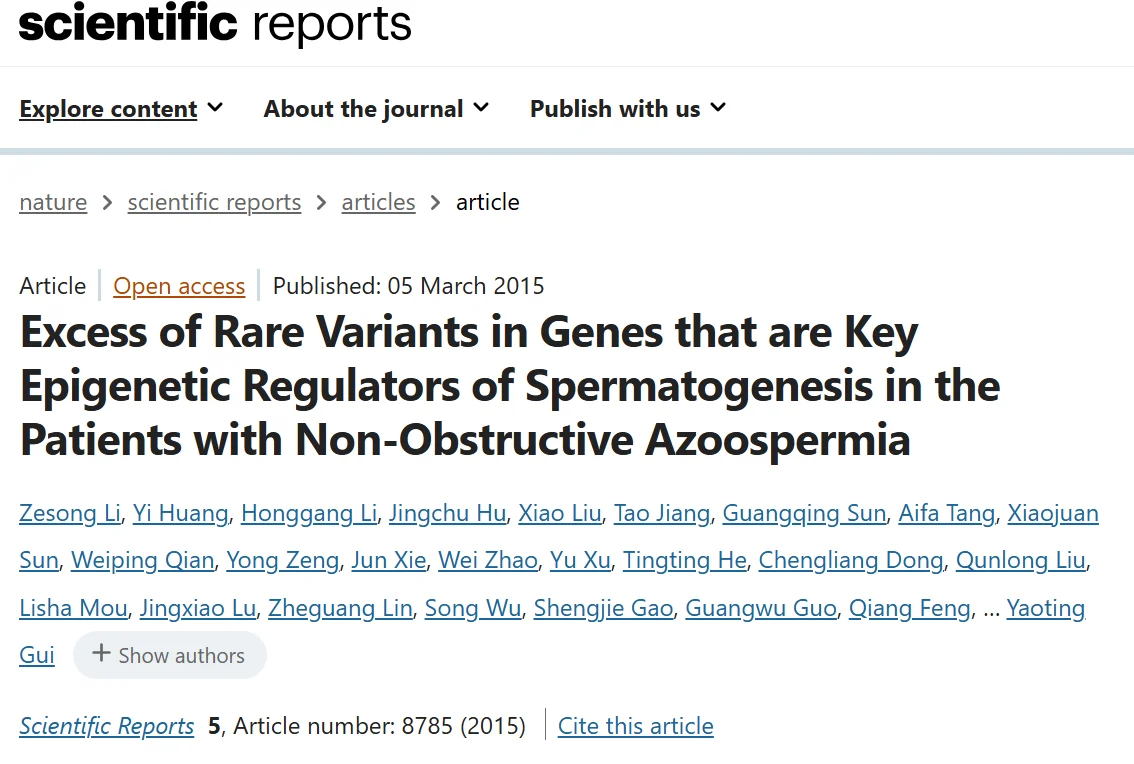
Excess of Rare Variants in Genes that are Key Epigenetic Regulators of Spermatogenesis in Patients with Non-Obstructive Azoospermia
Read more.
At that time, this discovery was theoretical and mechanistic—it helped us understand why spermatogenesis fails, but it was not yet clinically actionable.
What’s new now?
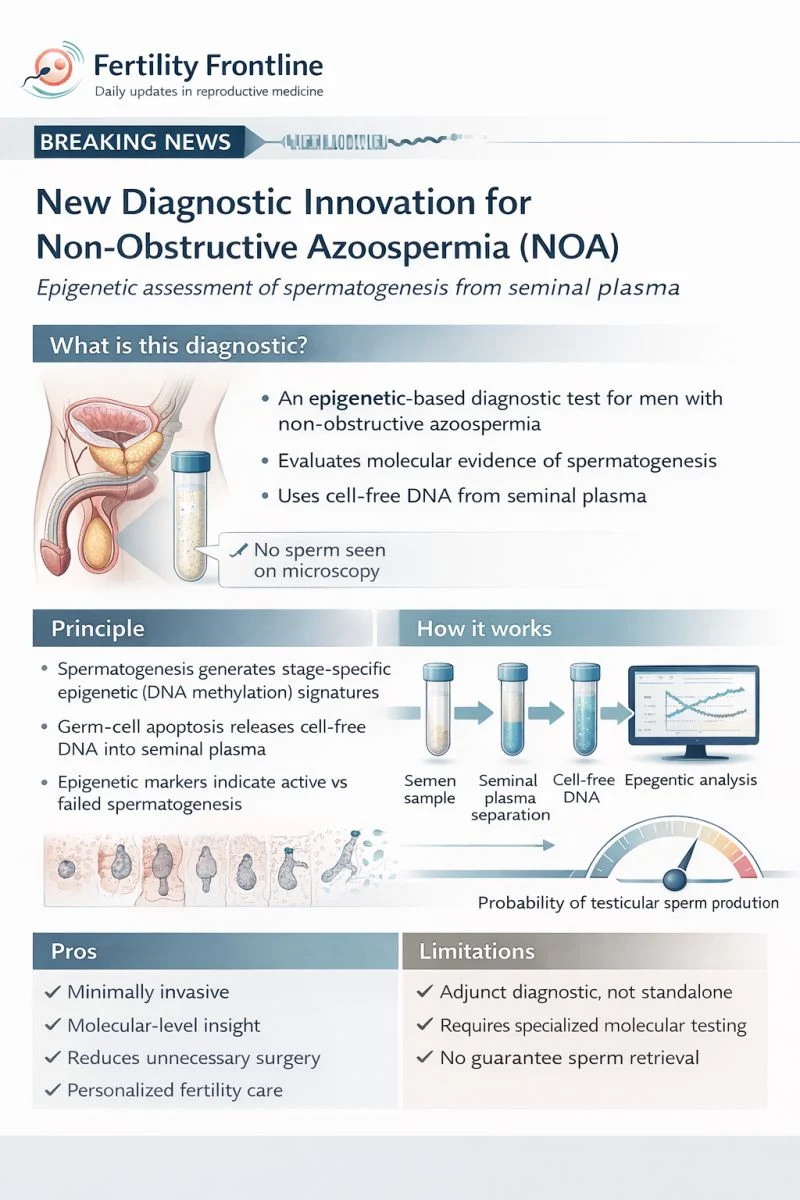
Fast forward to recent years: this foundational epigenetic knowledge has been translated into a clinical diagnostic test. The new approach analyzes cell-free DNA from seminal plasma, looking for spermatogenesis-specific epigenetic (DNA methylation) signatures—even when no sperm are visible under microscopy.
The biological principle:
During spermatogenesis, germ cells acquire stage-specific epigenetic patterns. When these cells undergo apoptosis, fragments of DNA carrying these epigenetic marks are released into seminal plasma. Detecting these signatures allows clinicians to infer whether active or failed spermatogenesis is occurring inside the testis.
Why this matters clinically:
- Predicts the likelihood of successful mTESE
- Improves patient counseling and expectation setting
- Reduces unnecessary invasive procedures
- Supports personalized fertility treatment planning
Important note:
This diagnostic is an adjunct tool, not a standalone test, and it does not guarantee sperm retrieval. However, it represents a major step forward in applying precision medicine to male infertility.
This is a powerful example of how a decade-old research insight has finally reached the clinic.
At Fertility Frontline, we bring you daily, evidence-based updates that bridge research and real-world fertility care.
Save | Share | Follow for daily updates in reproductive medicine”
Title: Excess of Rare Variants in Genes that are Key Epigenetic Regulators of Spermatogenesis in the Patients with Non-Obstructive Azoospermia
Authors: Zesong Li, Yi Huang, Honggang Li, Jingchu Hu, Xiao Liu, Tao Jiang, Guangqing Sun, Aifa Tang, Xiaojuan Sun, Weiping Qian, Yong Zeng, Jun Xie, Wei Zhao, Yu Xu, Tingting He, Chengliang Dong, Qunlong Liu, Lisha Mou, Jingxiao Lu, Zheguang Lin, Song Wu, Shengjie Gao, Guangwu Guo, Qiang Feng, Yaoting Gui
Stay updated on all scientific advances in the field of fertility with Fertility News.
-
Apr 3, 2026, 12:57Sergei Gorlovetsky: The Invisible Work Breaking Fertility Clinics
-
Apr 3, 2026, 12:50Ting Yuan: Rethinking Oocyte Quality Through Reproducible Patterns
-
Apr 3, 2026, 12:36Asma Khalil: An Incredibly Powerful Podcast Brings Attention to Women’s Fertility Challenges
-
Apr 3, 2026, 12:29Angela Koech: Every 30 Seconds, Africa Loses a Baby to a Preventable Stillbirth
-
Apr 3, 2026, 12:17Sergei Gorlovetsky: AI Support Expands Guidance for IVF Patients at Home
-
Apr 3, 2026, 12:06Thin Womb Lining Doesn’t Have to End Your IVF Dreams – Fertility Plus
-
Apr 3, 2026, 12:04Updated NICE IVF Guidance Contrasts with Declining NHS Support – HFEA
-
Apr 3, 2026, 11:59IVF Remains Safe for Women With a History of Cancer – ESHRE
-
Apr 3, 2026, 11:56Vitamin D Binding Protein and Reproductive Outcomes – Fertility and Sterility