
Fertility Preservation Before Cancer Treatment: What Patients Should Know
Fertility preservation before cancer treatment can be an important part of cancer care for patients who may want children in the future. Chemotherapy, radiation therapy, surgery, and some newer cancer treatments can affect the ovaries, testes, reproductive organs, or the hormones that control fertility.
The risk of infertility depends on the type of cancer treatment, the dose, the area of the body being treated, and the patient’s age and baseline fertility. For some patients, fertility may recover after treatment, while for others the effects can be long term or permanent.
Because many fertility preservation options work best before cancer treatment begins, early discussion is important. Options may include egg or embryo freezing, sperm banking, ovarian tissue cryopreservation, ovarian transposition, and fertility-sparing surgery.
This guide explains how cancer treatment can affect fertility, when fertility preservation should be discussed, which options are available for women and men, and whether fertility preservation can be completed without delaying cancer treatment.
How Does Cancer Treatment Affect Fertility?
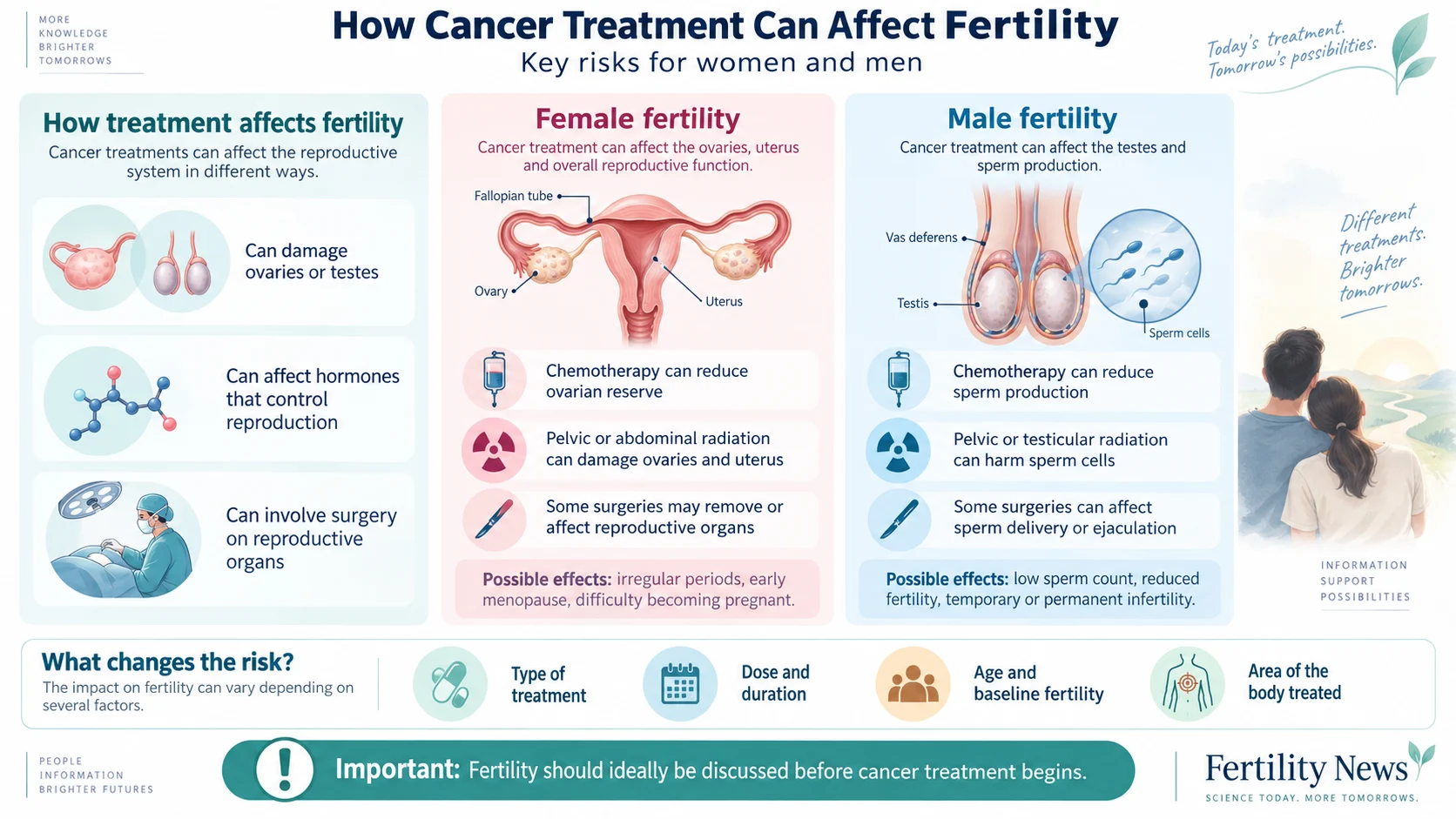
Cancer treatment can affect fertility by damaging the ovaries or testes, changing the hormones that control reproduction, or affecting reproductive organs directly. The risk depends on the type of treatment, the dose and duration, the patient’s age, baseline fertility, and which part of the body is treated. Changes in fertility may be temporary for some patients and permanent for others (National Cancer Institute; ASRM, 2026).
How Cancer Treatment Can Affect Female Fertility
Chemotherapy can damage the ovarian follicles that contain eggs and reduce the ovarian reserve, or the number of eggs remaining in the ovaries. Alkylating chemotherapy drugs, such as cyclophosphamide, ifosfamide, and procarbazine, are among the treatments with the greatest risk of ovarian damage. Some platinum-based treatments can also affect ovarian function. Depending on the treatment and individual patient, this may lead to temporary changes in menstrual periods, difficulty becoming pregnant, or primary ovarian insufficiency, in which the ovaries stop functioning normally earlier than expected (National Cancer Institute; ASRM, 2026).
Radiation therapy involving the pelvis or abdomen can damage the ovaries and reduce the number of remaining eggs. Radiation involving the uterus may also affect blood flow and tissue flexibility, which can influence the ability to carry a pregnancy later. Radiation to areas of the brain that include the hypothalamus or pituitary gland can interfere with hormonal signals needed for normal ovarian function. Surgery may also affect fertility when treatment requires removal of the uterus, both ovaries, or other reproductive structures (National Cancer Institute).
How Cancer Treatment Can Affect Male Fertility
In males, chemotherapy can damage the cells in the testes that produce sperm. Alkylating agents are particularly associated with impaired sperm production, while the effect of other treatments depends on the specific drug and cumulative dose. Sperm production may recover after treatment in some patients, while others may develop long-term or permanent infertility (National Cancer Institute).
Radiation involving the testes or pelvis can also reduce sperm production, while radiation affecting the hypothalamus or pituitary gland may disrupt the hormones needed for normal testosterone and sperm production. Surgery involving the testes, prostate, or other pelvic structures can affect sperm production, ejaculation, or the ability to deliver sperm normally (National Cancer Institute).
Because the effect of cancer treatment on fertility varies considerably between patients, fertility risk should ideally be discussed before cancer treatment begins. Current ASCO and ASRM guidance recommends early counseling and referral to a fertility specialist when future fertility may be important to the patient (Su et al., 2025; ASRM, 2026).
When Should Fertility Preservation Be Discussed Before Cancer Treatment?
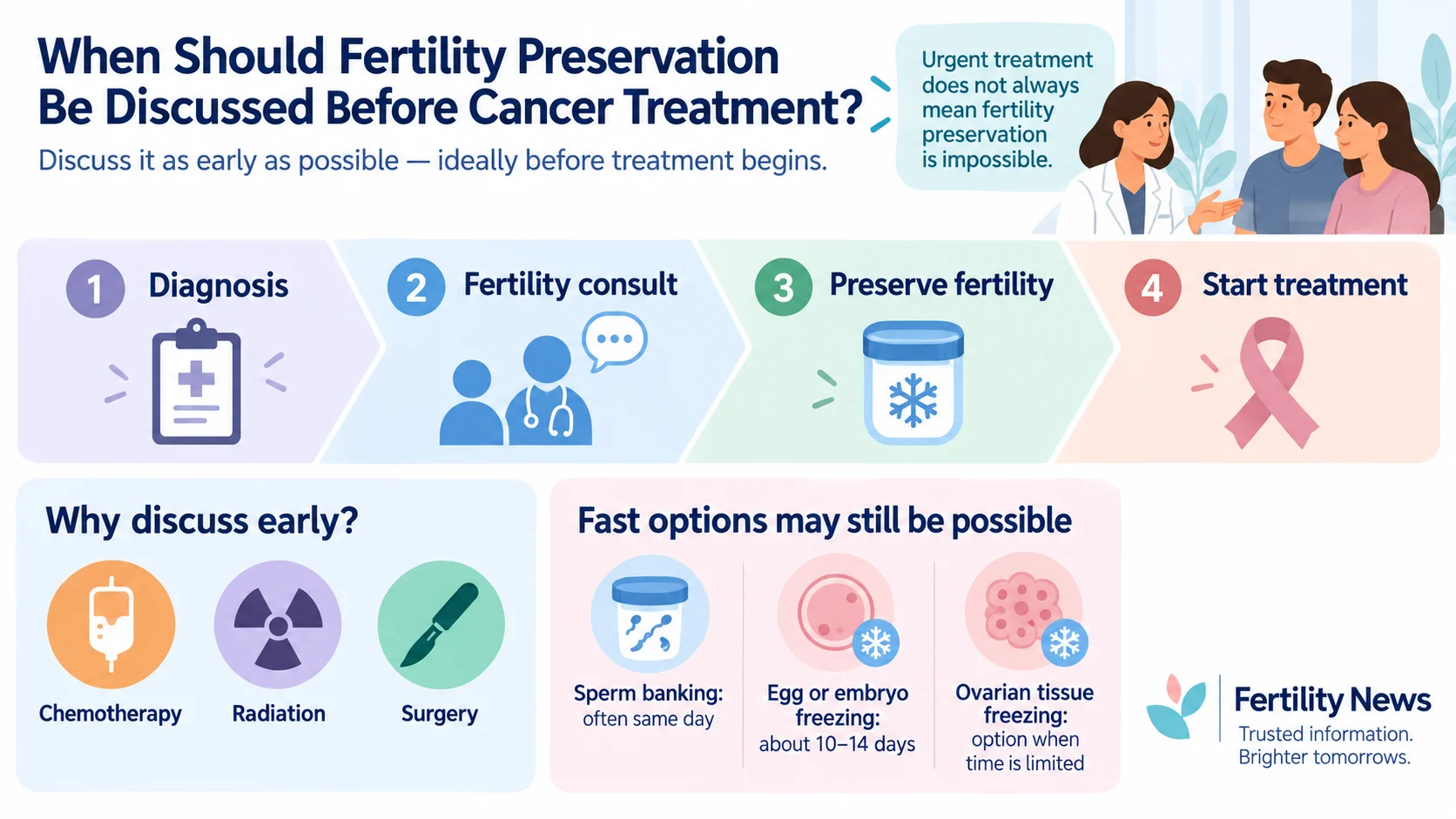
Fertility preservation should be discussed as early as possible after a cancer diagnosis and, whenever possible, before treatment that could affect future fertility begins. This includes certain chemotherapy drugs, radiation involving the reproductive organs or hormone-producing areas of the brain, and surgery involving the ovaries, uterus, testes, or other reproductive structures.
Current ASCO guidance recommends assessing reproductive risks at diagnosis and discussing fertility preservation before cancer-directed therapy. Patients who are interested in preserving fertility, or who are unsure about their future reproductive plans, should be referred promptly to a reproductive specialist so that available options can be reviewed without unnecessarily delaying cancer treatment (Su et al., 2025).
For many patients, fertility preservation can be completed within the limited time available before treatment. Sperm cryopreservation can often be arranged quickly, while embryo or egg freezing usually requires ovarian stimulation and egg retrieval. Ovarian tissue cryopreservation may be considered when there is not enough time for ovarian stimulation or in selected younger patients. ASRM similarly recommends prompt counseling before fertility-threatening treatment whenever possible (ASRM, 2026).
What If Cancer Treatment Needs to Start Quickly?
An urgent need to begin cancer treatment does not always mean fertility preservation is impossible. Modern random-start ovarian stimulation allows stimulation to begin at different points in the menstrual cycle rather than waiting for the next period, helping reduce the time needed before egg or embryo cryopreservation. ASRM notes that immediate-start approaches generally cause negligible treatment delays compared with conventional stimulation (ASRM, 2026).
When there is not enough time for egg or embryo freezing, other approaches may be considered depending on the patient. These can include ovarian tissue cryopreservation, rapid sperm collection, or ovarian transposition before pelvic radiation. The oncology and fertility teams should work together to choose an option that fits within the cancer treatment timeline without compromising necessary cancer care.
Fertility should also not be treated as a one-time conversation. Current ASCO guidance recommends revisiting reproductive health during survivorship, particularly for patients who were unable to preserve fertility before treatment or whose reproductive goals change later (Su et al., 2025).
What Fertility Preservation Options Are Available for Women With Cancer?
Women with cancer have several fertility preservation options, and the best approach depends on age, cancer type, how soon treatment needs to begin, and future pregnancy goals.
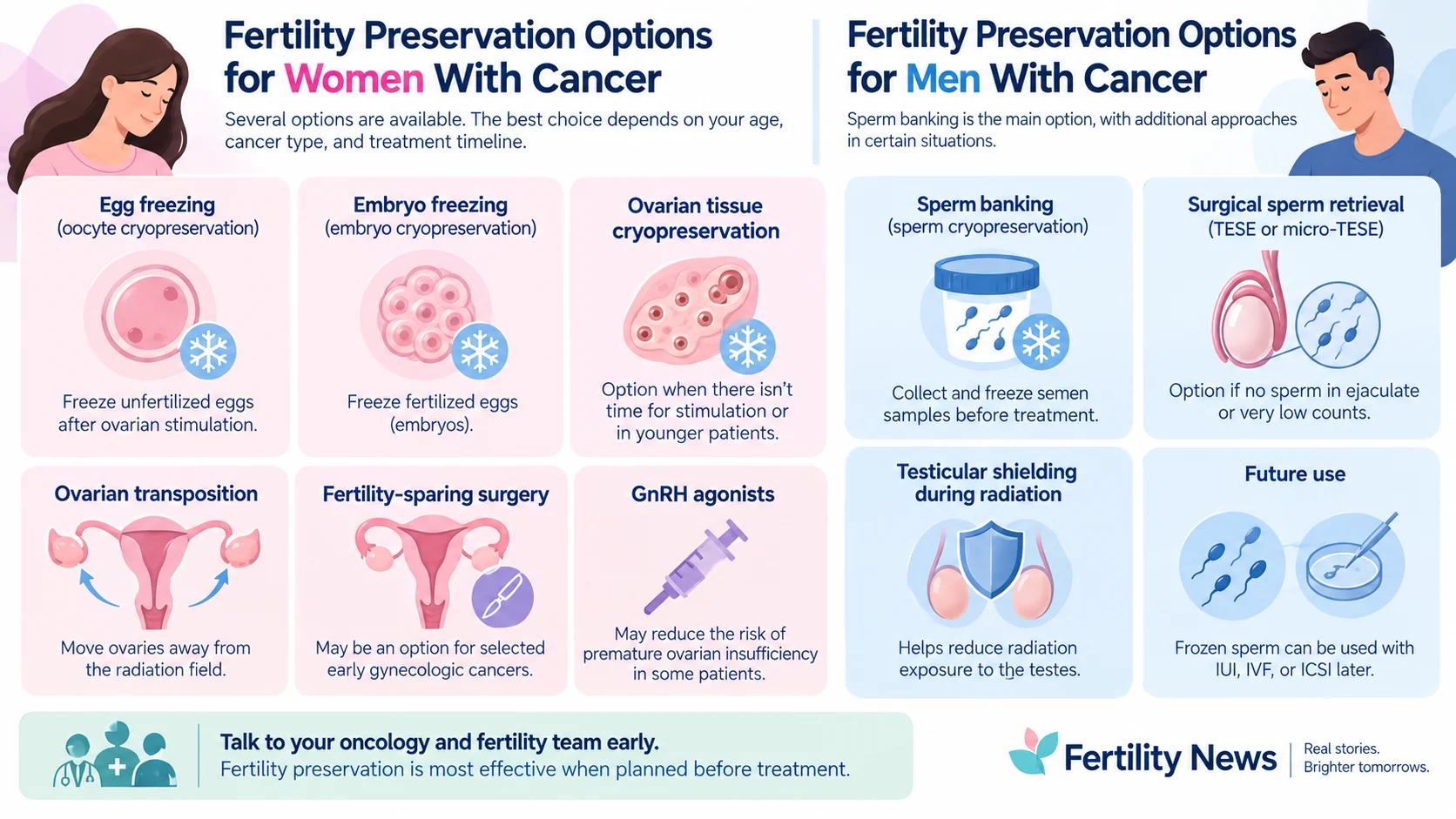
Egg and embryo cryopreservation are among the most established options. Both involve ovarian stimulation followed by egg retrieval. Eggs can be frozen unfertilized or fertilized and stored as embryos. Random-start stimulation can often begin at different points in the menstrual cycle, helping reduce delays before cancer treatment.
Ovarian tissue cryopreservation may be considered when there is not enough time for ovarian stimulation or in girls who have not yet reached puberty. Ovarian tissue is surgically removed and frozen, with the possibility of later transplantation to restore ovarian function and fertility.
For patients receiving pelvic radiation, ovarian transposition may be used to move the ovaries away from the radiation field. Selected patients with early gynecologic cancers may also be candidates for fertility-sparing surgery, depending on the cancer type, stage, and oncologic safety.
GnRH agonists may also be given during chemotherapy in some patients to reduce the risk of premature ovarian insufficiency. However, they are generally considered an additional strategy rather than a replacement for egg, embryo, or ovarian tissue cryopreservation.
Because no single option is right for everyone, fertility preservation should be planned together with the oncology and reproductive medicine teams before treatment whenever possible.
What Fertility Preservation Options Are Available for Men With Cancer?
For men and post-pubertal boys, sperm cryopreservation, or sperm banking, is the main fertility preservation option before cancer treatment. Whenever possible, sperm should be collected before chemotherapy, radiation involving the pelvis or testes, or surgery that could affect reproductive function.
Sperm banking usually involves collecting one or more semen samples, which are then frozen and stored for future use. If time allows, several samples may be collected to increase the amount of sperm available. Frozen sperm can later be used with assisted reproductive techniques such as intrauterine insemination (IUI), in vitro fertilization (IVF), or intracytoplasmic sperm injection (ICSI).
If a patient cannot produce a semen sample, has very low sperm counts, or has no sperm in the ejaculate, surgical sperm retrieval may be considered. Procedures such as testicular sperm extraction (TESE or micro-TESE) can sometimes retrieve sperm directly from testicular tissue for freezing or later use with ICSI.
For patients receiving radiation near the pelvis or testes, testicular shielding and careful radiation planning can help reduce unnecessary radiation exposure to the testes when this does not interfere with cancer treatment.
Fertility preservation should ideally be completed before treatment begins, because chemotherapy and radiation can reduce sperm production and may temporarily affect sperm quality. Some men who develop infertility after treatment may still have options, including surgical sperm retrieval, depending on their individual situation.
Can Fertility Preservation Be Done Without Delaying Cancer Treatment?
In many cases, fertility preservation can be completed without significantly delaying cancer treatment, especially when patients are referred to a fertility specialist soon after diagnosis.
For women, random-start ovarian stimulation allows egg or embryo freezing to begin at almost any point in the menstrual cycle rather than waiting for the next period. The process usually takes around 10–14 days, which can often fit within the time already needed for treatment planning or recovery after surgery.
For men, sperm banking can usually be completed very quickly, sometimes within one or two days, and therefore rarely causes a meaningful delay in treatment.
When cancer treatment needs to begin urgently, faster options may be considered. Ovarian tissue cryopreservation does not require ovarian stimulation and may be used when there is not enough time for egg or embryo freezing. Rapid sperm collection may also be arranged before treatment begins.
Some cancers, including certain acute leukemias or rapidly progressing diseases, may require treatment to start immediately. In these situations, the oncology team may recommend proceeding with cancer treatment rather than delaying it for fertility preservation.
The decision should always be individualized. Cancer type, stage, urgency of treatment, and the time required for the chosen fertility preservation method all need to be considered together by the oncology and reproductive medicine teams.
Written by Marine Marachlian, MD
FAQ
Can cancer treatment make you infertile?
Yes. Chemotherapy, radiation therapy, and some surgeries can temporarily or permanently affect fertility, depending on the treatment, dose, age, and reproductive organs involved.
When should fertility preservation be discussed?
Ideally, as soon as possible after diagnosis and before cancer treatment begins, especially if the planned therapy could affect future fertility.
What fertility preservation options are available for women with cancer?
Options may include egg freezing, embryo freezing, ovarian tissue cryopreservation, ovarian transposition, fertility-sparing surgery, and in some cases GnRH agonists.
What fertility preservation options are available for men with cancer?
Sperm banking is the main option. Surgical sperm retrieval may also be considered if sperm cannot be collected normally or sperm counts are very low.
Can fertility preservation delay cancer treatment?
Usually not significantly. Sperm banking can often be completed very quickly, while egg or embryo freezing typically takes around 10–14 days with modern random-start stimulation.
-
Sep 23, 2026, 18:2112 Myths about PMOS – Fertility Plus
-
Sep 23, 2026, 18:05Position Statement on Venous Thromboembolism in Pregnancy – RCOG
-
Sep 23, 2026, 17:55Devora Lieberman: After Nearly 30 Years in IVF in Australia, I’m Retiring from Clinical Practice
-
Sep 23, 2026, 17:49Stacy Macpherson: 2 Conferences, Countless Conversations, 1 Passionate Fertility Community
-
Sep 23, 2026, 17:36Aiden Dashti: IVF and ART Labware Dishes at a Glance
-
Sep 23, 2026, 17:26The Professional Perspectives Sessions Happening at ASRM 2026 in Baltimore
-
Sep 23, 2026, 17:10Devyanshi Dixit: Early Menarche – Is the Age of Puberty Really Changing?
-
Sep 23, 2026, 17:04Asma Khalil: A Fantastic Experience Delivering a Practical Session at the ISUOG World Congress
-
Sep 23, 2026, 17:01Alison Campbell։ A Great Weekend at the Trust Fertility Clinic Conference