

Giulia Zamagni: Critical Gaps in Machine Learning Models for Fetal Growth Restriction
Giulia Zamagni, PhD Candidate in Applied data Science and Artificial Intelligence at Università degli Studi di Trieste, shared a post on LinkedIn about a paper published in American Journal of Obstetrics and Gynecology MFM:
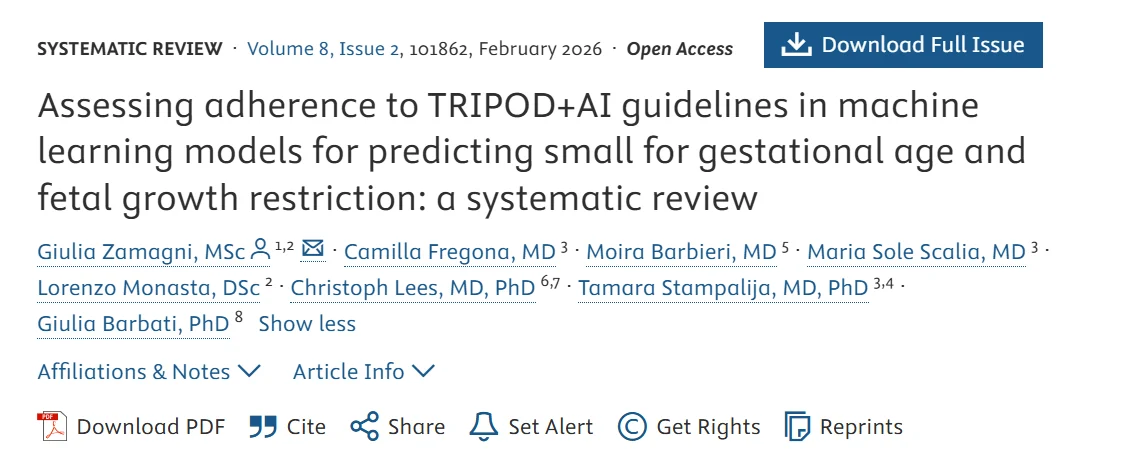
“I’m happy to share our latest work, published in American Journal of Obstetrics and Gynecology MFM: ‘Assessing Adherence to TRIPOD+AI Guidelines in Machine Learning Models for Predicting Small for Gestational Age and Fetal Growth Restriction: A Systematic Review’.
What did we find?
Despite the growing enthusiasm for machine learning in perinatal medicine, our systematic review reveals several critical gaps that limit clinical applicability:
Not a single model evaluated performance across clinically relevant subgroups. This means we have no idea whether these models behave differently – and potentially inequitably – for different populations.
Only 15% of studies evaluated calibration.
This is perhaps the most alarming finding.
In clinical prediction models, calibration is essential: predicted risks directly inform decisions such as surveillance intensity, timing of delivery, or need for intervention.
A model that is well-discriminating but poorly calibrated can overestimate or underestimate risks, leading to unnecessary interventions or missed opportunities for timely care. Yet, calibration was almost entirely overlooked.
Why this matters
Developing ML for healthcare must be more than a technical exercise: it requires robust methodology and thoughtful evaluation to truly support patient care.”
Title: Assessing adherence to TRIPOD+AI guidelines in machine learning models for predicting small for gestational age and fetal growth restriction: a systematic review
Authors: Giulia Zamagni, Camilla Fregona, Moira Barbieri, Maria Sole Scalia, Lorenzo Monasta, Christoph Lees, Tamara Stampalija, Giulia Barbati
Read the full article.
Stay updated on all scientific advances in the field of fertility with Fertility News.
-
Oct 11, 2025, 06:44The Global IVF Market Is Set to Reach $65B by 2032 – Meddilink
-
Mar 16, 2026, 13:30Simon Meagher and Rabih Chaoui Discuss Fetal Heart Scanning in the Latest ISUOG Podcast – ISUOG
-
Mar 16, 2026, 12:58Exploring the Link Between Adenomyosis and Proliferative Endometrial Disorders – Fertility and Sterility
-
Mar 16, 2026, 12:55Nicola Pozzi: A New Mechanism to Reduce Thrombus Formation Without Increasing Bleeding Risk
-
Mar 16, 2026, 12:44Endometriosis Awareness Month Virtual Issue! – ISUOG
-
Mar 16, 2026, 12:30Jeanne Conry: When the Government Intervenes, Women Die
-
Mar 16, 2026, 12:23Magdalena Simonis Highlights the Need to Change the Rhetoric on Endometriosis
-
Mar 16, 2026, 12:00Julia Chain Highlights Fertility Preservation as Part of Women’s Health Campaign – HFEA
-
Mar 15, 2026, 15:26Watching Life Begin: Scientists Track Embryo Implantation in Real Time! – Science Magazine
-
Mar 15, 2026, 15:03Reem Abu-Rustum Spotlights Fetal Situs in New ISUOG Quiz – ISUOG