
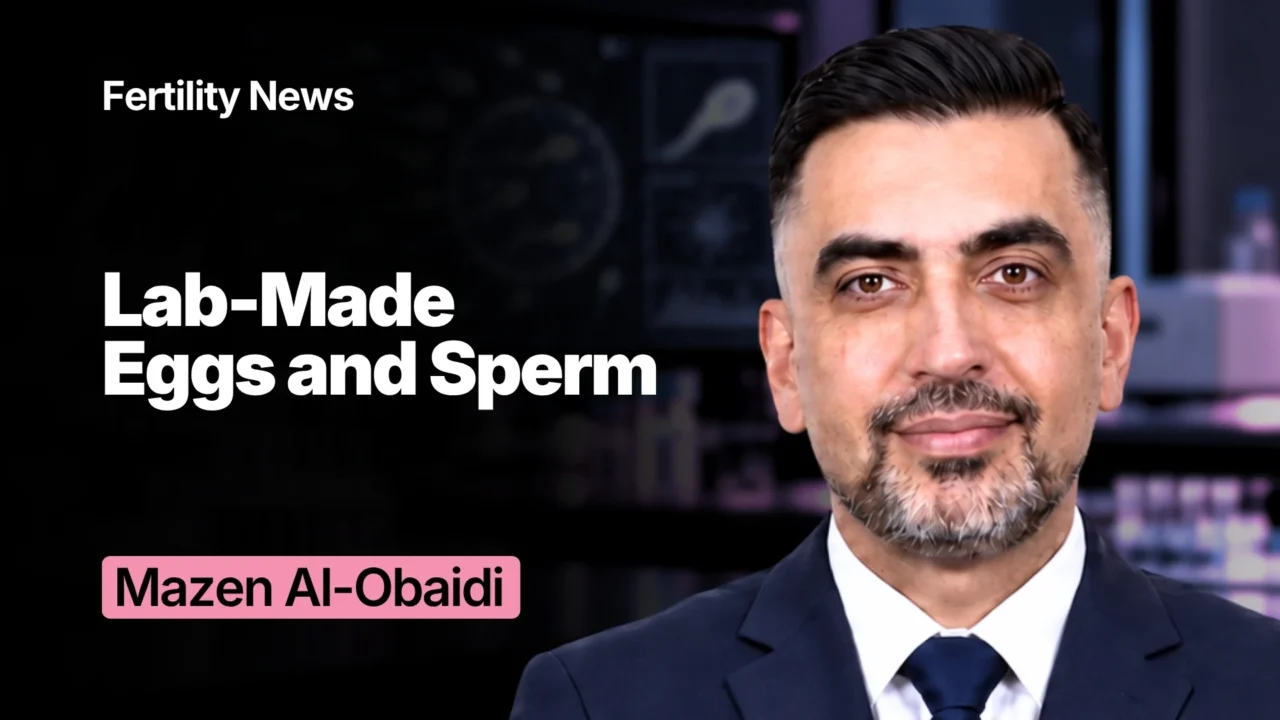
Mazen Al-Obaidi: Lab-Made Eggs and Sperm – The Science of In Vitro Gametogenesis
“In vitro gametogenesis is a laboratory method that makes eggs and sperm from ordinary body cells. In mice, the method already produces healthy, fertile offspring. In humans, it remains experimental and unproven. The approach draws strong scientific and ethical interest because it points to a new option for biological parenthood. This article explains what in vitro gametogenesis is, what it has achieved, who it targets, and the main challenges.
What is in vitro gametogenesis?
In vitro gametogenesis (IVG) turns a body cell into an egg or a sperm cell in the laboratory. The process runs in steps:
- A body cell, such as a skin cell, is reprogrammed into an induced pluripotent stem cell (iPSC). An iPSC is a cell able to form almost any cell type in the body.
- The iPSC is guided to become a primordial germ cell-like cell, the early form of an egg or sperm cell.
- The germ cell-like cell matures into a gamete, an egg or a sperm cell (Romualdez-Tan, 2023).
The method skips the need for natural egg or sperm production. This is the feature that draws interest for infertility care.
What has in vitro gametogenesis achieved so far?
The results in animals are advanced, while human work is at an early stage:
- In mice, iPSC-derived eggs show high fertilisation rates, and the embryos implant and lead to live births (Hikabe et al., 2016).
- Researchers have produced mice from two genetic mothers and from two genetic fathers using stem cell methods (Cho et al., 2023).
- In humans, the production of fully mature eggs or sperm in the laboratory remains unachieved (Kaltsas et al., 2025).
Who are the intended patients for in vitro gametogenesis?
Researchers describe several target groups (Cho et al., 2023):
- People with no retrievable sperm, such as men with non-obstructive azoospermia (an absence of sperm in the semen).
- Cancer survivors who lost fertility after treatment, through a fertility- preservation route from a simple skin biopsy (Wesevich et al., 2023).
- Women with few or no eggs due to advanced age or early ovarian failure.
- Same-sex or single people who seek a genetically related child.
What are the challenges and concerns?
Scientific hurdles remain large:
- Epigenetic reprogramming, the resetting of chemical marks on DNA, is hard to reproduce correctly in the laboratory (Adashi et al., 2024).
- The quality of laboratory-made eggs is a central concern for safety (Aizawa et al., 2024).
- Strict genomic and epigenomic quality control is required before any human use (Kaltsas et al., 2025).
Ethical and safety questions run alongside the science:
- The use of laboratory-made human gametes for reproduction is considered unsafe and unethical at present (Horer et al., 2023).
- The method raises questions about surplus embryos and the status of reproductive cells (Hein et al., 2025).”
Written by Mazen Al-Obaidi
Assistant Professor, University of Technology and Applied Sciences
References
Title: In vitro gametogenesis in the ongoing quest to vanquish infertility: the role of epigenetics
Authors: Eli Y. Adashi, Gary M. Wessel
You can read the Full Article in FandS Reports.

Title: In vitro gametogenesis: Towards competent oocytes
Authors: Eishi Aizawa, Antoine H. F. M. Peters, Anton Wutz
You can read the Full Article in BioEssays.
Title: Recent Developments in In Vitro Spermatogenesis and Future Directions
Authors: In Ki Cho, Charles A. Easley
You can read the Full Article in Reproductive Medicine.

Title: Making and disposing of life’s ‘starting materials’: A focus group study of attitudes concerning reproductive scarcity and abundance in in vitro gametogenesis
Authors: Robbin Jeffries Hein, Anne Le Goff, Hannah L. Landecker
You can read the Full Article in Social Science and Medicine
Title: Reconstitution in vitro of the entire cycle of the mouse female germ line
Authors: Orie Hikabe, Nobuhiko Hamazaki, Go Nagamatsu, Yayoi Obata, Yuji Hirao, Norio Hamada, So Shimamoto, Takuya Imamura, Kinichi Nakashima, Mitinori Saitou, Katsuhiko Hayashi
You can read the Full Article in Nature.
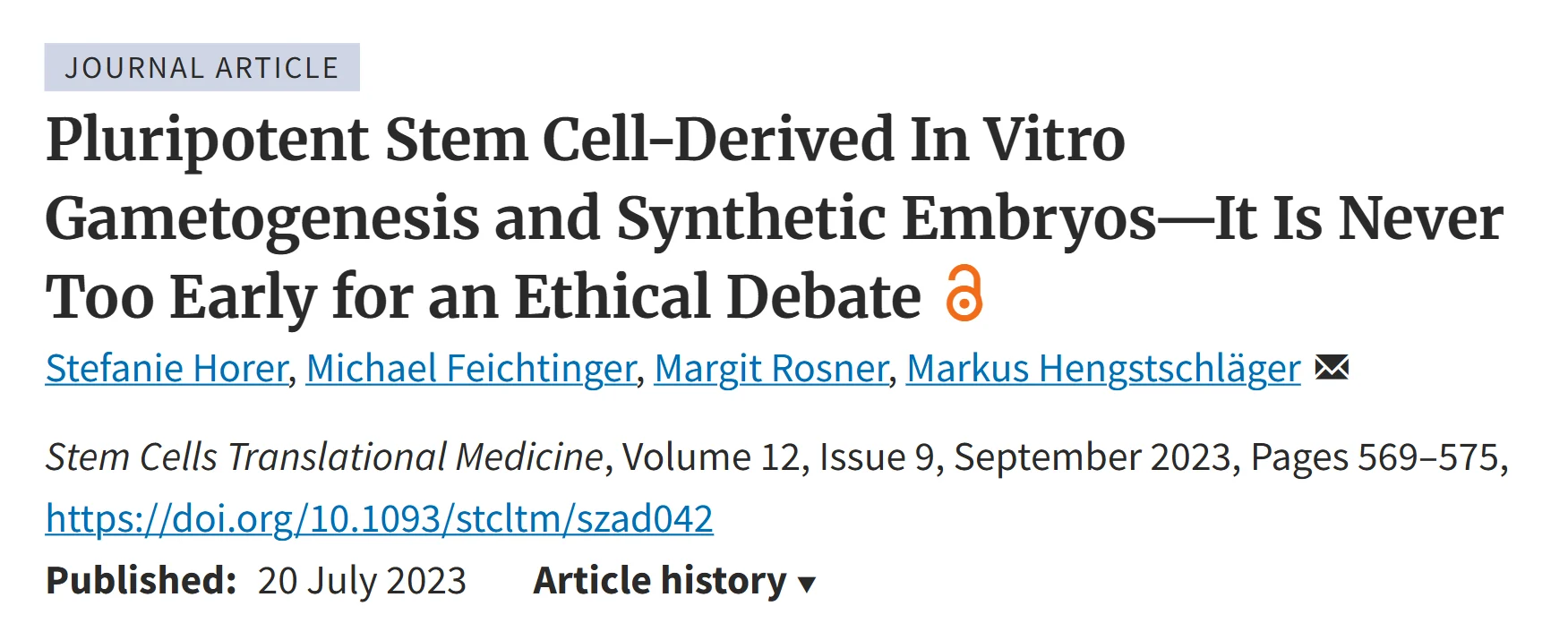
Title: Pluripotent Stem Cell-Derived In Vitro Gametogenesis and Synthetic Embryos – It Is Never Too Early for an Ethical Debate
Authors: Stefanie Horer, Michael Feichtinger, Margit Rosner, Markus Hengstschläger
You can read the Full Article in Stem Cells Translational Medicine.
Title: Artificial Gametogenesis and In Vitro Spermatogenesis: Emerging Strategies for the Treatment of Male Infertility
Authors: Aris Kaltsas, Maria-Anna Kyrgiafini, Eleftheria Markou, Andreas Koumenis, Zissis Mamuris, Fotios Dimitriadis, Athanasios Zachariou, Michael Chrisofos, Nikolaos Sofikitis
You can read the Full Article in the International Journal of Molecular Sciences.

Title: Modelling in vitro gametogenesis using induced pluripotent stem cells: a review
Authors: Maria Victoria Romualdez-Tan
You can read the Full Article in Cell Regeneration.

Title: In Vitro Gametogenesis in Oncofertility: A Review of Its Potential Use and Present-Day Challenges in Moving toward Fertility Preservation and Restoration
Authors: Victoria G. Wesevich, Christopher Arkfeld, David B. Seifer
You can read the Full Article in the Journal of Clinical Medicine.

Other articles featuring Mazen Al-Obaidi on Fertility News.
FAQ
Is in vitro gametogenesis available for patients now?
No. The method produces gametes and offspring in animals. Human clinical use is not available, and mature human gametes have not been made in the laboratory.
How are the eggs and sperm made?
A body cell is reprogrammed into an induced pluripotent stem cell, then guided into a germ cell, and finally into an egg or sperm cell.
Has in vitro gametogenesis produced live births?
Yes, in mice. Eggs made from stem cells produced embryos that implanted and led to live, fertile offspring.
Is same-sex genetic parenthood possible with this method?
In mice, researchers have produced offspring from two mothers and from two fathers. Human application has not been achieved.
What is the expected timeline for human use?
Most scientists do not expect clinical use in human reproduction within the next ten years.
Is the method safe and ethical for humans today?
The use of laboratory-made human gametes for reproduction is considered unsafe and unethical at present.
-
Sep 17, 2026, 19:28Svitlana Yashchenok: Who Is Really Choosing Your Embryo?
-
Sep 17, 2026, 19:20Having PMOS Does Not Mean You Can’t Become Pregnant – Spring Fertility
-
Sep 17, 2026, 19:13Lucy Froese: We Hear Fertility Stories Looking Backwards, But You Have to Live Yours Forward
-
Sep 17, 2026, 19:03Anna Figiel: Fertility Is Biological, But the Decisions Around It Are Not…
-
Sep 17, 2026, 18:49IFFS and ISA Joint Practice Guideline on Implementing Balanced Sexual and Reproductive Health
-
Sep 17, 2026, 18:30RBMO Live Episode 17: The Sperm Standards Session
-
Sep 17, 2026, 18:24Lata Sabarwal: What Happens to Fertility After 35?
-
Sep 17, 2026, 18:07Albert Irkaliev: Have We Underestimated the Corpus Luteum in Frozen Embryo Transfer?
-
Sep 17, 2026, 17:55Salma Yasin: A Great Pleasure to Attend BFS Study Week with Dr. Ippokratis Sarris