

Marieke Ogay: Understanding Uterine Fluid Dynamics in IVF Success
Marieke Ogay, Bachelor in Midwifery at Erasmushogeschool Brussel, shared a post on LinkedIn:
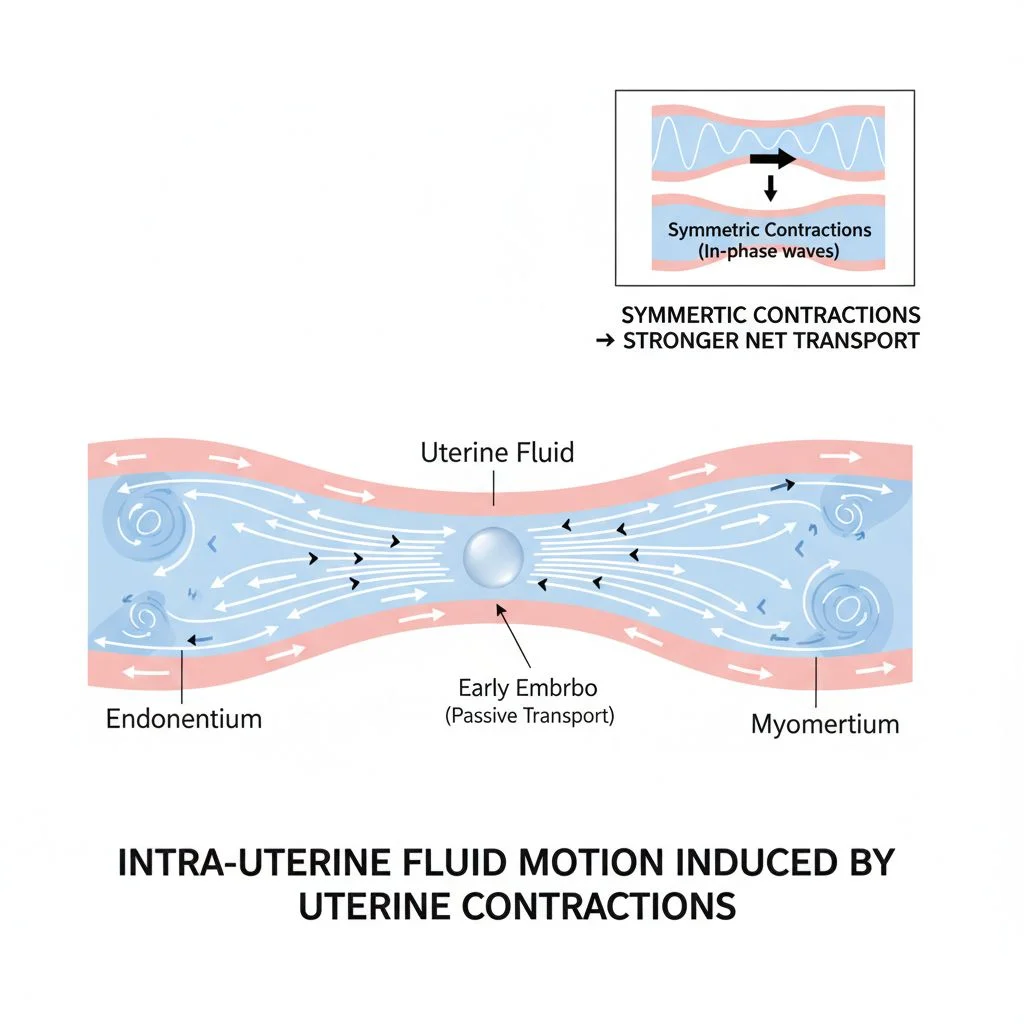
“Embryo transport in the uterus is not a passive ‘floating journey’, but a finely tuned biophysical process driven largely by uterine fluid motion generated by myometrial contractions, and this has major implications for fertility and IVF.
A non-pregnant uterus behaves, in part, like a narrow channel where rhythmic wall contractions create a peristaltic flow that carries the early embryo from the tubal isthmus toward the fundus over several days.
In this model, symmetric contractions of the uterine walls generate the highest fluid velocities and net forward transport, while increasing asymmetry between the upper and lower wall movements sharply reduces flow and can even cancel net transport.
Under certain combinations of amplitude and timing, the contractions can create ‘trapped boluses’ of fluid, essentially small moving pockets that could theoretically shuttle an embryo at the speed of the contraction wave itself.
Why this matters for implantation and miscarriage
The paper highlights that an embryo entering the uterus (≈100–150 µm) is much larger than surrounding cilia and behaves less like a massless particle, meaning drag forces may substantially slow its journey compared with the idealized model.
If contractions are too asymmetric or create reflux, the embryo may be held in a confined region, arrive late to an optimal fundal site, or implant in suboptimal locations, all of which could contribute to failed implantation or miscarriage.
Links to IVF and clinical practice
In IVF, fertilization success rates far exceed successful pregnancy rates, and the “critical phase” remains implantation in the uterine environment.
A deeper understanding of intra-uterine fluid dynamics could inform how and where embryos are placed, how uterine contractility is managed, and why some uteri support implantation better than others despite good-quality embryos.
Suggested closing line + source
This work reminds us that beyond hormones and endometrial thickness, the physics of uterine fluid movement and contraction patterns may be a missing piece in unexplained infertility and IVF failure—and deserve a place in our clinical conversations.
Source: O. Eytan and D. Elad, ‘Analysis of Intra-uterine Fluid Motion Induced by Uterine Contractions,’ Bulletin of Mathematical Biology.”
Stay updated on all scientific advances in the field of fertility with Fertility News.
-
Sep 13, 2026, 15:11Sachintha Alwis: From Impaired Sperm Motility to Microrobotics
-
Sep 13, 2026, 15:08Laurence Orbuch: Before Endometriosis Surgery, Ask…
-
Sep 13, 2026, 15:05Ademola Ayodele: IUI, IVF or Egg Freezing – Which One Is Right for You?
-
Sep 13, 2026, 14:59Fiona Pathiraja-Møller: Tennis Players No Longer Have to Choose Between Career and Family
-
Sep 13, 2026, 14:571-Day Virtual Experience for People Impacted by PMOS – PCOS Awareness Association
-
Sep 13, 2026, 14:53Ozor Victor: Behind Every Embryo Is a Story of Science, Precision, and Hope
-
Sep 13, 2026, 14:50Diana Kayal: What They Don’t Tell You About IVF
-
Sep 13, 2026, 14:44Vikram Sinai Talaulikar: A Heartfelt Thank You to All Who Donated and Supported “Menopause and Cancer”
-
Sep 13, 2026, 14:41Nicole McPherson: Changing IVF Practices Is Hard – Integration Needs to Be Easy