
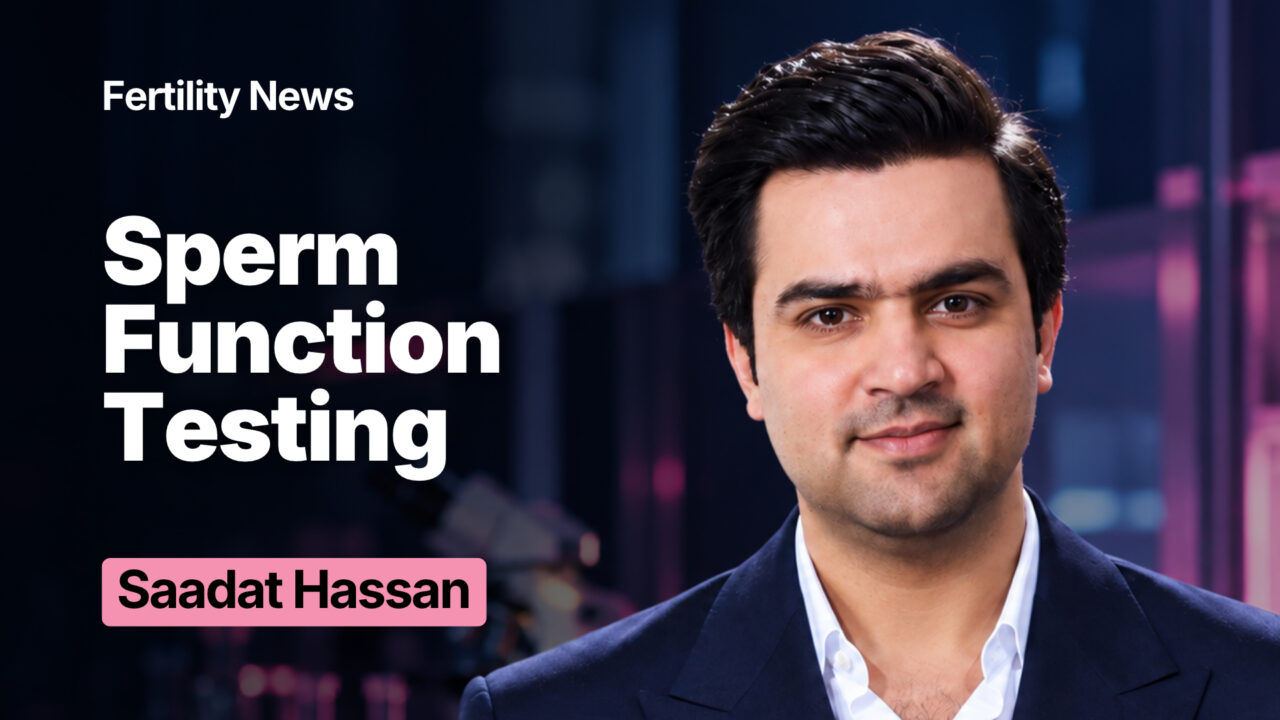
Saadat Hassan: Sperm Function Testing – Can Advanced Diagnostics Guide IVF and ICSI Selection?
“A normal semen analysis does not establish that every sperm function required for fertilization is intact. Routine assessment of sperm concentration, motility, and morphology remains fundamental to male infertility evaluation, yet fertilization also depends on capacitation, the acrosome reaction, sperm–oocyte recognition, and membrane fusion. These biological processes have renewed interest in sperm function testing, particularly when infertility persists despite apparently normal semen parameters.
The critical question is not whether an advanced test reveals additional biological information, but whether that information can improve clinical decisions. A 2026 experimental study of JUNO-coated beads offers an opportunity to distinguish promising laboratory science from clinically validated guidance for choosing conventional in vitro fertilization (IVF) or intracytoplasmic sperm injection (ICSI).
What Does Sperm Function Testing Add Beyond Semen Analysis?
Different sperm function tests interrogate different biological pathways. DNA fragmentation assays measure damage to sperm DNA; other investigations examine acrosomal activity, capacitation, oxidative stress, or interactions with structures resembling the oocyte. These measurements are not interchangeable. A spermatozoon with apparently normal morphology may have a functional defect, while an abnormal result in one assay does not establish failure of all other fertilization processes.
In a systematic review of 110 studies, Sanyal and colleagues (2024) identified persistent limitations in the clinical application of sperm function tests, including heterogeneous methodologies, insufficient high-quality outcome data, uncertain thresholds, and cost. No single assay provides a comprehensive or universally reliable prediction of male fertility. The value of testing therefore depends on the specific clinical question and the evidence connecting a result to patient management.
Can Advanced Testing Determine the Choice Between IVF and ICSI?
Conventional IVF requires sperm to complete several steps of interaction with the oocyte. ICSI introduces a selected spermatozoon directly into the oocyte cytoplasm, bypassing the usual sperm–oocyte binding and fusion events. A validated test of these functions could theoretically help explain certain cases of poor or failed fertilization with conventional IVF.
That possibility has not yet become a general clinical rule. The ASRM/SART committee opinion (2026) does not support routine ICSI for non-male-factor indications. Selected circumstances, including previous fertilization failure, warrant individualized discussion, but higher fertilization rates do not automatically establish better live birth outcomes.
Sperm DNA fragmentation also requires careful interpretation. The AUA/ASRM male infertility guideline, amended in 2024, does not recommend it as part of the routine initial assessment of all infertile couples. The ASRM recurrent pregnancy loss committee opinion (2026) identifies selected circumstances, including recurrent unexplained miscarriage or concurrent infertility, in which testing and reproductive urology evaluation may be considered. Recurrent miscarriage, repeated implantation failure, and failed fertilization are distinct clinical scenarios; none should be reduced to a universal testing algorithm.
What Does the 2026 JUNO-Coated Bead Study Demonstrate?
During fertilization, the sperm protein IZUMO1 interacts with JUNO, a receptor on the oocyte membrane. Cots-Rodríguez and colleagues (2026) developed beads coated with recombinant JUNO to investigate sperm binding to a model of this molecular interface.
Their cross-sectional experimental study involved 21 semen donors. The researchers assessed sperm binding, acrosomal status, DNA integrity, and differences between cryopreservation methods. JUNO-coated beads selectively bound acrosome-reacted spermatozoa with intact DNA, and sperm preserved through vitrification-based methods showed greater specific bead binding than conventionally slow-frozen samples under the study conditions. Additional experimental validation included a hamster penetration assay.
These findings illuminate an aspect of sperm function not captured by standard semen analysis. However, bead binding is a model of one molecular interaction, not a complete measure of fertilizing ability. The study did not establish validated diagnostic cut-offs, prospectively assess infertile couples undergoing IVF, or demonstrate that using the assay improves fertilization, embryo development, pregnancy, or live birth. Nor does it show that the result can determine whether an individual couple should undergo conventional IVF or ICSI. Its immediate contribution is mechanistic and investigational rather than a basis for routine clinical selection.
What Evidence Is Needed Before a New Assay Enters Clinical Practice?
A clinically useful diagnostic test must satisfy three related requirements. Analytical validity establishes whether the assay measures its intended target accurately and reproducibly. Clinical validity establishes whether the result meaningfully predicts a relevant condition or outcome in the intended population. Clinical utility establishes whether acting on the result improves care compared with existing management.
Standardization remains especially important. Sperm DNA fragmentation platforms differ in analytical principles, specimen handling, laboratory protocols, and reporting thresholds. Their numerical results and cut-offs are not necessarily interchangeable. Newer binding assays likewise require reproducibility studies, external laboratory validation, clinically meaningful thresholds, and prospective outcome data before they can support treatment decisions.
For the JUNO-coated bead assay, future studies would need to test performance in well-characterized infertile populations, account for female and laboratory factors, and establish whether assay-guided IVF or ICSI decisions improve outcomes that matter to patients.
Clinical Relevance and Patient Counselling
For a couple facing infertility despite normal semen parameters, an additional test is valuable only when it addresses a defined question and has a plausible role in management. A useful counselling question is: Would this result change our evaluation or treatment choice, or would it add information without a proven clinical consequence? Discussing uncertainty, cost, and potential anxiety helps prevent investigations from becoming ends in themselves.
Clinical assessment should begin with both partners’ reproductive histories, appropriate semen analysis, relevant examination and investigations, and previous treatment outcomes. Potentially modifiable factors, such as smoking, metabolic health, relevant exposures, and clinically significant varicocele, deserve assessment where indicated. Improvements in semen markers or DNA fragmentation after an intervention do not by themselves prove improved live birth rates, and antioxidant supplementation should not be presented as a reliable replacement for indicated treatment.
Advanced sperm function tests are most defensible when used selectively, interpreted within their assay-specific limitations, and integrated into shared clinical decision-making. The JUNO-coated bead model expands understanding of sperm–oocyte recognition, but its clinical promise will be determined by prospective evidence—not by biological novelty alone.”
Written by Saadat Hassan
Senior Clinical Embryologist/IVF and Embryology
BSc (Hons) Medical Laboratory Technology
King Edward Medical University, Lahore, Pakistan
References
Title: Clinical Utility of Sperm Function Tests in Predicting Male Fertility: A Systematic Review
Authors: Debarati Sanyal, Deepshikha Arya, Kumari Nishi, Nafisa Balasinor, Dipty Singh
You can read the Full Article in Reproductive Sciences.
Title: JUNO-coated beads as a functional assay to capture and characterize fertilization-competent human sperm
Authors: Paula Cots-Rodríguez, Xinyin Wang, Mirian Sanchez-Tudela, Karen K Siu, Patrick Yip, Emilio Gómez, Jeffrey E Lee, Julieta G Hamze, Maria Jiménez-Movilla
You can read the Full Article in Human Reproduction Open.
Title: Intracytoplasmic sperm injection for nonmale factor indications: a Committee opinion
Authors: Practice Committee of the American Society for Reproductive Medicine, Clarisa Gracia, Rebecca Flyckt, Karl Hansen, Tarun Jain, Suleena Kalra, Bruce Pier, Denny Sakkas, Belinda Yauger, Torie C. Plowden, Ryan Smith, Mark Trolice, Suneeta Senapati, Robert Brannigan, Amy Sparks, Jared Robins, Chevis N. Shannon, Jessica Goldstein, Madeline Brooks
You can read the Full Article in Fertility and Sterility.
Title: Evidence-based guideline: unexplained infertility
Authors: The Guideline Group on Unexplained Infertility, D Romualdi, B Ata, S Bhattacharya, E Bosch, M Costello, K Gersak, R Homburg, M Mincheva, R J Norman, T Piltonen, S Dos Santos-Ribeiro, D Scicluna, S Somers, S K Sunkara, H R Verhoeve, N Le Clef
You can read the Full Article in Human Reproduction.
Title: Recurrent pregnancy loss: a committee opinion
Authors: Practice Committee of the American Society for Reproductive Medicine
You can read the Full Article in Fertility and Sterility.
American Urological Association and American Society for Reproductive Medicine. Diagnosis and Treatment of Infertility in Men: AUA/ASRM Guideline. 2020; amended 2024
Other articles featuring Saadat Hassan on Fertility News.
-
Oct 29, 2026, 16:22Aysha O’Connor: One of the Hardest Parts of My Own Fertility Journey Was Loneliness…
-
Oct 29, 2026, 16:15Chaithra S K: Preimplantation Genetic Testing Still Requires an Embryo Biopsy
-
Oct 29, 2026, 16:11Filipina Woman’s Journey of Strength, Hope, and Finding Balance While Living with PCOS – PCOS Millennials
-
Oct 29, 2026, 15:58Eric Lameignere: Can DNA Fragmentation in Cumulus Cells Predict ICSI Outcomes?
-
Oct 29, 2026, 15:34Sara Spiro: Celebrating the Stories Members Have Trusted With at Maven Clinic – Here Is Mine
-
Oct 29, 2026, 15:31Dina Ibrahem: 0 Motility, 1 Critical Decision
-
Oct 29, 2026, 15:28AI and Automation in Fertility and Genomics: Pipeline or Pipe Dream? – ARCS
-
Oct 29, 2026, 15:26Michael Schindler: Large Networks or Small Centers – Who Delivers Better Care?
-
Oct 29, 2026, 15:24Denny Sakkas: Driving Innovation in Reproductive Medicine