

Negin Asadi: Embryonic Development Is Not Driven by DNA Sequence Alone
Negin Asadi, PhD in Biomedical Sciences (Reproductive and Developmental Biology) at Victoria University of Wellington, shared on LinkedIn about a paper by Amy L. Wilkinson et al. published in Cell Stem Cell:
“Global Epigenome Changes During Human Embryo Development
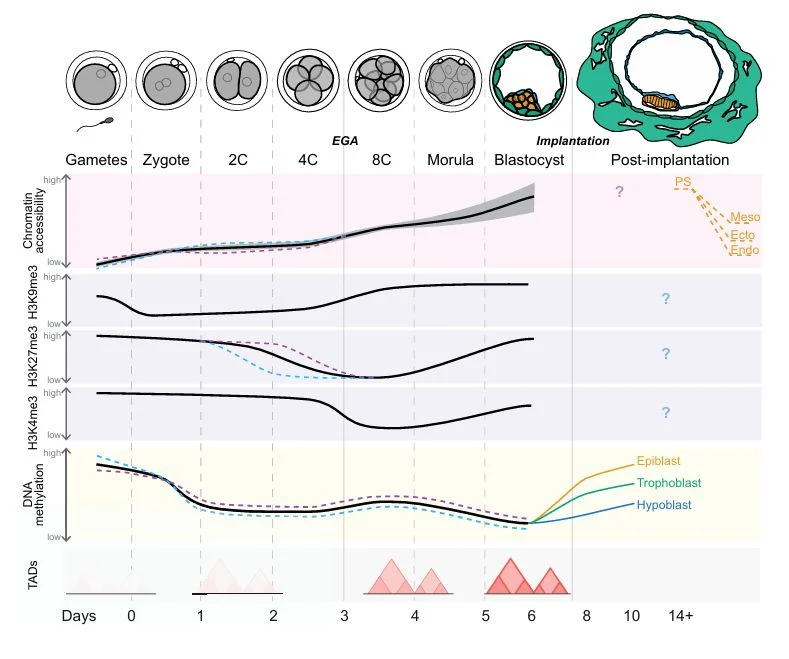
- DNA methylation is extensively erased after fertilisation, reaching its lowest levels around the blastocyst stage before being progressively re-established during post-implantation development.
- Chromatin accessibility increases dramatically during the earliest stages, allowing developmental genes and regulatory elements to become accessible for transcription.
- Histone modifications are dynamically remodelled throughout development, creating an epigenetic landscape that supports the transition from totipotency to lineage-specific gene expression.
- Three-dimensional genome organisation (TADs) is initially weak or absent in the early embryo but gradually strengthens after genome activation, reflecting the establishment of higher-order chromatin architecture.
An interesting aspect of this figure is the distinction between maternal and paternal genomes (shown as pink and blue dashed lines).
Although both genomes eventually converge toward a common embryonic epigenetic state, they begin development with distinct epigenetic signatures and undergo different reprogramming dynamics after fertilisation.
The figure also compares these developmental trajectories with those observed in cynomolgus monkey embryos, highlighting the remarkable conservation of epigenetic reprogramming across primates while emphasising species-specific differences.
This figure is an excellent reminder that embryonic development is not driven by DNA sequence alone; it is equally shaped by the dynamic regulation of the epigenome, which controls when, where, and how developmental genes are expressed.
Reference: Wilkinson AL, Zorzan I, Rugg-Gunn PJ. Epigenetic regulation of early human embryo development. Cell Stem Cell (2023).”
Title: Epigenetic regulation of early human embryo development
Authors: Amy L. Wilkinson, Irene Zorzan, Peter J. Rugg-Gunn
You can read the Full Article in Cell Stem Cell.
Stay informed with the latest updates in fertility and reproductive medicine on Fertility News.
-
Sep 18, 2026, 20:27Hrishikesh Pai: Rethinking Male Infertility
-
Sep 18, 2026, 20:25Eric Verdin: Wrapping Up the Reproductive Aging Summit at the Center for Healthy Aging in Women
-
Sep 18, 2026, 20:21Investigating Pregnancy Outcomes in Women with Idiopathic POI – RBMO
-
Sep 18, 2026, 20:18Sue Ritchie: Why Aren’t We Talking About Male Fertility More?
-
Sep 18, 2026, 20:13Salma Yasin: Every Day of BFS Study Week 2026 Has Been an Exceptional Learning Experience
-
Sep 18, 2026, 20:01Qingcai Wang: Over 35 and Torn Between Trying Longer and Starting IVF?
-
Sep 18, 2026, 19:58Bhumika: Can a Woman Become Pregnant Again While Already Pregnant?
-
Sep 18, 2026, 19:5215 More Experts Join the International Fertility Forum Mumbai 2026
-
Sep 18, 2026, 19:50Curious About What Happens Behind the Scenes in the Labs? – Sims IVF