

Nicole Homan: Ovulation Is Not the Endpoint in PMOS Fertility Care
Nicole Homan, Founder of Announcing soon, shared a post on LinkedIn about a paper by Bo Hyon Yun et al. published in Obstetrics and Gynecology:
“Ovulation is not the endpoint.
But it can be a signal of reproductive health.
A 2026 secondary analysis of PPCOS II evaluated 746 women with PCOS undergoing ovulation induction with letrozole or clomiphene.
The key finding was that the preconception metabolic phenotype continued to matter even after fertility treatment began.
Women in higher HOMA-IR (a fasting glucose-and-insulin estimate of insulin resistance) quartiles had lower ovulation, clinical pregnancy, and live-birth rates, while gestational diabetes risk was substantially higher. Improvement in HOMA-IR during treatment was also associated with higher odds of clinical pregnancy and lower preeclampsia risk.
So…If ovulation is successfully induced, but the same underlying metabolic-endocrine environment is carried directly into conception and throughout pregnancy, have we addressed the reproductive problem or only the most visible ‘bottleneck’ to treat?
The preconception window is a clinically meaningful period for maternal, placental, fetal, and potentially longer-term offspring health.
PCOS/PMOS entails insulin signaling, androgen biology, vascular health, body composition, sleep, nutrition, and broader cardiometabolic physiology that do not disappear once an LH surge occurs or a pregnancy test turns positive.
And pregnancy itself is a major metabolic and vascular stress test.
So perhaps the more complete fertility-care question is not only:
Can we help her ovulate and conceive?
but also:
What physiology are we helping her carry into implantation, placentation, and pregnancy, and how might that influence fetal development?
This is an opportunity for a more integrated model of preconception care, particularly in PCOS/PMOS to support maternal-fetal health outcomes.”
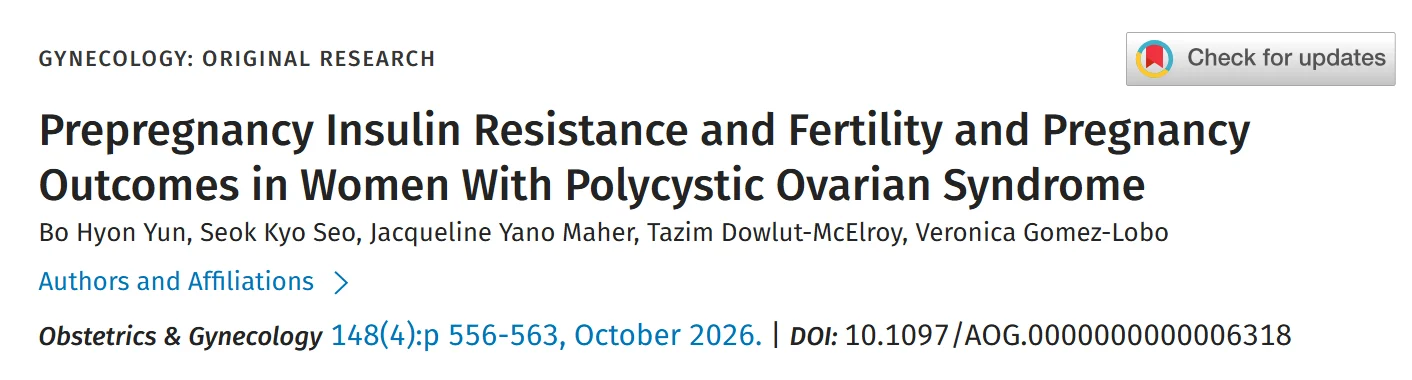
Title: Prepregnancy Insulin Resistance and Fertility and Pregnancy Outcomes in Women With Polycystic Ovarian Syndrome
Authors: Bo Hyon Yun, Seok Kyo Seo, Jacqueline Yano Maher, Tazim Dowlut-McElroy, Veronica Gomez-Lobo
You can read the Full Article in Obstetrics and Gynecology.
Stay informed with the latest updates in fertility and reproductive medicine on Fertility News.
-
Sep 30, 2026, 17:51Devyanshi Dixit: 11 Years of Knowledge, Connection, Advancing Women’s Health, Now Preparing for the 12th Edition
-
Sep 30, 2026, 17:48Ashley Evans: Infertility Isn’t Something You Can Simply Relax Your Way Out Of
-
Sep 30, 2026, 17:41Mark Trolice: New SIG: Independent Fertility Practices
-
Sep 30, 2026, 17:34Abdelrahman H. Daifalla: The Clinical Reality of IVF Is More Complex…
-
Sep 30, 2026, 17:13Devyanshi Dixit: What Happens When Chronic Pelvic Pain Becomes a Brain Problem?
-
Sep 30, 2026, 16:52Tunzala Ibadova: A Successful IVF Case – Individualized Approach to HLA Compatibility and Embryo Transfer
-
Sep 30, 2026, 16:49Robert Borowczyk: An IVF Conversion Rate Can Jump from 40% to 50% without 1 Extra Patient Starting Treatment
-
Sep 30, 2026, 16:46Asma Khalil: Important Reassurance for Women Who Become Pregnant after Taking GLP-1 Medicines
-
Sep 30, 2026, 16:41ACOG Joins the Society for Women’s Health Research, the Women First Research Coalition